
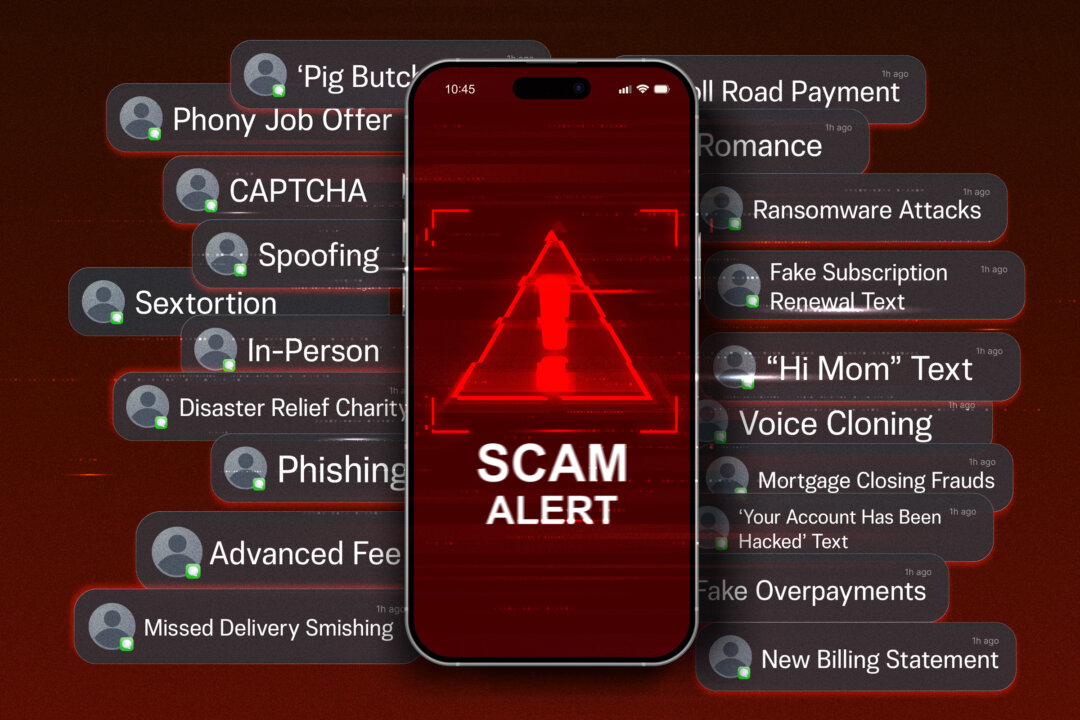
The emergence of artificial intelligence has given a boost to cybercrime gangs that are coming up with bolder and more sophisticated schemes to scam people out of their money.
Here is The Epoch Times’ rundown of 20 of the most common scams to watch out for.
CAPTCHA Scams
Let’s start with one of the newest scams out there. Most of us are familiar with CAPTCHA, a challenge-response test designed to confirm a human is in charge of a keyboard.
It often pops up on corporate websites, saying, “Are you a robot?” It then displays a selection of images and asks users to tick the boxes where there are bicycles, buses, or traffic lights.
But scammers have now set up bogus websites with fake CAPTCHA tests that ask the user to type a series of commands—“Windows + R,” then “Ctrl + V,” and then “Enter,” for example—but instead of being security verification, it is actually the steps to run hidden malware on your computer.
CAPTCHA scams were first reported in Australia last year, but the U.S. Federal Trade Commission issued a warning in June about them cropping up in the United States.
Romance Scams
Romance scammers can target men or women of any age, but the most common victim demographic is divorced or widowed people over the age of 50.
Often using a catfished image of a beautiful young woman or a handsome man, scammers contact victims via online dating apps and slowly seduce them into thinking they are in a relationship. The scammers then either create a crisis, which involves victims needing to send them money, or they ask victims to send them the funds to book a plane ticket to visit.
In 2023, Nigerian romance scammer Akohomen Ighedoise was jailed in Tampa, Florida, for 17 years and six months for conspiracy to commit mail and wire fraud.

An online romance scam victim holds her phone in Washington, on May 27, 2026. Madalina Kilroy/The Epoch Times
“Many of the victims were widowed, single, or divorced elderly women who developed relationships with fake suitors on dating websites as part of so-called ‘romance scams,’” the U.S. Attorney’s Office for the Middle District of Florida said in a statement.
“The women were then convinced to wire money, which often consisted of their entire retirement savings and cash taken out from home equity to bank accounts in the United States as part of a supposed investment opportunity.”
Ighedoise was a member of the Nigeria-based Black Axe network, which was targeted by police in Europe in April, but numerous gangs and individuals run romance scams.
‘Pig Butchering’ Scams
There has been massive growth in recent years in long-term scams known as “pig butchering,” which lure people into fake cryptocurrency investments.
The phrase comes from the Chinese term “sha zhu pan,” and most of the rackets are run by Chinese-organized crime syndicates operating out of vast scam centers in Southeast Asia.
The scammer, usually using a fake image of a young woman, contacts the victim or “pig” through an online dating app or a random email, and slowly gains their trust, known as “fattening them up.”
Eventually, the scammer convinces their victim to invest money in a cryptocurrency scheme, which turns out to be bogus. At that point, the “slaughter” is completed and the scammer vanishes.

U.S. Attorney Jeanine Pirro points to a scam text message as she announces a strike force to go after crypto investment fraudsters in Washington on Nov. 12, 2025. Cliff Owen/AP
Ransomware Attacks
Ransomware attacks are usually mounted against companies or extremely wealthy individuals rather than the average Joe.
Ransomware is a type of malicious software—or malware—that prevents users from accessing their computer files, systems, or networks and demands that they pay a ransom for their return, according to the FBI.
Ransoms are almost always paid in bitcoin and other cryptocurrencies, which are harder to trace than regular bank transfers.
Paul Abbott, former director of UK trucking company KNP Logistics Group, told The Epoch Times last year that KNP had to close down in September 2023 as a direct result of a ransomware attack, meaning the loss of 730 jobs.
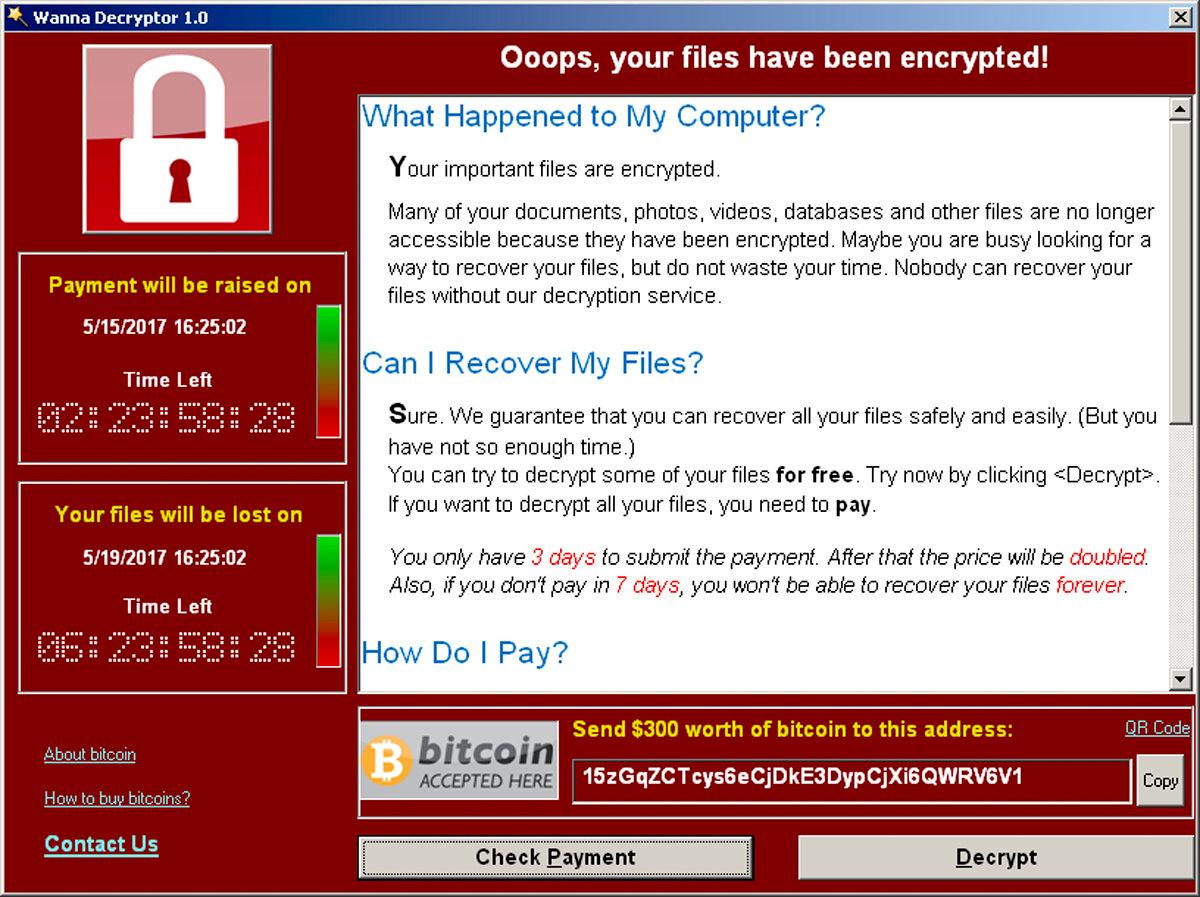
A screenshot shows a ransomware demand, provided by cybersecurity firm Symantec, in Mountain View, Calif., in this file photo. Courtesy of Symantec/Handout via Reuters
Spoofing Scams
Spoofing is when cyber criminals mask their own phone numbers and trick victims into thinking they are being contacted by genuine staff from banks, tax offices, or even police departments.
After convincing victims that they are genuine, they then ask for their financial account details, bank card details, or even PINs, ironically pretending they are confirming details to protect victims from cyber criminals. Having done so, they then use those details to steal money from victims’ accounts.
In May 2023, UK cyber criminal Tejay Fletcher was sentenced to 13 years and four months in prison. Fletcher was the co-founder and administrator of iSpoof, a website that became a “fraud shop” for scammers who spoofed 200,000 people around the world—many of them elderly—out of 100 million pounds ($134 million).

British cyber criminal Tejay Fletcher, who was sentenced to 13 years in prison for the iSpoof banking fraud scam, in this file photo. Crown Prosecution Service
Sextortion Scams
Financial sextortion occurs when a criminal, often using a messaging app such as Kik, Telegram, or Signal, tricks a person into sending a sexual image or filming a sexual act on their phone, and then demands money or gift cards in exchange for keeping the images private.
The victims can sometimes be children or teenagers, and the consequences can be horrific. On Nov. 6, 2025, Bryce Tate, 15, shot himself at his home in West Virginia, just three hours after receiving the first of several Snapchat messages from an extortionist who had tricked him into sending a nude photograph after posing as a 17-year-old girl.
In June 2023, the FBI also warned that sextortionists were using deepfakes—fake media created from otherwise benign content.

(L–R) Bryce Tate poses with his parents, Adam and Amanda, in this file photo. The 15-year-old took his own life in November 2025 after an hours-long exchange with an online predator. Courtesy of Adam Tate
Disaster Relief Charity Scams
In March 2024, the FBI warned of an increasing number of charity scams being carried out by criminals trying to take advantage of people’s goodwill in the wake of natural disasters and international crises, such as the conflict in Gaza.
“Unfortunately, conflicts and crises create ideal situations for criminals to take advantage of people who are either stressed about their own losses or who want to help others—or both,” said Cheyvoryea Gibson, then special agent in charge of the FBI’s Detroit field office.
The FBI said the bogus charity appeals could come via emails, texts, or on the street.
Phishing Scams
“The scam begins with a text message,” Google warned in a lawsuit against Chinese scammers in November 2025. “It may alert you to a problem with the delivery of a package and invite you to click a link to correct your address and pay a small delivery fee.
“Or it may warn you of an unpaid toll or ticket, directing you to a toll collection website that appears legitimate to pay the outstanding charges.”
Scammers often ask recipients to make a small transaction, as little as a dollar, to verify their accounts, allowing the scammers to gain access to the accounts themselves.

A room set up to resemble a bank branch is pictured inside an abandoned scam center in O’Smach, Cambodia, on March 12, 2026. Most “pig butchering” scams originate from vast scam centers in Southeast Asia, run by Chinese organized crime syndicates. Lillian Suwanrumpha / AFP via Getty Images
‘Hi Mom’ Text Scams
A text message pops up on your phone. It’s from your son, your daughter, one of your grandchildren, or maybe a close friend. They say they are using a stranger’s phone—because their battery is dead—and they are stranded and need money urgently.
If victims reply sympathetically, scammers will provide the details of their bank accounts, but of course the whole thing is a ruse, designed to play on victims’ emotions and get them to transfer money to a scammer or even gain access to their accounts.
Voice Cloning Scams
AI is now capable of cloning voices and sending voice messages to unsuspecting relatives, friends, or even colleagues. It is known as “vishing,” or voice phishing.
Cyber scammers have used this ability to produce a variation of the “Hi Mom” text message scam.
Now they can send a voice note purporting to be from the stranded or desperate relative and ask victims to transfer some money to their bank accounts.
Jurgita Lapienyte, chief editor of Lithuania-based cybersecurity publication Cybernews, told The Epoch Times last year that AI voice cloning technology is currently only able to stick to a script and cannot react spontaneously to questions or responses in real time, so vishing is only ever prerecorded voice notes.

This illustration image created on June 9, 2023, shows a smartphone recording in front of a voice cloning screen in Los Angeles. “Vishing” scams involve fraudsters who use convincing AI voice cloning tools to steal from people by impersonating family members. Chris Delmas / AFP via Getty Images
In-Person Scams
It is quite rare nowadays, but occasionally scammers will turn up at your door and try to trick you into providing money or personal information.
They may simply claim to be carrying out a survey to obtain your personal information, such as your date of birth, which will allow them to carry out identity fraud.
They may claim to be from a charity, offer to repair your roof, or offer to sell you insurance or some other product, and request your bank or credit card details for a down payment.
Mortgage Closing Fraud
Buying a house or apartment is a stressful time, and sometimes people do not think straight when they are desperate to make a payment to secure their new home.
Some fraudsters use emails or text messages to pose as a victim’s real estate agent or mortgage loan officer to steal down payments or closing costs.
They will claim there are some last-minute changes to the wiring instructions, when in fact they are simply diverting funds into their accounts.
Mortgage closing fraud is just one of a number of scams targeting homeowners.

Property for sale in Elkridge, Md., on Sept. 2, 2025. Some fraudsters use emails or text messages to pose as your real estate agent or mortgage loan officer in order to steal your down payment or closing costs. Madalina Kilroy/The Epoch Times
Fake Overpayments
In the social media age, it is not uncommon for people to be approached on Instagram, TikTok, or Facebook by a stranger who praises one of your images or videos.
We are all suckers for flattery, so when someone tells us they want to use one of our images and offers to send us a check, many of us will fall for it. Then they say they accidentally sent you too much and ask you to pay the difference before the check clears.
Another scam involves being told you have won a prize, but you need to send money to cover taxes or fees.
Advanced Fee Frauds
One of the oldest scams around is advanced fee fraud, which was masterminded by criminals from Nigeria.
As a result, it is sometimes known as a 419 scam, named after a section of that country’s criminal code, or the “Nigerian prince” scam.
In the scam, victims will receive an email from someone who claims to be a government minister, his widow, a lawyer representing a deceased but wealthy client from a foreign country, or a business owner who wants to deposit money in your bank account.
There are many variations of the scam. They usually promise a huge windfall, but ask for a very small “transaction fee” that allows fraudsters to gain access to your accounts.

A researcher browses an internet site with a job offer for a United Nations agency that has been flagged as a scam, in Nairobi, Kenya, on June 30, 2022. Tony Karumba/AFP via Getty Images
Missed Delivery Smishing Scams
In a world where we all shop online and get constant deliveries, receiving a text from UPS, FedEx, or the U.S. Postal Service saying you have missed a delivery is not a big surprise.
The text offers victims the opportunity to reschedule delivery upon clicking a link, but by doing so, scammers may obtain their personal information or even solicit an advance payment to “ensure prompt delivery.”
Toll Road Payment Scams
Another smishing scam, which the Federal Communications Commission has warned about, is texts that purport to be from legitimate toll-payment companies.
They say that recipients have unpaid tolls or owe an outstanding balance on their accounts. Sometimes, the text threatens to suspend recipients’ driver’s licenses if the tolls are not paid.
The message often asks for the fee to be paid in non-standard ways, such as gift cards or wire transfers. The sender’s number is usually international, or there may be other phone numbers included as recipients.
Phony Job Offer Scams
“Want to earn at least $9,000 per month by working only 30–60 minutes a week?” a scam text might read.
Of course you do. But if it sounds too good to be true, then it likely is, and most of these text messages, emails, or unsolicited social media DMs will turn out to be scams.
The ads, which sometimes say the work involves being a mystery shopper, are usually just an excuse for obtaining victims’ bank details in order to pay out the fictitious salary.

A cellphone displays a scam message, dated July 11, 2026, advertising a job, in Sydney, in this file photo. Luyi Liu/The Epoch Times
New Billing Statement Scams
“Thank you for your payment,” says the text message or email, which pretends you have just paid a large fee to renew your Amazon Prime membership, or your antivirus software.
It comes with a link encouraging victims to click on it to cancel or ask for a refund, but the link will actually prompt a malware download or ask for victims’ bank credentials.
‘Your Account Has Been Hacked’ Text Scams
You would like to think that if your bank account or your iPhone were hacked, the company’s fraud department would text you to warn you about it.
But that text message is actually a scam, and you have not been hacked. Do not click on the link or call the phone number. They are after your personal information again.
Fake Subscription Renewal Text Scams
Sometimes, scammers can find out what services you subscribe to and even when the renewal is due.
So they text you, offering a reduced rate on a subscription if you click on the link. But it is, of course, just another ruse to bring you to another fake website and give away your personal information or download malware.