Federal Regulators Probe Tesla’s Safety Certification of Cybercab
 Bill PanUpdated 3 hours Ago2 Mins read
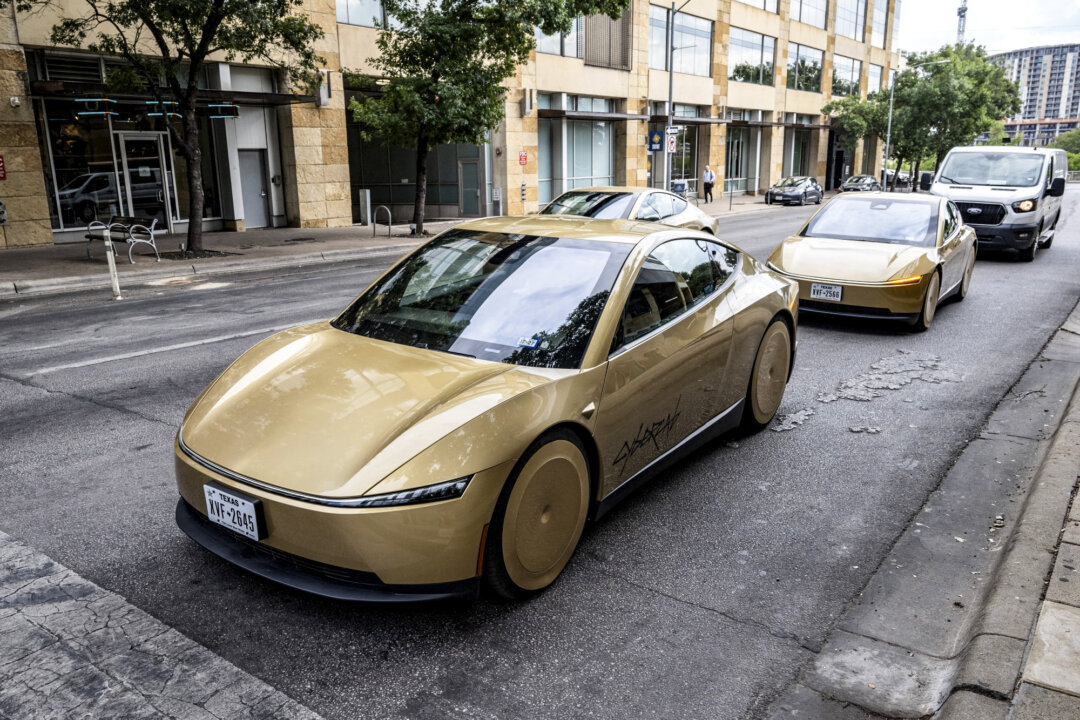

A couple of Tesla’s “Cybercab” are seen on the street in downtown Austin, Texas, on Sept. 3, 2026. Ronaldo Schemidt/AFP via Getty Images
Federal auto safety regulators have opened an investigation into whether Tesla properly certified its new Cybercab for use on public roads.
The National Highway Traffic Safety Administration (NHTSA) announced the probe on Friday, one day after Tesla held a closed-door Cybercab launch event in Austin, Texas.
The two-seat, gold-colored electric vehicle is designed to operate without a human driver. It has no steering wheel, brake pedals, or traditional side mirrors.
Existing Federal Motor Vehicle Safety Standards require manual controls like brake pedals. The Transportation Department is working to update some of those rules to accommodate fully autonomous vehicles, but those changes have not yet been finalized.
Tesla did not seek a federal exemption that would allow it to operate the Cybercab in a commercial fleet, according to NHTSA. Instead, the company certified that the vehicle already meets all the applicable standards.
NHTSA said it will examine the technical data and process Tesla used to reach that conclusion.
In particular, the agency will look at whether Tesla determined that some federal safety standards do not apply because the Cybercab was designed without traditional driver controls.
“NHTSA fully supports the safe development and deployment of automated vehicles. But as the federal regulator, we need to ensure that all of our laws are followed,” Administrator Jonathan Morrison said in a statement. “Our approach of balancing innovation with safety oversight will allow the United States to maintain its global leadership in [automated vehicle] innovation.”
Tesla did not respond to The Epoch Times’ request for comment before publication.
The Cybercab launch was relatively low-key compared with many of Tesla’s previous product events. CEO Elon Musk was not present, and the event, which was closed to the media, was not livestreamed.
Musk has compared his vision for Tesla’s robotaxi service to a combination of Airbnb and Uber. He has said that, in the future, owners could add their vehicles to Tesla’s autonomous ride-hailing network and earn money when they are not using them.
Zoox Faced Similar Scrutiny
There is precedent for NHTSA questioning how an autonomous-vehicle maker certified their product.
Amazon-owned Zoox self-certified its purpose-built robotaxi in 2022. Like the Cybercab, the vehicle was designed without a steering wheel or pedals.
Later that year, NHTSA issued a special order seeking information from Zoox. The following March, the agency opened an Audit Query, the same type of investigation it has now opened into Tesla.
Zoox eventually shifted to operating the vehicles under federal exemptions.
In August 2025, NHTSA granted Zoox an exemption allowing demonstrations of its U.S.-built robotaxis, but not commercial service.
The agency closed the certification investigation after Zoox agreed to remove claims that the vehicles complied with all applicable federal safety standards.
In July, NHTSA granted Zoox another temporary exemption. That approval allows the company to commercially deploy up to 2,500 robotaxis a year for two years under additional federal oversight.

Trump Issues Executive Orders to Expand Markets for Ranchers, Small Meat and Poultry Processors
President Donald Trump signed two executive orders on Friday that aim to...
Wall Street Review: Stocks Mixed Amid Oil Surge, Strong Job Growth
Stocks finished the week mixed as oil prices climbed and hiring data...
Volkswagen Approves Restructuring Plan With 50,000 More Job Cuts
Volkswagen won board approval for a restructuring plan that includes cutting about...
Chevron Ramps Up Venezuela Operations With $7 Billion Investment
A pumpjack is pictured at the Campo Elias neighborhood in Cabimas, south...