War as a Business Plan: Ukraine, Iran, and the Global Industry of Profitable Conflict
 HeraklesUpdated 3 hours Ago3 Mins read
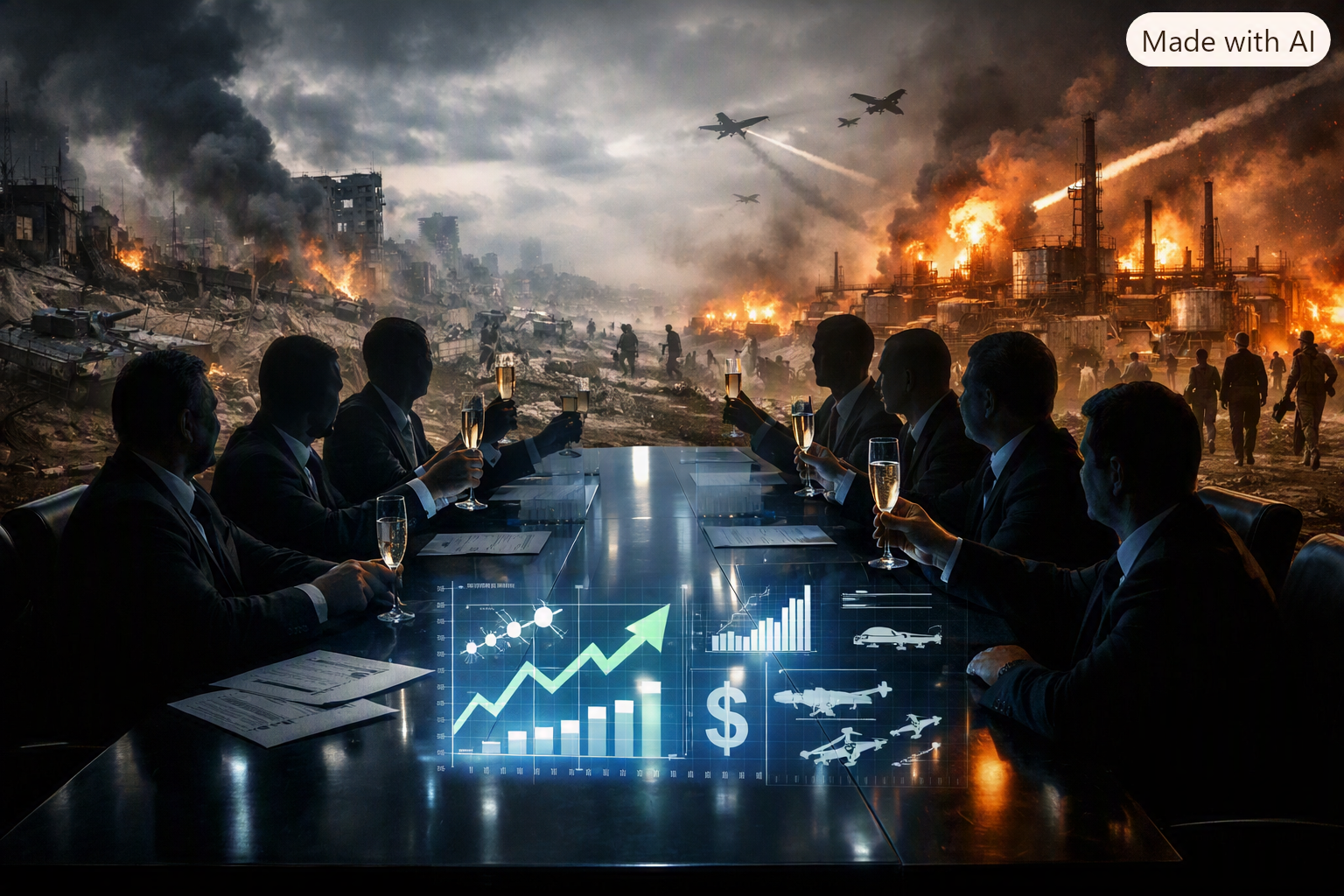
Modern warfare has undergone a grotesque transformation. What once was a last resort — a failure of diplomacy, a tragedy of nations — has become a business model, a predictable revenue engine, a spreadsheet-driven industry. Today, wars in Ukraine and Iran are not only geopolitical crises; they are also economic opportunities for corporations, investors, and defense manufacturers whose profits rise in direct proportion to human suffering.
This is not rhetoric. It is documented reality.
Ukraine: A War That Reshaped Europe’s Defense Economy
Russia’s full-scale invasion of Ukraine in 2022 triggered one of the largest geopolitical shocks of the decade. Beyond the battlefield, it reshaped European economic strategy, driving unprecedented investment in defense manufacturing, cybersecurity, and military technology. Governments that once prioritized fiscal restraint now pour billions into weapons procurement, creating new opportunities for aerospace, electronics, and advanced manufacturing firms.
The war has also disrupted global corporate investment. Firms exposed to the conflict — even indirectly — significantly reduced investment due to geopolitical uncertainty. A Federal Reserve study of 6,500 companies across 50 countries found that those discussing the war in early 2022 invested substantially less than similar firms, highlighting how conflict reshapes global financial behavior.
Meanwhile, the arms industry has seen record revenues. According to global defense analysts, the prolonged conflict in Ukraine has driven weapons demand to historic highs, sustaining a lucrative cycle of procurement and resupply. Defense manufacturers, arms dealers, and strategic suppliers have seen profit margins expand with each escalation.
Every missile fired, every drone deployed, every tank destroyed becomes a line item in someone’s quarterly earnings report.
Iran: A Conflict That Turned Energy Markets Into Profit Machines
The escalating conflict involving Iran has produced a parallel economic phenomenon. The closure of the Strait of Hormuz — a corridor through which one-fifth of the world’s oil normally passes — triggered extreme volatility in global energy markets. This volatility has been a financial windfall for major oil and gas companies.
- BP doubled its quarterly profit to $3.2 billion.
- Shell reported nearly $7 billion in profit in a single quarter.
- TotalEnergies saw profits rise by nearly one-third.
These gains were driven not by innovation or efficiency, but by war — by uncertainty, disrupted supply chains, and skyrocketing prices. U.S. fuel exports reached record levels as Europe and Asia scrambled to replace Middle Eastern shipments, generating an estimated $60 billion in additional cash flow for American energy companies.
Investment banks also profited from wartime volatility, earning record revenues from trading divisions that thrive on instability.
While families around the world struggle with rising costs of living, corporations toast champagne to “exceptional performance.”
The Same Profiteers Across Different Wars
Analysts note that despite the geographic differences, the wars in Ukraine, Gaza, and Iran share a common economic engine: the global arms industry. As long as hostilities endure, defense manufacturers enjoy unprecedented demand. Nations embroiled in conflict — or fearing imminent conflict — purchase missiles, drones, air-defense systems, and munitions at record levels.
War has become a consistent generator of revenue, not an aberration.
Russia’s Gains From the Iran Conflict — And Ukraine’s Countermoves
The Iran conflict has indirectly reshaped the balance of power in Ukraine. Russia, heavily dependent on hydrocarbon exports, benefited from soaring oil prices triggered by Middle Eastern instability. Its oil revenues doubled in March, reversing years of sanctions pressure.
But Ukraine responded aggressively. Long-range drone strikes on Russian export facilities stalled Russian oil exports by an estimated 40%, costing Russia over $13 billion in damage in 2025 alone.
Even here, the logic remains the same: war creates markets, markets create incentives, and incentives prolong war.
The Spreadsheet Logic of Modern Conflict
Behind every battlefield is a boardroom. Behind every casualty is a calculation.
Wars today are managed through:
- procurement cycles
- logistics spreadsheets
- cost-per-kill ratios
- drone replacement schedules
- insurance liabilities
- quarterly defense budgets
Human lives — Ukrainian soldiers, Iranian civilians, conscripts, volunteers — are reduced to inventory, metrics, and forecasts.
The tragedy is not only the loss of life. It is the normalization of that loss.
Young Lives as Disposable Inventory
Thousands of young people are sacrificed in these conflicts — not for noble ideals, but for geopolitical leverage and corporate profit. They die while executives celebrate rising stock prices. They bleed while investors discuss “market resilience.” They are buried while corporations announce “record earnings.”
There is no mercy in this system. No respect. No pause.
The Final Principle: Accountability for Those Who Choose War
If war is to remain a possibility in human affairs, then accountability must be absolute.
It should be the law of every nation that the one who decides for a whole nation to go to war must stand on the frontline of every battle — on foot.
Only then will war cease to be a business plan. Only then will decisions carry the weight they deserve. Only then will human life regain its value.






At Republican midterm convention, Trump urges voters to let him ‘finish the job’
U.S. President Donald Trump arrives to speak during the Republican National Midterm Convention...

COVID Vaccine-Injured Testify on Issues With Federal Support System at Inquiry
Michelle Worton testifies before the Allison Inquiry in Ottawa on Sept. 9,...

Canada unveils more sign-based retaliation against the U.S.
A sign on display during a B.C. Premier David Eby news conference...
Afternoon front page: The importance of teaching Canadian history; is Trump escalating the trade war?; and more
Wounded Canadians take cover behind a pillbox during the Battle of Passchendaele...