
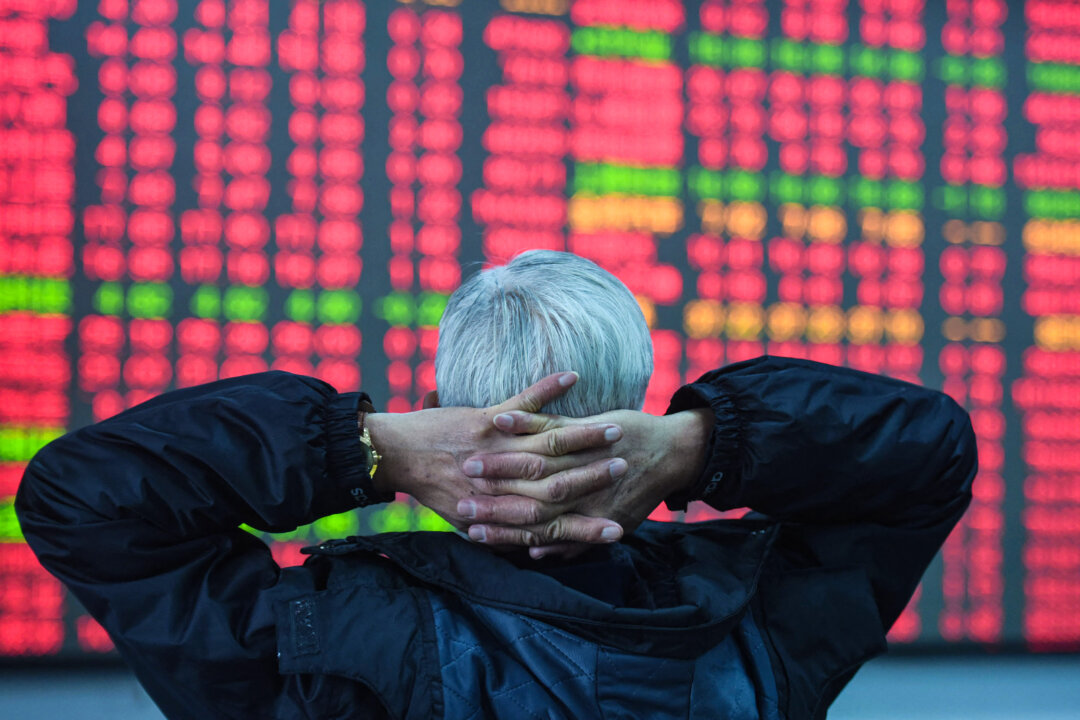


An investor looks at a screen showing stock market movements at a securities company in Hangzhou, Zhejiang Province, China, on Feb. 8, 2024. AFP via Getty Images
Last week, a selloff in Chinese technology stocks dragged the country’s markets sharply lower. Over the weekend, the state stepped in to stop the slide. Two state-owned firms stated that they had spent about $8.9 billion buying shares, and China’s top securities regulator called investors to a meeting and vowed to make “all efforts” to steady the market.
The buyers were part of what China’s markets call the “national team”—a group of state-backed funds that step in to purchase shares whenever prices fall too far. Their speed and scale showed how quickly Beijing moves to put a floor under its markets rather than let a sharp drop run its course.
The two firms disclosed the purchases on July 19. China Reform Holdings stated that it and its affiliates had injected more than 50 billion yuan (about $7 billion) into share buybacks and larger stakes, drawing in part on a central bank facility created to fund such purchases. China Chengtong Holdings Group stated that it had put forward nearly 10 billion yuan (about $1.4 billion) and would keep buying shares and exchange-traded funds (ETFs) tied to state firms and technology companies.
On July 20, the head of the China Securities Regulatory Commission (CSRC), Wu Qing, met eight investor representatives in Beijing and pledged to safeguard market stability. The regulator stated that it would hold more sessions with brokerages, fund managers, and listed companies to gather ideas for shoring up prices.
A Bruising Two Weeks
The rescue followed a steep decline. The benchmark CSI 300 index fell by more than 8 percent this month, and a two-week slide had wiped about 10 trillion yuan ($1.48 trillion) from Chinese shares, with the steepest losses in tech. Shanghai’s tech-focused STAR Market fell by about 25 percent from its July peak.
The selling was set off by a global retreat from chip stocks, itself triggered by the debut of a powerful, low-cost Chinese AI model called Kimi K3 that raised doubts about the vast sums companies spend on computing power. The mood worsened amid renewed conflict in the Middle East and a rush of cash toward the $8.6 billion stock listing of memory-chip maker ChangXin Memory Technologies (CXMT), which pulled money out of other shares.
Technology stocks kept sliding on July 17, even as the broader market rose.
The state funds bought the AI and chip shares even as they remained expensive relative to their profits and amid criticism that price-insensitive purchases can pull valuations further from company fundamentals—the kind of market distortion Beijing has long condemned in the West.
A Familiar Playbook
The intervention was a well-worn one. Under the Chinese Communist Party (CCP), state funds have repeatedly moved to arrest market declines—a tactic first used on a large scale during the country’s 2015 stock market crash. State-backed funds such as Central Huijin Investment buy shares and index funds when prices fall, then hold them to steady the market.
The effort reached beyond the two funds this time. The state parents of listed firms, such as Aluminum Corp. of China and train maker China Railway Rolling Stock Corp. (CRRC), stated that they would raise their holdings. Five state-backed insurers, including Ping An Insurance Group, stated that they would buy more stock.
The rescue came as China’s own official data show a weakening economy. Growth slowed to 4.3 percent in the second quarter, its weakest in more than three years, with investment and consumer spending deteriorating even as exports held up. The billions spent lifting share prices did nothing to address those deeper strains.
Reuters contributed to this report.