US Budget Deficit Nears $2 Trillion Amid Bond Market Jitters
 Andrew MoranUpdated 4 hours Ago2 Mins read
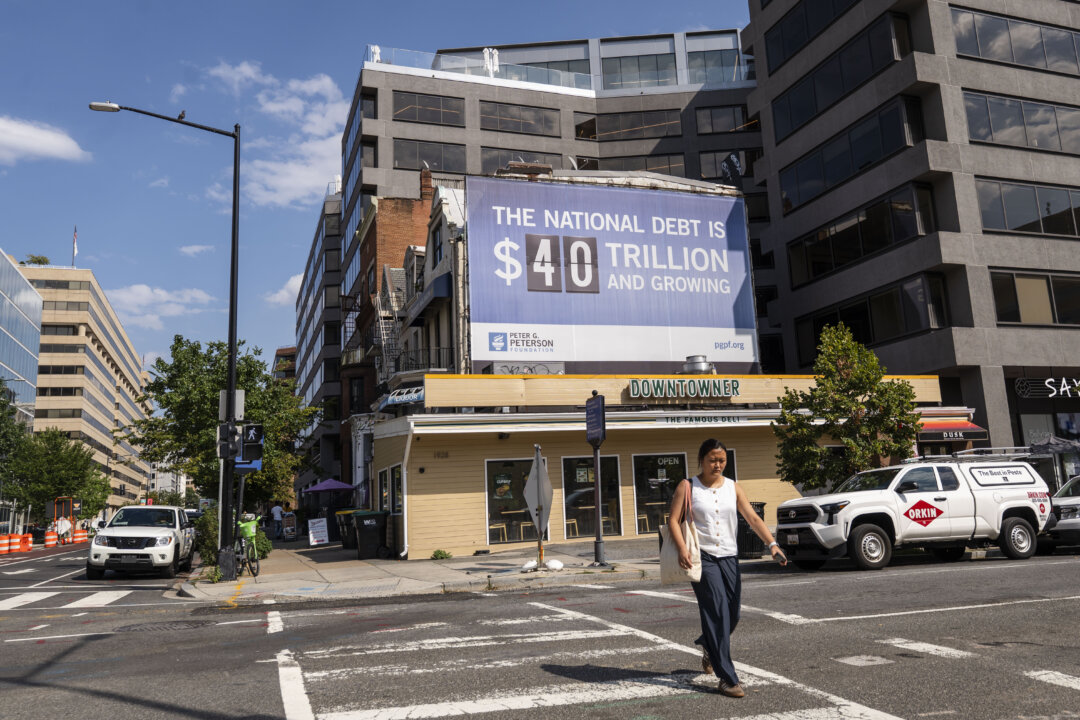
The U.S. budget deficit inched closer to $2 trillion after the first 11 months of fiscal year 2026, the Treasury Department reported on Sept. 11.
August’s Monthly Treasury Statement showed the federal government logging a $167 billion shortfall, far below the consensus estimate of a $404 billion deficit.
Last month’s shortfall marked a 61 percent decline from July’s $432 billion gap. It was also down 52 percent from August 2025’s $345 billion deficit.
Overall, the fiscal year-to-date budget deficit totaled $1.97 trillion, almost $200 billion higher than the same 11-month span in the prior fiscal year.
Tax receipts were $360 billion last month, bringing this fiscal year’s total to nearly $4.9 trillion. This was slightly lower than the $5.2 trillion posted during the same 11-month span in fiscal year 2025.
Federal spending slowed to $527 billion, with Social Security being the top budgetary item ($141 billion). This was followed by net interest payments ($86 billion), healthcare ($81 billion), and national defense ($72 billion).
Debt-servicing payments overtook Medicare as the federal government’s second-largest fiscal year-to-date expenditure, exceeding $1 trillion in August. The largest expenditure was Social Security, topping $1.5 trillion.
Interest costs are expected to take a larger share of the budget going forward. The national debt keeps growing—reaching $40.048 trillion on Sept. 10—and yields on Treasury bonds continue to climb to their highest levels in years.
Bond markets were also rattled this week when President Donald Trump pledged $5,000 checks to the American people if the Republicans secure a majority in Congress in the November midterm elections. He doubled down on this commitment in a Sept. 11 Truth Social post.
“When I say something, I mean it! The $5,000 Dividend will happen because the People of our Country deserve it,” the president said.
Interest Rate Management
Treasury Secretary Scott Bessent has been working to push down long‑dated yields by pairing a series of debt buybacks with increased issuance of short‑term T‑bills.
After his Aug. 19 announcement, the department outlined the operation this week, kicking off with a $6 billion buyback of 10- and 20-year government bonds on Sept. 10.
Before these liquidity-support efforts, the Treasury also executed two $12.5 billion buybacks on Sept. 3 and Sept. 9, bringing the week’s total to $31 billion.
Looking ahead, the Treasury has scheduled 12 more debt buyback operations, ranging from $500 million to $4 billion.

Treasury Secretary Scott Bessent speaks at Day 1 of the Republican Midterm Convention in Dallas on Sept. 9, 2026. John Fredricks/The Epoch Times
But investors were not convinced as the 10- and 30-year Treasury yields finished the trading week at 4.97 percent and 5.36 percent, respectively.
“Yields have followed a two-steps-forward, one-step-back path for much of the year,” Adam Turnquist, chief technical strategist at LPL Financial, said in a note emailed to The Epoch Times. “Over the last month, however, rates appear to have traded the stairs for the elevator.”
Persistent war-driven inflation, fiscal concerns, and Federal Reserve policy expectations have contributed to the yield curve’s acceleration this summer.
Following August’s Consumer Price Index, futures markets have fully priced in a quarter-point rate hike at next week’s Federal Open Market Committee meeting.
The annual inflation rate held steady at 3.4 percent last month as gas prices continue to put pressure on consumer prices. Core inflation, which strips out the volatile energy and food prices, eased to 2.4 percent, the lowest level since March 2021.
Despite the Treasury’s actions to manage interest rates, little relief is on the way, Turnquist said. “Momentum indicators continue to point toward higher yields” he said.
A new trend could also be forming in the Treasury market.
On Sept. 10, the Treasury sold $22 billion in 30-year bonds. Demand among primary dealers—mainly Wall Street banks—was extremely low, at nearly $485 million. But indirect bidders—generally foreign central banks—scooped up almost $17.5 billion, signaling the world’s appetite for high-yield U.S. debt.





Why Your Long-Term Care Insurance Premium Has Soared
Individuals who have purchased long-term care insurance are now facing significant premium...
US House to Vote on Russia Sanctions Bill Next Week
The U.S. Capitol building on Aug. 17, 2026. Madalina Kilroy/The Epoch TimesThe...
Trump Says He’s Open to Chinese Automakers Building Cars in US
President Donald Trump speaks during the 2026 Republican Midterm Convention in Dallas...
Commerce Department Finalizes Steep Duties on Solar Imports From India, Indonesia, Laos
The Commerce Department on Friday finalized steep duty rates on imports of...