Housing Affordability Could Weaken as Construction Slows: National Housing Agency
 William HetheringtonUpdated 7 hours Ago2 Mins read
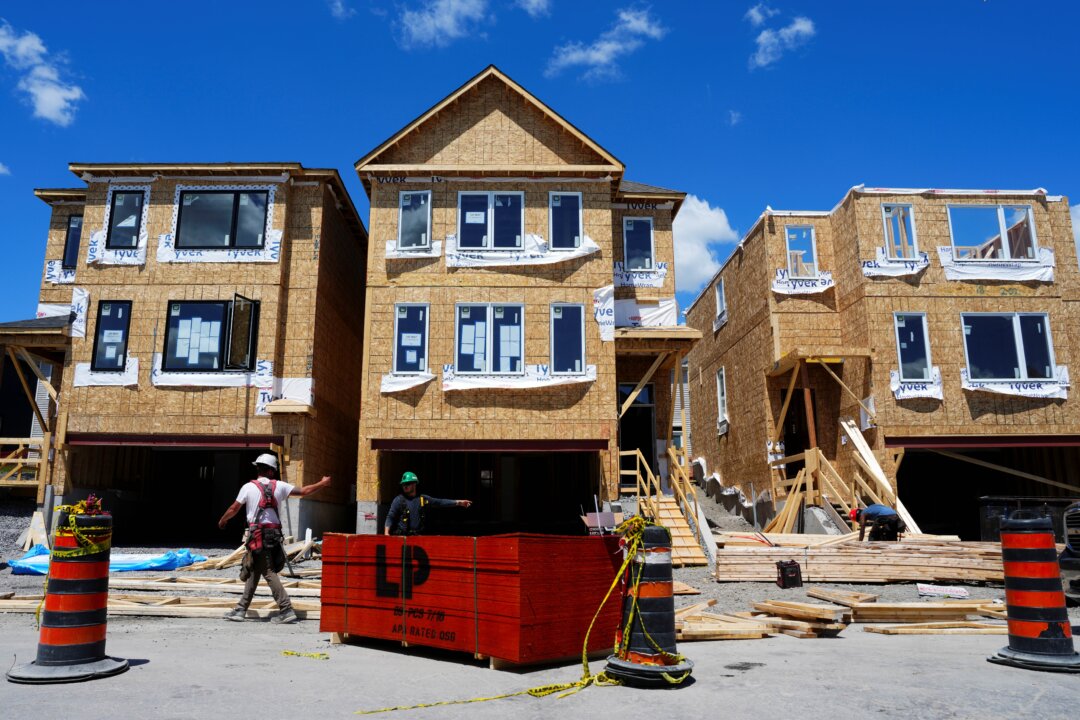

New homes are constructed in Ottawa on June 1, 2026. The Canadian Press/Sean Kilpatrick
Recent gains in housing affordability across Canada could be at risk as new-home construction slows, according to a report from the Canada Mortgage and Housing Corporation.
The housing supply gap is largely unchanged year-on-year relative to 2025, but construction is expected to slow faster than demand, which would make it hard to sustain affordability improvements gained since 2023, the report said.
Bringing affordability within 10 years to levels observed prior to the COVID-19 pandemic would require 417,000 to 469,000 housing starts annually leading up to 2036, it said.
A housing start is defined as the beginning of construction work on a building, usually when the concrete has been poured for the whole of the footing around the structure, or an equivalent stage where a basement will not be part of the structure.
“Based on our current projection, Canada still faces a long-term housing supply gap of 187,000 to 238,000 homes per year over the next decade,” the agency said.
The report found that Toronto’s housing supply gap had narrowed, but construction had slowed, impacting the supply of housing for home ownership. Ottawa and Montreal showed a widening gap, while that for Vancouver remained largely unchanged.
Edmonton showed no measurable housing supply gap, as construction there had kept pace with population growth.
In markets with a large supply gap, ownership-oriented housing is the most affected, particularly since the construction of new condo buildings has slowed.
Renters are seeing improved conditions as purpose-built rental construction adds supply. The report attributed this to developers responding to changes in population growth.
“While we assess affordability over a 10-year horizon, developers base construction decisions on near-term expectations for demand, absorption, financing conditions and profitability,” it said. “We expect slower demographic growth to weigh on new project launches in the near term.”
“However, housing supply needs will increase over the long term. Population growth is expected to recover across most major cities, and rising incomes will support housing demand,” the report added. “Meeting future housing demand will depend on the pace of new construction.”
The report cautioned that increasing construction faces challenges such as high costs and weak market conditions that make developers cautious.
Despite that, government measures such as financing programs, lower or deferred development charges, and zoning reforms are improving financial conditions for developers, which could boost construction, it said.
“These trends suggest that housing demand will likely strengthen over time, while supply may respond more slowly,” it said. “Restoring affordability will require not only more housing, but the right mix of housing to meet future needs.”







School Screen Time Capped as Students Go Back to Basics
A 14-year-old Australian boy posing at his home as he looks at...

Fresh ‘Adult Time’ Pledge in Youth Crime Crackdown
NSW Opposition Leader Kellie Sloane speaks at a memorial for the victims...

Censorship Fear Forces Labor to Mull Digital Law Change
Children holding a smartphone displaying social media applications, in Tunisia, on June...

Ottawa’s MAID Plan Undermines Suicide Prevention
CommentaryCanada’s 9-8-8 suicide prevention helpline has received more than 1 million calls...