
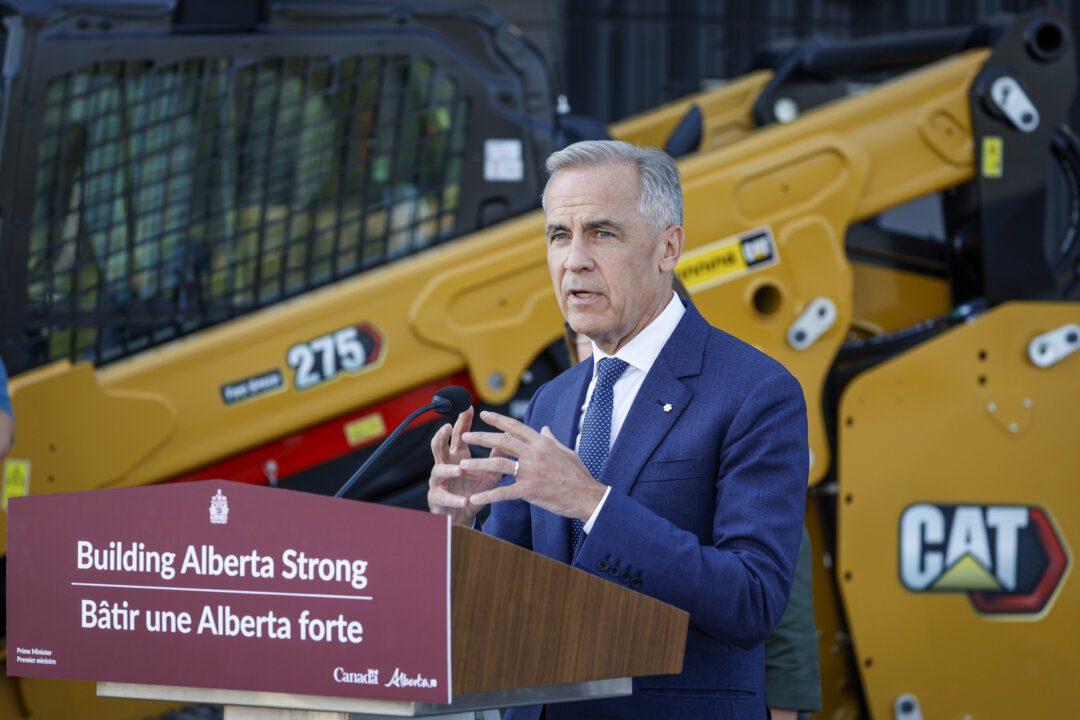


Prime Minister Mark Carney makes a housing announcement in Red Deer, Alta., on July 29, 2026. The Canadian Press/Jeff McIntosh
Prime Minister Mark Carney says it’s important for Canada to be a “reliable supplier” of energy and rejected calls that Canada should use energy exports as leverage in trade negotiations with Washington.
Carney’s comments come in the wake of calls by Ontario Premier Doug Ford for Canada to use energy as a bargaining chip to “dismantle” the United States in the face of looming 50 percent American tariffs on roughly $28 billion in Canadian goods that are set to go into effect Aug. 19.
“Being a reliable supplier is important,” Carney said July 29 while answering questions from media at an unrelated press conference alongside Alberta Premier Danielle Smith in Red Deer, Alta.
“Canadians are reliable. Canadians can be trusted. One of the things that you see in the world … we have many exports and commodities. One of the biggest commodities, arguably the best, is trust,” Carney added.
Negotiations
Minister of Canada-U.S. Trade Dominic LeBlanc and Canada’s top trade negotiator Janice Charette were in Washington July 29 for talks with U.S. officials ahead of the threatened tariffs from the Trump administration.
The Trump administration’s 50 percent tariffs were proclaimed July 20 under Section 338 of the Tariff Act of 1930 and would apply to a range of Canadian goods from cement and automobiles to dairy and alcohol products, various agricultural and vegetable products, as well as numerous foods, packaging, luggage, clothing, and hundreds of other items.
Section 338 is part of a law allowing the U.S. president to impose tariffs of up to 50 percent if a trade partner is considered to have been using unfair trade practices against the United States or disadvantaging the United States compared to treatment of other trade partners.
The proposed duties would apply to goods whether or not they comply with the existing free trade agreement known as the Canada–United States–Mexico Agreement (CUSMA), which is currently in place on a rolling annual basis after the United States declined to renew it to a full 16-year term earlier this month.
U.S. Trade Representative Jamieson Greer said the new 50 percent tariffs are being imposed due to a number of trade irritants that Washington considers to be unfair trade practices by Canada.
These include several ongoing provincial bans on the sale of U.S. alcohol, Canada’s supply management dairy policies that Washington says give European products better market access than similar American goods, and limits on vehicle exports to Canada from U.S. companies who have shifted production from Canada back to the United States.
Carney said that Canada has “lots of options” in order to work toward resolving the current trade tensions with the United States but did not specify what these options were in his July 29 comments.
“We have many things we can do. The first and foremost is to work towards an agreement. That’s what we’re going to do,” he said. “But there’s other things we could do if we needed to address the situation.”
The prime minister said last week that he spoke with Trump and the two had agreed to intensify negotiations in coming weeks.
Conservative Leader Pierre Poilievre has criticized Carney’s handling of trade negotiations, saying he has been making various concessions without results.