EU Chief Calls for Bloc-Wide Social Media Restrictions for Under-18s
 Rachel RobertsUpdated 3 hours Ago4 Mins read
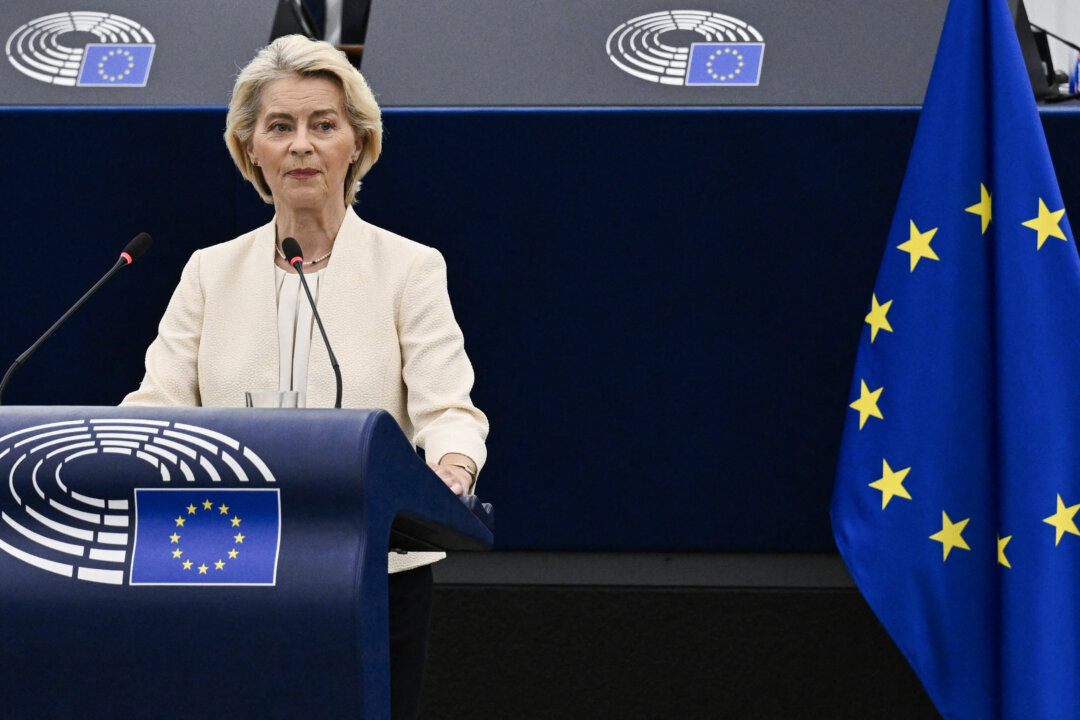
The European Union’s top official has proposed a social media ban for children under 13 across the 27-nation bloc, along with limits on older teens’ access to the platforms.
The plan builds on global efforts to prevent online harms to young people by preventing or restricting their use of platforms such as Instagram and TikTok.
“I am aware that many perceive the power of Big Tech as overwhelming and impossible to roll back. I disagree,” European Commission President Ursula von der Leyen said in her annual State of the Union address delivered on Wednesday in the French city of Strasbourg.
‘Addictive Features’
“We do not have to accept addictive features. We do not have to accept children being drawn into ever more extreme content. We do not have to accept that girls have their photos used for AI-generated sexualized images,” she said.
Von der Leyen said that under her proposal, “mini accounts” chaperoned by parents would be granted to children ages 13 to 15. These would have limits on features and the length of time they could be accessed.
For 15-to-18-year-olds, social media companies will need to come up with a “safe design,” she said.
The proposed ban is not guaranteed to go through, and could take years to implement. The EU’s member nations will need to debate and then vote on the plan.
The attempt to impose blanket age restrictions on social media could cause tensions with Washington. U.S. President Donald Trump has opposed government-imposed age bans on platforms, arguing instead that parents should have greater control over their children’s online activity.
Trump has raised concerns about the effects of social media on children, while opposing broader forms of government control over online speech.
At the May 2025 signing of the Take It Down Act, First Lady Melania Trump described social media and artificial intelligence (AI) as “digital candy of the next generation” and said they could be addictive and affect children’s development. The law addressed online exploitation and nonconsensual intimate imagery and deepfakes.
‘Phased and Gradual’
Von der Leyen hinted at the EU plan earlier this year, saying children should be permitted to use social media in a “phased and gradual” way.
Platforms such as Facebook, Instagram, and TikTok already prohibit children under 13 from opening accounts, but authorities have accused the companies of failing to take sufficient action to ensure compliance.

A teenager holds a mobile phone displaying a message from social media platform Instagram after the account was locked for age verification in Sydney on Dec. 9, 2025 AFP via Getty Images
Some experts said the social media industry’s core business model is based on getting users hooked on scrolling through endless, addictive content, while showing them ads, and that the EU is unwilling to tackle this.
The European Commission’s proposal “merely delays young people’s exposure to the risks of online harm instead of addressing the business model and extractive practices which fuel it,” said Simeon de Brouwer, a policy adviser at digital rights group EDRi, adding that the platforms will “unavoidably target them as soon as they’re a day older than the threshold.”
The commission’s proposal marks the first move to introduce a bloc-wide age limit for social media.
Member states such as
France
,
Denmark
, Portugal, and
Spain
have taken steps to ban or restrict teens from social media. Australia rolled out the world’s first
ban
for under-16s.
Not all attempts have been successful. France’s top court last month struck down a law banning under-15s from social media, saying it infringed on fundamental freedoms. French President Emmanuel Macron has vowed to rework the legislation to ensure it passes.
Privacy Concerns of Age Verification
Opponents of sweeping bans warn that implementing them would
require
the government to collect more data on everyone, raising privacy concerns. SpaceX boss Elon Musk is among those who have warned that social media age verification could become part of the push for digital ID for everyone.
To settle a long-running
trial
over teen social media addiction in the United States, Meta last month agreed to
pay
up to $18 billion and bolster child-protection measures on its Facebook and Instagram platforms. Claims had been filed against the tech giant by almost every state.
Manfred Weber, head of the largest group in the European Parliament, the center-right European People’s Party, spoke after von der Leyen to propose that the EU should allow citizens to switch off social media algorithms, following Australia’s lead.
“Elon Musk will not like it, but probably that is a reason for doing it,” he said.
Von der Leyen said the commission would also discuss efforts to slow the development of advanced AI with leading companies, following recent debate over the potential risks the technology poses to humanity.
She said the EU would work with “like-minded partners,” including Canada and former member Britain, on the issue.
“We want to team up on model evaluation, verification, early warning, AI security and much more,” she said.

Meta CEO and Chairman Mark Zuckerberg (C) leaves the Los Angeles Superior Court after testifying in the social media trial tasked with determining whether social media giants deliberately designed their platforms to be addictive to children, in Los Angeles on Feb. 18, 2026. Apu Gomes/AFP via Getty Images
‘Confront Big Tech’
Brando Benifei, an Italian member of the European Parliament’s largest left bloc, the Progressive Alliance of Socialists and Democrats, said he supported the plan and that Brussels should not back down from confronting the dominant U.S. tech companies.
“To apply this, you need to confront in a very frontal way the interests of platforms and Big Tech who are not happy with this,” he said.
The European Commission’s proposal is part of an EU Kids Act that von der Leyen and EU tech chief Henna Virkkunen were due to present on Thursday.
Reuters and The Associated Press contributed to this report.






10/3 podcast: Byelection fallout and Alberta’s looming referendum
Alberta Premier Danielle Smith responds to calls for Canada to use oil...
Marc-Olivier Fortin: The CAQ’s fear-of-Trump campaign starts to crumble
Coalition Avenir Québec Leader Christine Fréchette speaks to reporters following the Noovo...
Hockey jersey, selfies and applause: Carney mobbed by fans at EU speech as one member chanted ‘USA’
Canada's Prime Minister Mark Carney delivers a speech in the hemicycle at...
What Carney said about his vision for ‘associate membership’ in EU | Read or watch the full speech
'A Canada-EU alliance would create a beacon for other democracies,' the prime...