
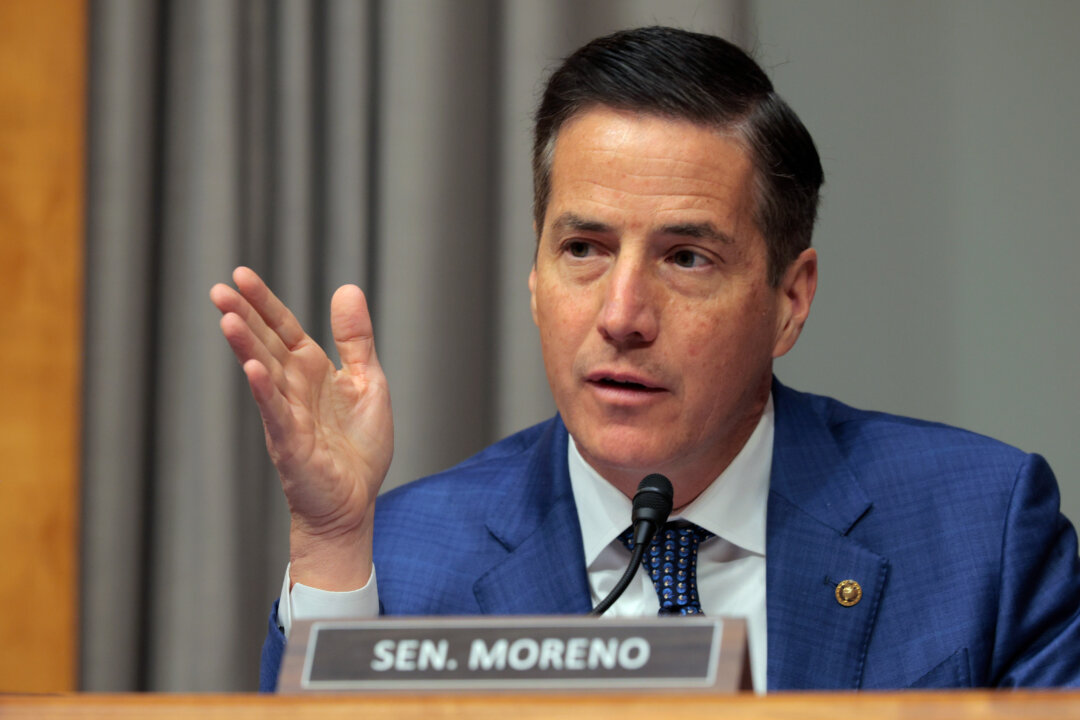

Sen. Bernie Moreno (R-Ohio) has asked Treasury Secretary Scott Bessent to carry out a national security review of a Chinese solar company’s potential use of a facility located near a major U.S. military base in Dayton, Ohio.
Moreno, who serves on the Committee on Homeland Security and Governmental Affairs, sent a July 31 letter to Bessent, expressing his concerns about a pending real estate transaction involving SolarSpace Technology, a China-based manufacturer of photovoltaic cells and modules
“It is my understanding that SolarSpace intends to lease or purchase a facility located at 2555 Woodman Drive, Kettering, Ohio, which is approximately 13 miles from Wright-Patterson Air Force Base,” Moreno wrote.
“The Chinese Communist Party is never allowed to purchase or lease land near our military installations.”
Wright-Patterson Air Force Base is home to the Air Force Materiel Command, the Air Force Research Laboratory, and the National Air and Space Intelligence Center, employing more than 38,000 military personnel, civilians, and contractors.
The Air Force Research Laboratory has conducted hypersonic science and technology research since the early 1960s, a decades-long effort that a senior laboratory scientist said in 2021 was supported by roughly $1.7 billion in U.S. investment over the previous 25 years.
In 2014, a former civilian employee of the Air Force Research Laboratory was sentenced to 37 months in federal prison in Los Angeles for selling the laboratory’s sensitive information to an individual he believed was a Chinese intelligence agent.
According to Moreno, the base “is not only one of the Department of War’s most strategically significant installations, but also a cornerstone of U.S. air and space superiority, serving as a central hub for aerospace research, engineering, and intelligence.”
Moreno contended that SolarSpace Technology poses a national security risk because “the Chinese Communist Party has leveraged American commercial entities to advance its military and intelligence objectives.”
SolarSpace Technology is headquartered in Xuzhou, a city in northwestern China’s Jiangsu Province. According to the company’s website, it has an overseas office in Wilmington, Delaware.
A 2023 report submitted to China’s Shenzhen Stock Exchange showed that the company had received millions in Chinese government subsidies from 2020 to the first half of 2023.
As chairperson of the Committee on Foreign Investment in the United States (CFIUS), Bessent should immediately investigate SolarSpace Technology, according to Moreno.
“We cannot let this potential transaction proceed without investigation,” Moreno wrote. “We cannot allow potential shell companies for the Chinese Communist Party to buy land or facilities near our most sensitive military and critical infrastructure sites, including Wright-Patterson Air Force Base.”
Chinese entities owned 277,336 acres of U.S. agricultural land as of Dec. 31, 2023,
the U.S. Department of Agriculture. The holdings—concentrated in Texas, North Carolina, Missouri, Utah, and Florida—include properties located within 150 miles of at least 30 U.S. military installations.
Many states—including
, Georgia, Indiana, Missouri, and South Dakota—have taken legislative or executive action to address concerns about foreign ownership of U.S. land.
In 2024, Missouri Gov. Mike Parson
an executive order banning China and other foreign adversaries from owning agricultural land within 10 miles of critical military facilities in the state. Missouri is home to several military facilities, including Whiteman Air Force Base, which hosts the nuclear-capable B-2 Spirit stealth bombers.
To confront the issue, Sen. Tim Scott (R-S.C.) led a group of Republican senators, including Moreno, in reintroducing the Protect Our Bases Act (S.2116) in June 2025.
The legislation would “strengthen CFIUS to review these purchases near sensitive national security installations to protect our nation’s security from being compromised by the CCP [Chinese Communist Party] and other enemies,” Moreno
in a statement at the time.
SolarSpace Technology did not respond to a request for comment by the time of publication.