US Business Is ‘Clearly Booming,’ Says S&P Global’s Chief Economist
 Andrew MoranUpdated 3 hours Ago3 Mins read
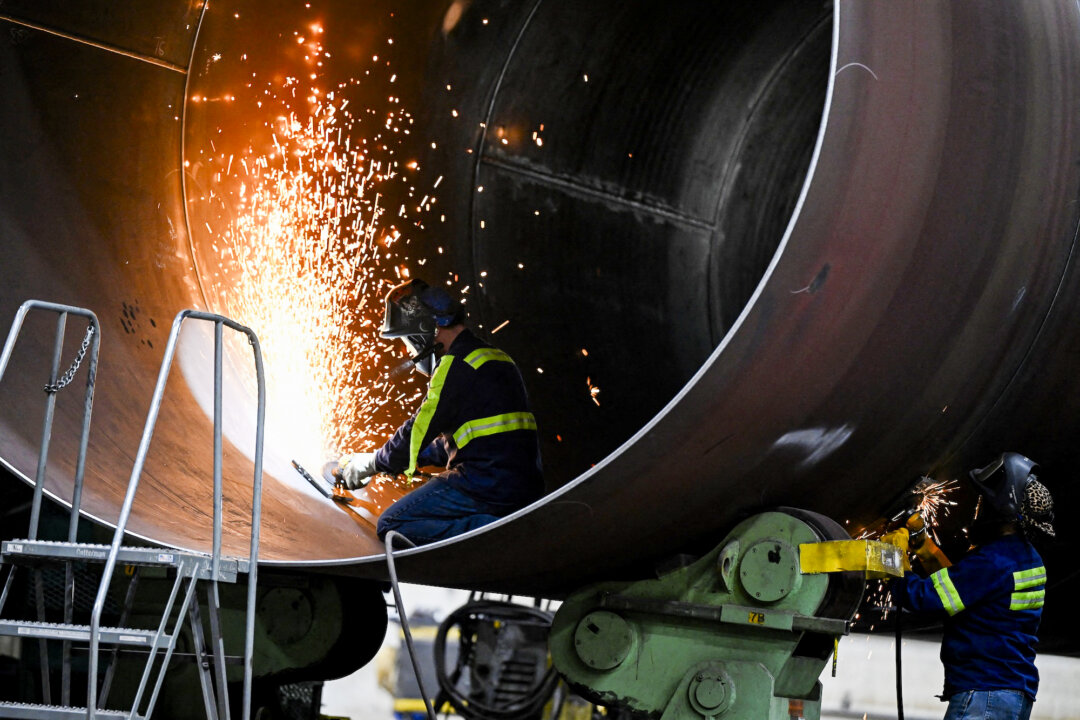
U.S. business conditions strengthened to their best level in five years this month as the manufacturing and services sectors helped the economy shrug off global inflation pressures.
Business growth accelerated to 58.4 in the PMI (Purchasing Managers’ Index) output in September, up from 56 in August.
This is the highest level in 62 months. Excluding the pandemic years of 2020 and 2021, business activity has been at its highest level since 2015, S&P Global said on Sept. 23.
September’s gain was fueled by stronger manufacturing output growth and faster business activity in the services sector.
The manufacturing purchasing managers’ index—a monthly survey of the industry’s prevailing economic direction—jumped to a 52-month high of 57, from 53.9 in August. The services PMI climbed to a 59-month high of 58.7, from 56.5.
The latest numbers indicate that annualized economic growth could be around 5 percent, “with a 4 percent gain now signaled for the third quarter as a whole,” says Chris Williamson, chief business economist at S&P Global Market Intelligence.
“To put the growth surge in context, barring the spike in demand following the opening up of the economy after the COVID-19 lockdowns, the latest improvement in business activity is the greatest recorded since early 2015,” Williamson said in the report.
“Business is clearly booming now in both manufacturing and services.”
Employment also improved in September. Job growth was the best in more than four years, with companies aiming to satisfy intensifying demand.
Businesses’ expectations were unchanged in September, hovering around pre-conflict levels amid solid demand and economic resilience.
The Inflation Outlook
Despite a robust economic landscape, persistent war-driven inflation risks could further weigh on U.S. firms.
Average input costs for goods and services were the highest since October 2022, S&P Global said.
Higher fuel and transportation costs are exacerbating input price pressures. This could lead to elevated selling prices in the coming months, the report noted.
U.S. crude oil prices are above $90 per barrel, according to the American Automobile Association. The national average for a gallon of gasoline is $4.47, and diesel is at $6.52.
This could begin filtering through core inflation—a key measure that strips out volatile energy and food prices—says Beth Ann Bovino, chief U.S. economist at U.S. Bank and head of the American Bankers Association’s Economic Advisory Committee.

A truck is refueled with diesel at a truck stop in Commerce, Calif., on Aug. 26, 2026. Patrick T. Fallon/AFP via Getty Images
So far, higher energy prices have fed into the truck services and trucking transportation side of core inflation, which could eventually traverse through overall consumer prices.
“Businesses are kind of almost … testing the waters of what they can get through without losing the customer,” Bovino told The Epoch Times during an American Bankers Association virtual event on Sept. 23. “I do think that businesses now have started to see more of that in terms of businesses seeing a pass-through.”
Annual core inflation has been tame despite the spike in headline consumer prices.
August’s 12-month core inflation rate slowed to 2.4 percent. Looking ahead to the September numbers, the Cleveland Federal Reserve said it should hold steady.
But the Federal Reserve’s preferred Personal Consumption Expenditures (PCE) Price Index has been higher, as it differs from the CPI in component weightings. Core PCE is firmly above 3 percent.
Market watchers are sounding the alarm about the upstream effects of higher energy and transportation costs, as well as tariffs.
“Each of these has a significant chance of applying pressure on goods if energy prices can’t offset this,” Oliver Rust, head of data at Truflation, told The Epoch Times.
“With diesel at an all-time high, this will affect the transportation of goods, since most are shipped by diesel-powered trucks.”
The U.S. central bank followed through on a widely expected quarter-point interest rate increase this past week to prevent second- and third-order effects from the oil price shock.
While critics fear this could adversely affect business activity, Fed Chairman Kevin Warsh told reporters at the post-meeting conference that the rate hike only removed a “dose of accommodation” from the broader economy.
“Consider the geopolitical landscape of shocks and uncertainty, and you begin to appreciate the resilience of the U.S. economy,” Warsh said.
“Given that resilience, and the potential for even greater performance, an attitude of optimism is exactly what I heard inside the [Federal Open Market Committee] these last two days.”
Like the financial markets, the U.S. economy continues to shrug off multiple headwinds, whether revived inflation or higher interest rates.
The Atlanta Fed’s widely watched GDPNow Model indicates third-quarter growth will be about 5 percent, driven by consumer spending, business investment, and changes in private inventories.
To date, financial conditions have held steady, according to the Chicago Fed’s National Financial Conditions Index.
Whether the economy can withstand higher interest rates—from rising Treasury bond yields to the Fed’s policy tightening efforts—remains to be seen heading into 2027.




Judge Dismisses Michigan Case Accusing Oil Majors of Suppressing Renewables
A federal judge dismissed an antitrust lawsuit in which Michigan accused four...

More US Homebuyers Apply for Riskier Mortgages as Interest Rates Top 7 Percent
Higher interest rates pushed prospective homebuyers toward riskier mortgages last week, new...

Trump Says Iran Is Open to Ending the War
President Donald Trump in the Oval Office of the White House in...
Rubio to Meet Lavrov in New York Amid Trump’s Russia–Ukraine Peace Push
U.S. Secretary of State Marco Rubio will meet Russian Foreign Minister Sergei...