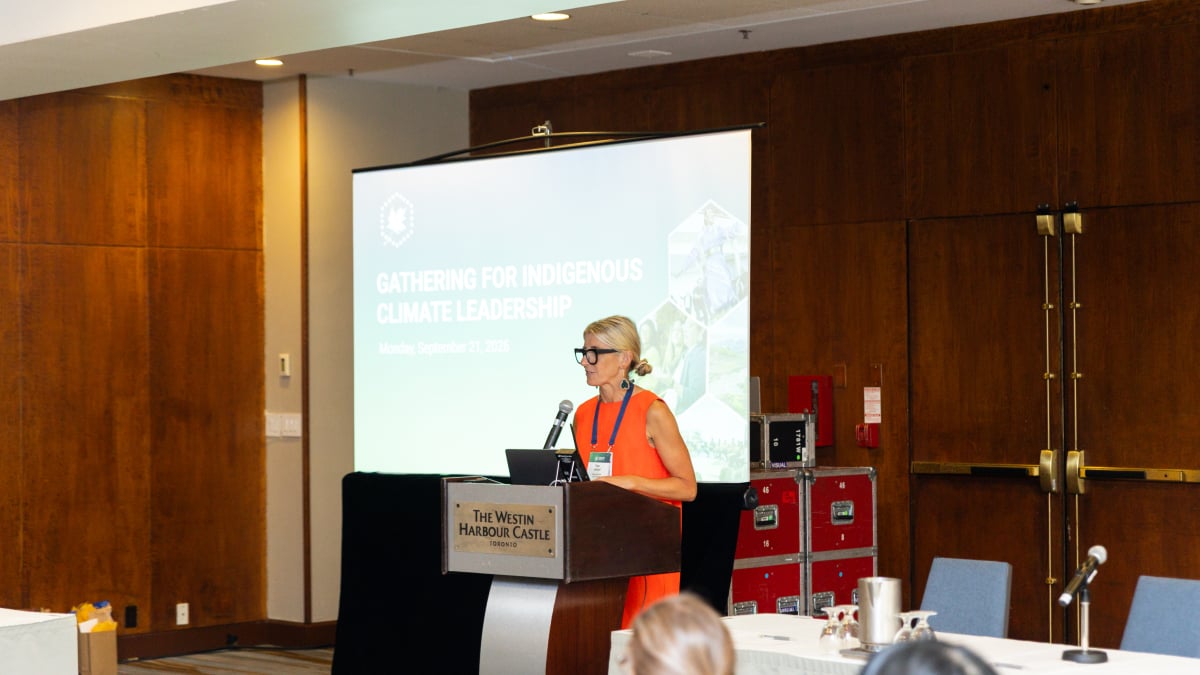
There’s little pessimism at Adaptation Canada 2026, where about 1,000 of the country’s leading climate change experts are gathering in Toronto this week, marking the third national conference for climate impacts and adaptation since its inception in 2016.
Hosted by ICLEI Canada on behalf of Environment and Climate Change Canada, the summit assembles academics, advocacy groups, bankers, insurers, engineers and energy executives to collaborate on the building of climate resilience.
Environmental researchers shook hands with insurance brokers. Enbridge, the natural gas company, distributed samples of soap apparently made with captured carbon — all while encouraging municipal leaders to discuss their infrastructure challenges during extreme weather events.

If Canada’s national climate adaptation conference gave space to apparently competing priorities, it’s simply a reflection of where the country is today, said Ewa Jackson, the managing director of ICLEI Canada, in an interview with Canada’s National Observer.
In early September, for example, Canada’s Changing Climate Report declared that Canada’s average annual temperature will continue to rise over the next decade or so — even if global greenhouse gas emissions fell to zero tomorrow.
There was also Prime Minister Mark Carney’s investment summit on Sept. 14 and 15, held a few blocks away from this week’s climate conference, where projects such as pipelines and mines were discussed alongside green energy infrastructure.
And, this week, the federal government introduced sweeping legislation that has sparked backlash from environmentalists and praise from some business groups urging the feds to do even more to stimulate investment.
Jackson acknowledges the climate risks are plentiful, referencing the national report’s finding that global warming will almost definitely reach “1.5°C above the 1850–1900 average” by the middle of this century.
“There are a lot of challenges, and we’re working in uncertain times,” Jackson said. “But people are doing the work, and there are a lot of good things happening. We need to scale it, we need to do more of it faster.”
Jackson has attended these national adaptation conferences since the first iteration. She told CNO that the focus of the conference has shifted over time to focus less on “new solutions” and more on implementing and scaling them.
Now, she said, local governments better understand the risks their communities face. The questions have shifted: “How do I protect the people who are most vulnerable, or exposed to that flood? How do I do that quickly, because the next flood could be right next to me?”
Most importantly: “How do I pay for it?”
Several of the conference’s 70 sessions attempted to answer those questions. Themes ranged from raising private capital to facing the rapid impacts of climate change in Canada’s northern communities.
The booth for Canadian mutual insurer Wawanesa, for example, encouraged participants to put a coloured sticker next to the element — staff capacity, partnerships, data, leadership and a few others — that would “have the greatest impact on moving projects from awareness to action.” Most people responded that money and grants would help most. Where this funding would come from is uncertain.
The presence of banks and insurers at the climate conference was “a testament that [those companies] are thinking about this whole issue,” Jackson said, though she also noted the conference’s venue — right in the middle of Toronto’s financial district — likely drew the attention of the private sector, too.
While delegates considered funding and capital, they also embraced the conference as a forum to share solutions.
Take the “Relocating for Resilience” panel: Sean Strang and Graham Watt, the city officials responsible for flood recovery in Merritt and Grand Forks, BC, respectively, said that collaboration saved them time and effort. When Merritt flooded three years after Grand Forks, the two shared ideas and replicated what worked rather than starting from scratch. Together, Strang and Watt have worked on a provincial framework to compensate homeowners whose properties are expropriated after floods.
It remains to be seen what all the business card-exchanging and breakout rooms will amount to after the conference ends on Sept. 24. Jackson is hopeful she’ll hear stories down the line of great relationships and innovations sparked at the event.
“Maybe that’s a bit naive on my part.” But, she said, “We wanted to focus on solutions and not just doom and gloom.”
September 24th 2026