
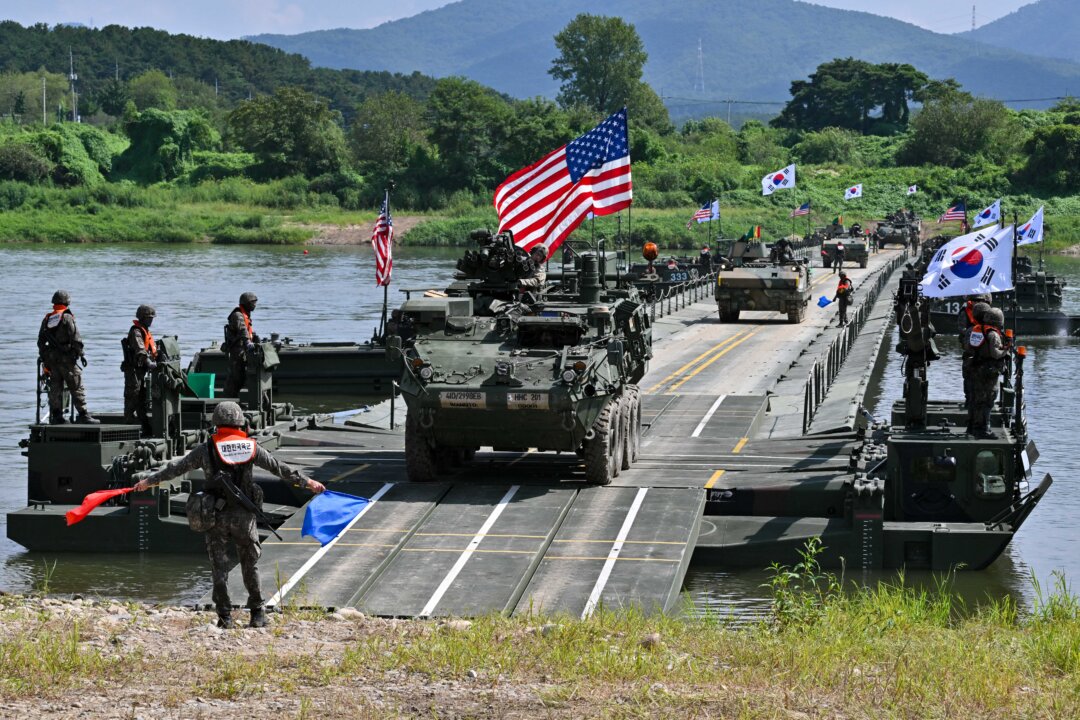
This year’s U.S.–South Korean joint military drills, taking place from Aug. 18 to Aug. 21, highlighted the First Island Chain security, with the official U.S. rhetoric showing that its strategic focus has shifted to war preparation against the Chinese communist regime and its allies along the critical island chain in the Asia-Pacific, according to analysts who spoke with The Epoch Times.
Ahead of the joint military drills—Ulchi Freedom Shield (UFS)—the U.S. Army Eighth Army stationed in South Korea said in a statement that the exercises will feature the rapid distribution and preparation of Army Prepositioned Stock 4 (APS-4), “demonstrating the alliance’s ability to rapidly project combat power and secure key terrain within the First Island Chain.”
The Eighth Army said the drill focuses on strengthening its “Fight Tonight” posture of constant combat readiness, modernizing the South Korea–U.S. alliance, and shaping the security environment in Northeast Asia.
The First Island Chain is a strategic string of Pacific archipelagos stretching from the Kamchatka Peninsula in the Russian Far East down toward Southeast Asia, designated by the United States to contain communist China and Russia’s maritime expansion in the Pacific since the Cold War.
The current Trump administration promotes the “deterrence by denial” military strategy in the Indo-Pacific region, which aims to make it difficult for China and its allies to achieve military objectives within the First Island Chain—a line connecting Japan’s Okinawa, Taiwan, and the Philippines.
Elbridge Colby, U.S. undersecretary of defense for policy, said on Aug. 13 of U.S. military presence along the First Island Chain: “We are not leaving. In fact, we are digging in.”
The U.S. Army’s Eighth Army is the sole permanently stationed regular U.S. Army force on the Asian mainland. It operates under the command structure of United States Forces Korea (USFK) and also is part of the U.S. Army Pacific (USARPAC) system, operating primarily in South Korea to support regional security and readiness, according to public information.
Projecting Combat Power Along the First Island Chain
Su Tzu-yun, researcher and director of the Division of Defense Strategy and Resources at Taiwan’s Institute for National Defense and Security Research, told The Epoch Times that the U.S. military’s projection of combat power in the region has evolved in response to Beijing’s increasingly assertive posture.
“Historically, the role of U.S. forces in South Korea was to assist in defending the Korean Peninsula. However, given the expansion of the Chinese communist regime, these forces may now support the defense of the First Island Chain—particularly through air and naval assets based in Busan.”
As the U.S. forces stationed in South Korea are the closest to mainland China, Su said that the strategic shift “symbolizes a potential adjustment in the role of U.S. forces in South Korea to strengthen the defense and deterrence of the First Island Chain.”

First and second island chains. Courtesy of Department of Defense
The U.S.-South Korean joint exercises highlighted the “APS-4”—Army Prepositioned Stocks-4, which emphasizes the implementation of the “island chain” operational concept, Chung Chih-tung, associate research fellow at Taiwan’s Institute for National Defense and Security Research, told The Epoch Times.
There are two significant implications, Chung said.
“The first is strategic deterrence. The second is combat readiness,” he said. “Whether in the current context of the Korean Peninsula or in future scenarios involving the Taiwan Strait, the South China Sea, or the East China Sea, should a contingency arise, these U.S. troops stationed in South Korea are a deployable force.”
Their combat readiness preparation centers primarily on the “APS-4”—specifically, the pre-positioning of relevant equipment and ammunition in South Korea, Chung said.
“Should a wartime need arise, U.S. forces stationed in South Korea would be able to rapidly project capabilities toward the First Island Chain, encompassing both personnel and logistics,” he said.
Su said the U.S. military is testing a “cross-theater reinforcement system,” noting that “U.S. forces stationed in South Korea consist primarily of Army troops, providing partial support for the country’s defense and deterring rash actions by North Korea. However, U.S. naval and air forces stationed there would provide cross-sea combat support, while U.S. bases in South Korea would facilitate logistics.”
If conflicts occur along the First Island Chain, from Japan to the Philippines and South Korea, these U.S. military bases—whether permanent or temporary—will eventually be linked together in operation. Su said.
South Korea is on the Korean peninsula, “but it is functionally part of the first island chain, and it could be a strategic anchor of the chain,” the U.S. Naval Institute noted in a June article titled “Keep the Steel in the First Island Chain” in its monthly magazine Proceedings.
“South Korea would enable U.S. power projection and sustainment for any regional fight, including for sea and air denial in the Yellow Sea. This would bottle up the PLA Navy’s North Sea Fleet, the naval component of the PLA’s Northern Theater Command,” the article read.

A U.S. Air Force B-1B bomber, sixth from top left, South Korean Air Force F-35 fighter jets and U.S. F-16 fighter jets, left, during a joint air drill in South Korea on Nov. 19, 2022. South Korean Defense Ministry via AP
Confronting China–Russia–North Korean Alliances
China and Russia have frequently held joint naval and air drills in Northeast Asia, including near the Korean Peninsula, the Sea of Japan, and the Yellow Sea, confronting the U.S. military-designated First Island Chain.
As the U.S.-South Korean military exercises near their close, North Korea, another state in the “Axis of Evil” alliance along with China and Russia, launched 10 ballistic missiles on Aug. 20, which flew into the sea.
North Korea also test-fired ballistic missiles toward the Sea of Japan on both Aug. 6 and Aug. 12, before the U.S.-South Korean drills. The missile launched on Aug. 12 flew more than 700 kilometers (435 miles) before landing in waters outside Japan’s Exclusive Economic Zone (EEZ).
The U.S. military’s emphasis on the ability to project combat power along the First Island Chain, which includes South Korea, Japan, and all operational zones extending to the South China Sea—essentially representing the integration of operations across the chain, Chung said.
“So, this recent exercise—framed as a strategic power projection drill along the First Island Chain—certainly reflects a significant interconnectedness of the entire Indo-Pacific region, spanning from the Korean Peninsula and the East China Sea to the South China Sea,” he said.
In the context of escalating threats from the Chinese regime toward Taiwan and potential conflict in the Taiwan Strait, Su said: “U.S. bases in South Korea can accommodate U.S. Air Force aircraft arriving from Alaska, while their ports can facilitate docking and resupply for the Pacific-based Seventh Fleet—these are the logistical aspects. Meanwhile, U.S. Air Force units stationed at these bases can directly engage in combat.”
Su said this indicates that U.S. military bases along the First and even the Second Island Chains are gradually being linked together, noting that “the United States is also making strategic deployments along the second line to deepen the combat involvement of Australia and New Zealand.”
Cheng Mulan, Luo Ya, and Reuters contributed to this report.