
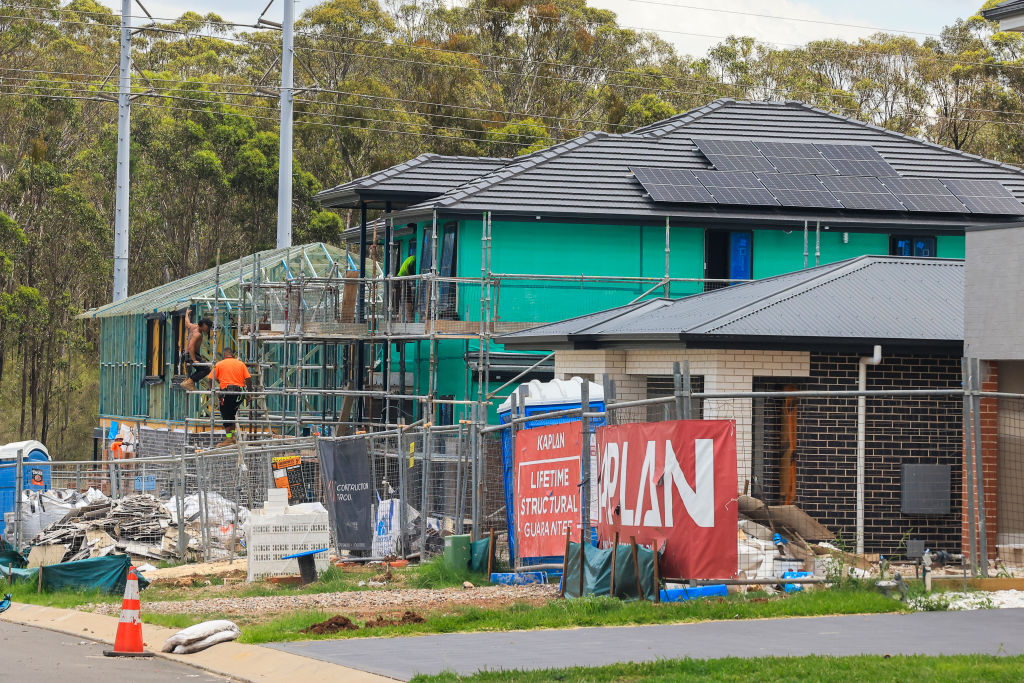

Workers are seen on a building site in the Western Suburbs on Jan. 11, 2024 in Sydney, Australia.Photo by Jenny Evans/Getty Images
New rules introduced in 2025 to temporarily ban foreign entities from buying existing dwellings in Australia have contributed to a 22.4 percent fall in investment approvals, the Productivity Commission has revealed.
According to government data, foreign investment approvals overall fell from 6,812 in 2023-24 to 5,284 in 2024-25, a drop the Commission said was “almost entirely” due to a fall in residential real estate approvals.
But it noted that the ban applied only during the final quarter of the 2024–25 financial year and that a decline in housing approvals was already underway in the previous year, before the ban took effect.
As a result, its full impact will not become evident until data for the current financial year becomes available.
In its latest Trade Assistance Review (pdf), the Commission also revealed that the value of foreign investment approvals in the past financial year actually increased to $256 billion (US$183 billion), up from $194 billion the previous year but still below the 2021-22 peak of $338.1 billion.
Residential real estate accounted for the vast majority of applications but only a small share of their value. In 2024–25, residential applications made up 74 percent of approvals but accounted for just 2 percent of the total value of approved investments.
Foreign buyers, including temporary residents, generally must obtain approval before purchasing residential real estate. Under the ban, applications to purchase established dwellings were generally refused, subject to limited exceptions.
The ban, which was originally intended to run for two years, has since been extended by a further two years and three months and is now set to end on June 30, 2029.
Separately, the government is also targeting land banking by foreign investors, giving the Australian Taxation Office and Treasury increased funding to enhance compliance activity in this area.
Both major parties proposed foreign buyer bans at the recent federal election, but the Real Estate Institute of Queensland (REIQ) warned at the time that such measures could backfire.
Queensland has experienced the largest increase in interstate migration since the COVID-19 pandemic.
“Foreign investors are a small part of the housing market, and there are already significant deterrents and restrictions in place,” REIQ CEO Antonia Mercorella said, noting that the ban could remove the incentive for builders to construct new homes.
The decline in foreign buyer interest has so far failed to dampen housing price growth, with Australia’s dwelling stock increasing in value by $384.8 billion, or 3.2 percent, in the December quarter of 2025 to reach $12 trillion, according to ABS figures.