
The difference between an ordinary photo and a memorable one can come down to a matter of seconds.
David Holman has learned to wait for those moments, whether that’s sitting quietly near a hissing bird, or a pride of lions after a kill as the African sun sets.
Or spending hours capturing cosmic bodies while battling light pollution, passing aircraft, and even Elon Musk’s Starlink.
“Photography for me is all about capturing a moment in time that I want to remember,” Holman told The Epoch Times.
“And for me, it’s all about the light.
“Yes, I like taking photos of my family, and happy snaps … but using light to paint a memorable picture is what really excites me.”
Capturing the Milky Way An ‘Honour’
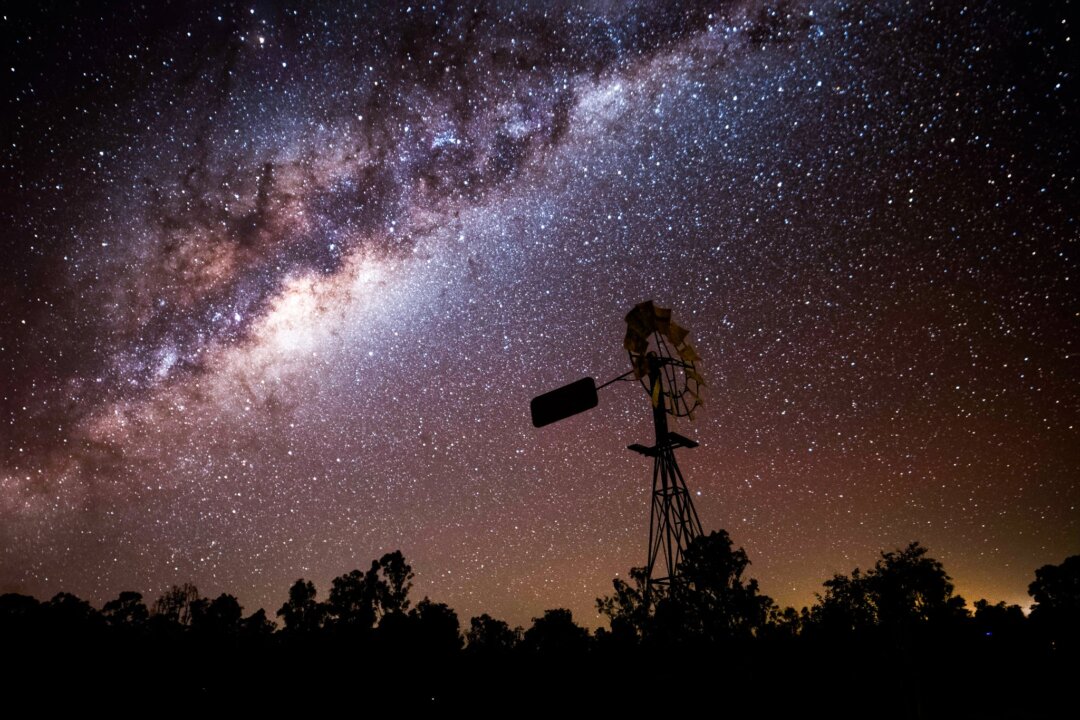
Photographing heavenly bodies isn’t as simple as it seems, often requiring complex settings and careful planning.
“Absence of light pollution is really important, if you can get it. Even a small light can reduce the impact of a picture under long exposures,” Holman says.
He reveals he uses 15-20 second exposures and a tripod. Holman also uses a zoom lens to capture the core of the Milky Way, and sets up his camera with a high sensitivity for nighttime shots—up to 3,200 ISO.
“You have to set the camera up to absorb a lot of light. This means a slow shutter speed, I use an aperture of f2.8, and you need a wide angle lens to capture the expansive sky, I generally use a 15 millimetre lens,” the photographer says.

A photo Holman calls the “two ugly sisters”, taken at Lakefield National Park, with the Milky Way in the background. Courtesy of David Holman
One challenge is satellites and planes interrupting his shots.
“Musk’s Starlink is proving to be problematic,” he said.
Over 40 Years of Photography
The Sunshine Coast man has worked his whole career in the agriculture and seed industry, while living in Australia, the Philippines, Canada and the United States. He now works part-time and volunteers as a Surf Life Saver.
“I bought my first Nikon film camera in 1984, I am 73 years old now and have been taking photos since then,” Holman said.
“Digital photography enabled me to really get into it, as other than the camera and lenses, it was no cost after that, other than to buy some processing software.”
It’s a passion he hasn’t stepped away from since.

Photographer David Holman and his wife, Pam, out and about with a bearded dragon. Courtesy of David Holman
Those Few Moments of Light
It was near dusk in far North Queensland when he spotted a family of stone bush-curlews enjoying the shade.
Holman watched the parents and their young for 30 minutes, sitting just metres away.
“They were comfortable at that distance, but if I got too close, they emitted their warning hiss,” he said.
“Just as the sun was setting, the fading rays hit the female and created perfect light for this shot.”

A bush stone-curlew during a quiet encounter. Courtesy of David Holman
Another time in South Africa’s Madikwe National Park, it was again dusk when Holman captured a majestic shot of a male lion after it had feasted on a kill.
“The king was lying down with a full belly, and his pride lay around him,” he said.
“As the sun set he got up and looked towards the setting sun, allowing me to capture the king in all his glory.”

The pride leader surveys his domain, in a photo taken in Africa. Courtesy of David Holman
Into the Danger Zone
One of Holman’s riskiest pursuits is that of crocodiles, which he doesn’t recommend for those without the experience.
“You can take a croc-watching tour on a river like the Daintree River in North Queensland,” he said.
“There, local experts will look for crocs on the river banks and in the water. They generally know the crocs in the area, as they are very territorial animals.

A saltwater crocodile blends into the reedy banks of North Queensland. Courtesy of David Holman

A crocodile in the Daintree rainforest in North Queensland. Courtesy of David Holman
Holman frequents the Lakefield National Park in the lower Cape York region west of Cooktown.
He uses a zoom lens to keep a safe distance, while hiding behind trees.
“The Northern Territory and northern Western Australia (WA) has far more crocs than Queensland, and they are very plentiful in rivers like the Ord in WA,” he said.
Capturing Special Moments in Time
Meanwhile, Holman says he has no intention to stop taking photos any time soon.
“For me photography is now more about capturing interesting and dramatic light opportunities,” he said.
“Like the bush stone-curlew shot and the black and white lion shot.
“I will still take happy snaps, but my real focus is capturing special moments in time. Of course, like any art form, it is all in the eye of the beholder. What I like, others may not.”

An inquisitive ostrich gets up close and personal with Holman’s camera. Courtesy of David Holman