
Political leaders are united on them across the divide, while billions in taxpayer dollars could be saved and some hard reforms delivered.
Four-year parliamentary terms, though, remain maddeningly beyond reach.
Like John Howard, Kevin Rudd and Malcolm Turnbull before him, Anthony Albanese is a backer but knows it would require a referendum.
Already bitten by the failed Indigenous voice campaign, the prime minister is perhaps twice shy.
That’s a great shame, according to 4 Year Terms Australia founder Marty Gray, who is frustrated by a system that stymies reforms.
“Would governments be more willing to engage in bold reform under a four-year fixed term?” he asks.
“I think the answer to that, all things being equal, is that is definitely true.
“You only have three budgets in a three-year system and the first year is setting up paying for election commitments, the last year often has a lot of handouts to get re-elected,” Gray noted.
“So you only have one real budget in the middle where where you undertake meaningful reform.
“If you do move to a system where you’ve got two budgets in the middle, then all of a sudden you’ve got a world where 50 percent of the budgets … have the opportunity for reform.”
Alongside a longer stint in office, 4 Year Terms Australia also wants fixed terms to remove the guessing-game on election dates which also gives incumbents a poll advantage.
It last week released a report claiming the country stood to gain as much as $93 billion (US$66.7 billion) in economic activity if the reform happened tomorrow.
The modelling, conducted by consultants Mandala Partners, includes cost-saving on fewer elections (the 2022 federal poll cost $522 million) and a productivity gain from voters not spending time going to the ballot box.
It also factors in reduced business investment during election years—a globally-experienced phenomenon—and public servants spending less time in caretaker mode.
Perhaps most contentiously, it models a 25 percent lift in productivity-boosting policy reform given fewer election years, when governments tend to be more cautious.

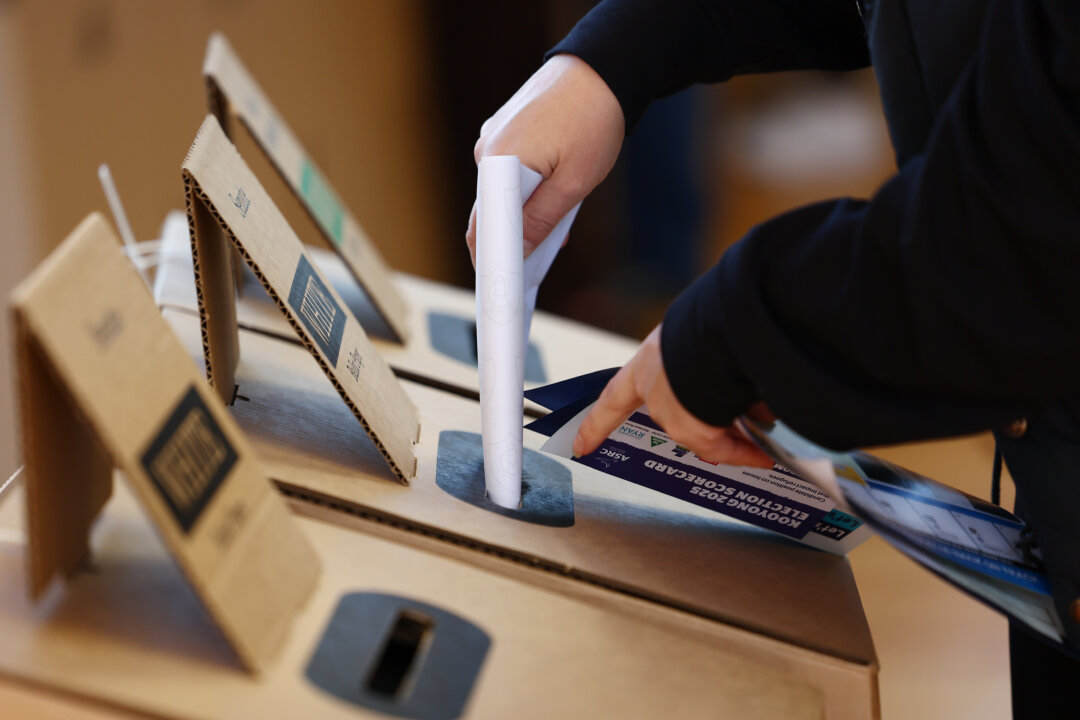
Voters mark their ballot papers at a pre-polling centre in Sydney, Australia, on May 2, 2025. David Gray/AFP via Getty Images
Opponents of four-year terms say the notion governments would abandon the political imperative and focus on difficult reforms is fanciful.
“It’s empirically not true,” Institute of Public Affairs director of research Morgan Begg told AAP.
“We have decades of experience … where every mainland state has adopted fixed four-year terms and it would be an extraordinary reach to claim they have become better at government.
“The problem is with the political class … and fixed four-year terms clearly will not address that.”
The IPA’s primary objection is a democratic argument: longer terms mean fewer chances to vote, which takes power away from citizens.
One Nation is also opposed on this basis and so too ex-prime minister Tony Abbott.
The reform itself is also wickedly difficult.
It would require constitutional change, meaning it must be supported by a majority of Australians and a majority in a majority of states.
For this reason Albanese’s government—while sympathetic—is not pursuing it, with the Labor leader pledging not to hold a further referendum after his experience with the voice vote.
Bob Hawke was the last prime minister to attempt the reform.
He included it as one of four referendums in 1988 along with human rights protection, local government recognition and other electoral reform.
All of them failed.
In 2017, Opposition Leader Bill Shorten offered bipartisan support for a fresh referendum to then-prime minister Turnbull.
While Turnbull was supportive in principle, the idea fizzled during his tenure and that of his successor Scott Morrison.
Shorten said he even offered to extend his term by a year if it would make it work.
“I don’t think many opposition leaders have offered support to a prime minister,” he told AAP.
“I don’t think he could get it through his party room.”
The benefits were obvious to the former Labor leader.
“Three-year cycles are too short,” he said.
“When you’re a government, it takes a while for new ministers to find their feet and the process of legislation can, unless it’s a super-crisis, take about a year.
Sitting 70-80 days a year across a three-year cycle makes for about 200 active days, Shorten said.
“Understanding the last third becomes pretty contested; the window to do stuff is not that long,” he said.
Gray made the point that Australia is one of just two liberal democracies with a three-year national parliamentary term.
The other, New Zealand, does not have the legislative handbrake of an upper house, which can lengthen and complicate lawmaking.
It has also long flirted with a shift to four years: the last six prime ministers, from Helen Clark, who served from 1999 to 2008, to incumbent Chris Luxon, were all in favour of governments getting a longer go.
None have attempted the reform.
Jacinda Ardern’s deputy, Grant Robertson, said given the change relies on a public vote, the push needed to come from outside parliament.
“The four-year term is important but I’ve always felt the movement to create it needed to come from civil society,” he said last week.
Ardern’s government prioritised two other referendums: to legalise euthanasia, which passed, and recreational cannabis use, which failed.
Luxon told an election debate in 2023 he was in favour of the change but earlier in 2026 said his government would not prioritise it.
Back home, Albanese might have ruled out a referendum but Gray is hopeful a parliamentary push will keep mounting the case.
An inquiry has been tasked with considering the case for four-year terms, along with a larger parliament, and a huge number of advocacy groups have backed it.
Albanese has also scotched parliamentary expansion but Gray says he is hopeful the prime minister will change his tune.
“The Labor national platform just came out and for the first time in its history had a standalone commitment to progress fixed four-year terms for both the House and the Senate,” he said.
By Ben McKay in Hobart