
Could you please replace the featured image with a more recent picture of Jean-Luc Melenchon? Thank you.
PARIS—Jean-Luc Melenchon, founder of the hard-left La France Insoumise (LFI), would reach the second round of France’s 2027 presidential election in three of five scenarios tested, according to a poll published on Aug. 24, a day after he formally launched his fourth run for the presidency.
In all five first-round configurations, National Rally leader Marine Le Pen finished far ahead, with 35 percent to 38 percent of voting intentions in a four-candidate race.
Melenchon polled between 16 percent and 17 percent, up from 12 percent in the institute’s April wave, according to Agence France-Presse. Against both Edouard Philippe and Gabriel Attal, who each served as prime minister under President Emmanuel Macron, he takes 16 percent, ahead of Philippe at 14 percent and Attal at 8 percent.
The runoff figures remain punishing: Le Pen would beat Melenchon 68 percent to 32 percent, compared with the 57 percent she would win against Attal or 55 percent against Philippe.
The survey was conducted online on Aug. 18 and 19 by Toluna Harris Interactive for the broadcasters M6 and RTL, among 1,764 registered voters drawn from a sample of 2,114.
Climate and Revolution
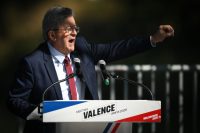
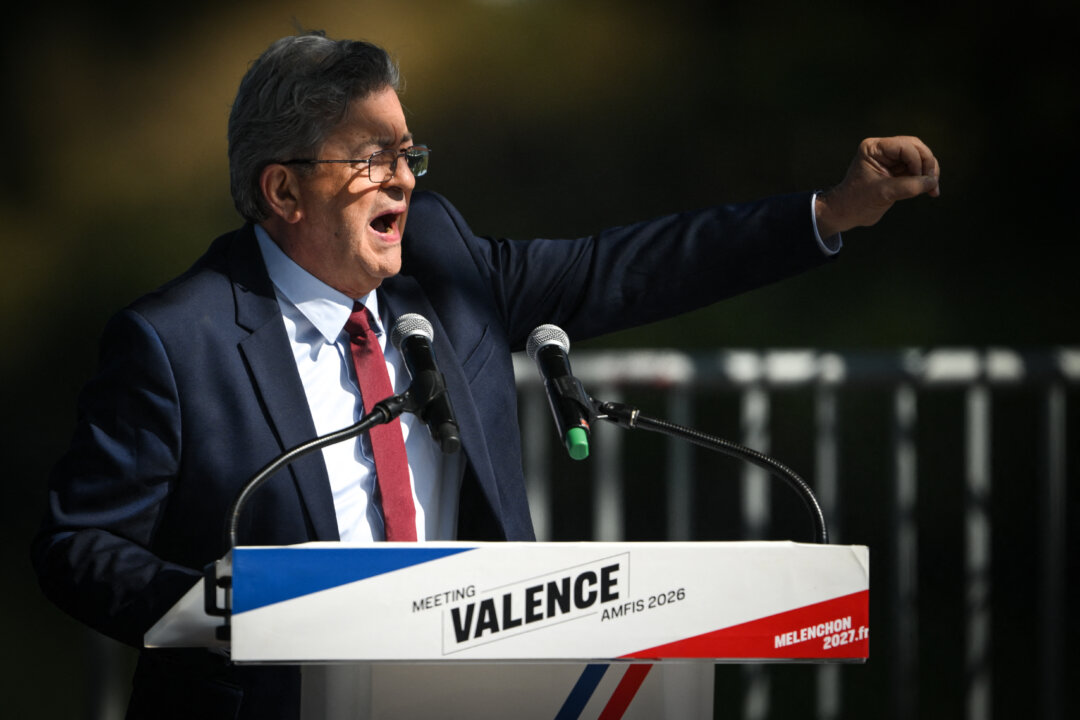
The poll landed as Melenchon closed his movement’s summer conference on Aug. 23 near Valence in southeastern France, before more than 10,000 supporters, according to organizers.
He opened his address by telling the crowd that “victory is possible.”
Citing what he described as a “climate crisis,” he argued that it was “vital to completely change the way we live, produce, and trade.”
He called for the creation of a “green state” and a fight against “the dictatorship of shareholders,” with the stated aim of combining “environmental consciousness and revolutionary consciousness.”
He went on to propose a guard formed through “ecological conscription,” which he said would serve as a mass reserve.
“In the face of profiteering capitalist irresponsibility, we respond at every moment with mutual aid and new disciplines for life in society,” he said, describing the “citizens’ revolution” his movement advocates as “a cultural revolution, a concrete change in society’s reference points.”
Melenchon also used the speech to denounce what he called a “genocide in Gaza,” “Israeli crimes,” “unabashed Islamophobia,” “police violence,” and “Epstein impunity in Paris.”
Charisma, Doctrine and a Divided Left
Arnaud Benedetti, a political scientist and associate professor at Paris-Sorbonne University, told The Epoch Times that Melenchon’s surge rests on the nature of the office, the coherence of his platform, and the disarray of his rivals.
“The presidential election is an election of incarnation,” Benedetti said, using a common French expression for a contest in which voters choose a person more than a program. “Melenchon indisputably has charismatic capital that allows him to stand apart from all his potential competitors on the left.”
He has also managed to establish among young people what Benedetti called “an identifiable doctrine” with “an intellectual coherence.”
The far-left candidate draws his support largely from “an urban, educated but somewhat downwardly mobile youth” and from voters in immigrant neighborhoods, according to Benedetti, who also credited Melenchon’s early entry into the race with giving him a head start over rivals in a divided social-democratic camp.
“He has already been preparing the ground for a broader rallying of the left in the second round,” Benedetti said, while cautioning that the campaign is far from over.
Olivier Vial, who heads the Center for University Studies and Research (CERU) and its program on new forms of radicalism, told The Epoch Times that Melenchon’s ascendancy also reflects an ideological hardening.
“The intellectual leadership on the left in France is now clearly on the side of the far left,” he said, arguing that intersectional theory and decolonial thought have spread throughout society and become entrenched.
The surge is also being carried by outlets that conventional political coverage barely registers, according to Vial.
“We are used to looking only at television and news channels,” he said, adding that the young voters LFI is winning over get far more of their content from social media, YouTube, and alternative outlets than from television.
Melenchon remains, however, the country’s most rejected political figure.
An Odoxa-Mascaret barometer published in June found 69 percent of respondents expressed rejection of him and ranked him 18th for approval, at 16 percent, even as he led all figures on the left among left-leaning sympathizers at 49 percent.
Other polls published in recent months had nonetheless also found that Melenchon could qualify for the second round of the presidential election.
Hostility Toward Washington
Melenchon and his party have advocated a confrontational approach to U.S. foreign policy.
In January 2026, following the capture of Venezuelan dictator Nicolás Maduro by U.S. forces, he declared that “the Venezuelan people must defend themselves and, if necessary, take up arms against the North American invasion.”
At a conference in January, he said he would bet that in the event of a U.S. military intervention in Cuba, the Cuban people would “break the back” of the United States, adding: “I hope so, I wish for it, I want it.”
In May, he said that, had he been French president, he would have sought to form a “front of refusal” with Spain’s Socialist Prime Minister Pedro Sánchez and other left-wing governments in Latin America and Asia to oppose U.S. intervention against the Islamic Republic of Iran, while stressing his own opposition to the Iranian regime.
In June, Melenchon called for a “policy of enhanced cooperation” with the Chinese regime.
His hostility toward Washington has not prevented him from cultivating ties with the American left.
After meeting far-left streamer Hasan Piker in France in May 2025, he described him as “the most interesting American I’ve ever met.” Manon Aubry, one of his party’s leading figures, campaigned on the ground for Zohran Mamdani during his successful bid for mayor of New York, a victory Melenchon hailed as “very good news.”