

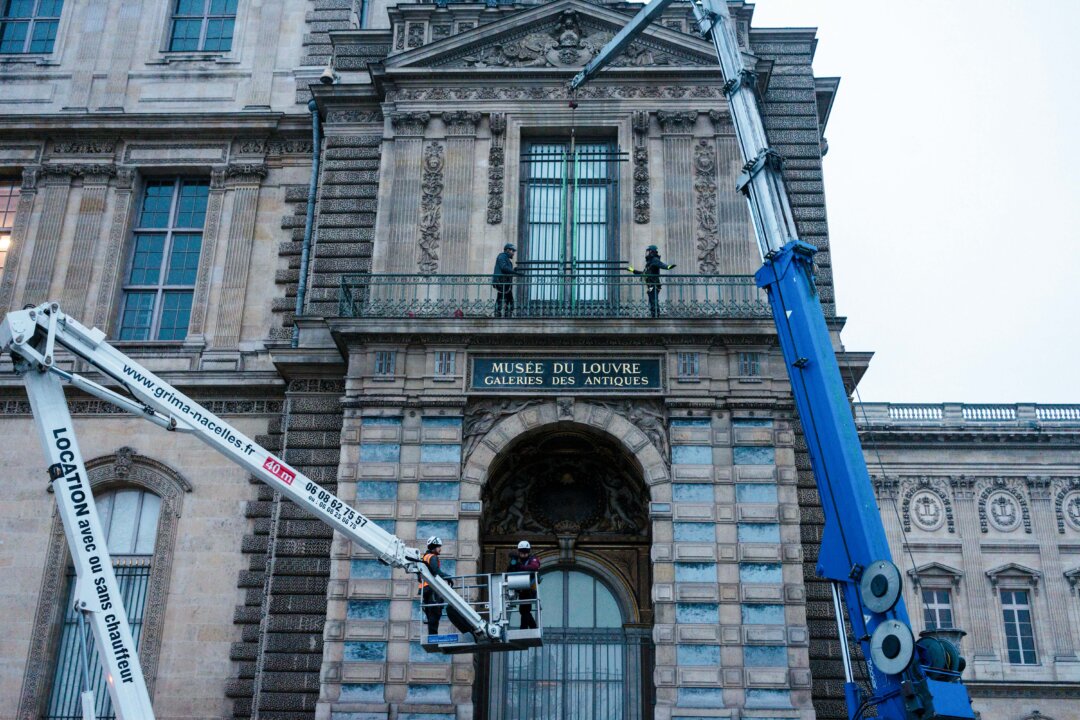
PARIS—Museum thefts across Europe are becoming more violent, and criminals are increasingly focusing on three categories of loot: precious metals, gemstones, and Chinese cultural artifacts, the EU’s law enforcement agency warned in a report published on Aug. 24.
The Europol Spotlight report, “Changing Tactics, Changing Targets: The Evolving Nature of Museum Heists,” notes that museum theft was long regarded as a non-violent crime relying on stealth.
Recent cases tell a different story: Offenders have used sledgehammers, axes, crowbars, and even explosives to breach premises and display cases, and firearms to intimidate guards and visitors.
The agency also sees signs of a new type of perpetrator, recruited through social media on a “crime-as-a-service” basis.
“Another development concerns the targeting of Chinese cultural artefacts,” the report states, listing 12th- and 13th-century porcelain plates, Ming Dynasty jars, and Ming and Qing enameled bronze vases among recent losses.
Such thefts show “deliberate preparation, including prior reconnaissance and planning, rather than indiscriminate looting,” Europol says, adding that ancient Chinese porcelain is “likely targeted by cultural goods traffickers for financial gain” and “likely to be easily sold on the art market.”
‘Structured in Layers’
“One should first bear in mind that illicit art trafficking is ranked by UNESCO as the world’s third-largest criminal trade, behind only drug and arms trafficking,” Luc Larriba, a French journalist and author of “Art Trafficking: An Investigation Inside the OCBC,” a book on France’s police unit for cultural property crime, told The Epoch Times.
The thefts are the work of “real organized crime, structured in layers, exactly like drug or arms trafficking,” he said, adding that “it can start from very high up, from a sponsor, and then unfold across different levels.”
France’s own Chinese artifacts and precious metals have been a target.
On March 1, 2015, burglars broke into the Chinese Museum at the Château de Fontainebleau, southeast of Paris, and were gone within seven minutes, taking some 15 works, including the crown of the King of Siam and a Qianlong-era cloisonné chimera.
The stolen pieces have never been recovered, and the culprits never identified.
A second attempt was thwarted in December 2019, when five Spaniards and a Chinese national were arrested near the palace and handed preliminary charges of criminal conspiracy and organized theft.
A French police officer specializing in such cases told the French media Journal du Dimanche that whoever commissioned the operation could only belong to a Chinese triad, since the pieces were unsellable on the art market and were destined for China.
Investigators also found two photographs on the Chinese national’s phone showing objects stolen in the 2015 heist.
In September 2025, three Chinese porcelain pieces classified as national treasures were stolen from the Adrien Dubouché National Museum in Limoges, in central France. They remain missing.
Less than two weeks later, a lone intruder made off with nearly 6 kilograms (13 pounds) of gold nuggets valued at 1.5 million euros from the National Museum of Natural History in Paris, prosecutor Laure Beccuau said.
A 24-year-old Chinese woman was arrested in Barcelona on Sept. 30 as she tried to dispose of nearly a kilogram of melted-down gold and prepared to return to China. She was charged with organized theft and criminal conspiracy and jailed pending trial.
“Chinese organized crime is obviously active in this field in Europe. It’s an open secret.” Larriba said. Its networks “are extremely discreet, but can be ruthless,” he added.
“The lines between art trafficking and the drug and arms trades are blurred, and trafficking in cultural goods opens up vast opportunities for money laundering.”
Beyond the Triads
André Gattolin, a former French senator and China specialist, sees a larger hand at work. The triads “are often a convenient scapegoat,” he told The Epoch Times, noting what he described as their subordination to the Chinese regime.
“The mafia is powerful, but the Communist Party exercises control over it,” he said. “Even if the state does not necessarily organize these thefts, it makes them possible.”
“The mafia often serves as an auxiliary of the central government, particularly outside China, and is frequently used as an instrument of transnational repression.”