
China is strategically exploiting the trade divide between Canada and the United States to sow division between the two countries with the goal of dividing North America, an expert on Asia and China–U.S. relations says.
The idea is not a new one, Alberta-born professor Stephen R. Nagy says. A Canadian Security Intelligence Service assessment from July 2021 said that China sees Canada as a “high-priority” target for foreign interference.
Now, the analyst is cautioning that Ottawa needs to prepare in the coming weeks for a focused campaign of Chinese “cognitive warfare” meant to exploit national anxieties related to the unsuccessful trade deal.
China’s plan is “straightforward,” Nagy, a professor of politics and international studies at the International Christian University in Tokyo, said in a report for the Macdonald-Laurier Institute, an Ottawa-based think tank.
Any compromise of Canada poses a direct threat to Washington due to the geographic, institutional, and cultural proximity of the two nations, said Nagy.
“If Beijing—America’s primary security challenger—can exert enough influence to misalign Canadian domestic and foreign policy from that of the US, it effectively renders North America vulnerable,” he wrote. “This threat is not theoretical, and the timing is critical.”
Relations between Canada and the United States have reached a state of heightened vulnerability after the failed trade deal, and Beijing is doing everything in its power to keep it that way, Nagy said.
One of Beijing’s main goals is to prevent U.S. President Donald Trump’s push to re-centre global manufacturing, technology, and supply chains in North America, he said—and that means the Canada–United States–Mexico Agreement (CUSMA) is not in the communist regime’s best interests.
Nagy said a deal is in the best interests of both Canada and the United States, however, even if it contains clauses about who member countries can trade with.
“It is entirely logical that the US would seek to prevent Canada from signing free trade agreements with a strategic competitor,” he wrote. “Clauses akin to those in [CUSMA], which grant the US a veto over trade deals with non-market economies, reflect the necessary geoeconomic architecture of the modern era.”
Prime Minister Mark Carney said on Aug. 22 that one of the reasons he walked away from Washington’s proposed trade deal is that the U.S. side wanted to restrict Canada’s international trade agreements.
U.S. Trade Representative Jamieson Greer disputed Carney’s characterization, saying in an interview with CBC News on Aug. 26 that Washington only wanted to prevent issues such as a third country dumping steel in Canada and those products being shipped into the United States if Canada has a preferential tariff rate.

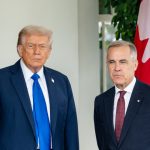
U.S. President Donald Trump speaks with Canadian Prime Minister Mark Carney during a work lunch as part of the G7 summit, in Evian, France, on June 16, 2026.Evelyn Hockstein/POOL/AFP via Getty Images
‘Wedge’ Tactics
Beijing is taking advantage of the ongoing trade stalemate between the two countries to implement “wedge politics,” with the intention of undermining North American unity, Nagy said.
There are generally four types of wedge strategies, he said. Realignment is the process of enticing a target to join an adversary’s side, dealignment seeks to move a target toward a neutral stance, disalignment aims to diminish the unity of an alliance without resulting in its total collapse, and prealignment works to prevent the establishment of a coalition altogether.
“While these concepts may seem academic, they are actively playing out in Canadian policymaking,” Nagy said. “During periods of heightened Canada–US friction, Beijing has adeptly lured Ottawa with the promise of a ‘strategic partnership’—a textbook realignment tactic.”
Carney used the term “strategic partnership” during his visit to Beijing in January, saying it positioned Canada well for the “new world order.” A few days later, at the World Economic Forum in Davos, Switzerland, Carney indirectly criticized Washington’s policies and encouraged “middle powers” to band together against “great powers,” which he appeared to be referring to as the United States and China. Trump criticized Carney over the speech the next day and withdrew his invitation to Carney to join his newly formed Board of Peace.
Nagy added that reluctance from Canada to extend diplomatic or material support for American military endeavours in the Middle East, particularly in the Strait of Hormuz, reflects a clear instance of dealignment and disalignment.
Nagy also pointed to Canada’s delayed response to foreign interference and low defence spending as elements that play into Beijing’s prealignment goals by weakening national security and alienating it from its closest ally.
“By neglecting our military and intelligence capabilities, Ottawa fails to be a credible defence partner, preventing a stronger North American security coalition from materializing,” he wrote.
China’s weapons of choice to execute its “wedge” strategies are disinformation, propaganda, and diaspora-targeted narratives that frame legitimate criticism of the Chinese Communist Party (CCP) as racial discrimination to weaken the Chinese diaspora’s loyalty to Canada, Nagy said.
Other wedge tactics used by the CCP include portraying Beijing as a reliable trading alternative to the United States and preventing Western coordination on tariffs.
One example of this is when Ottawa adopted a strategy similar to that of France in 2024 by imposing tariffs on Chinese electric vehicles and Beijing responded with its own tariffs on Canadian canola and pork, the report author said. Beijing then eased the agricultural pressure when Carney rolled back the EV levy in 2026.

A truck crosses the Gordie Howe International Bridge, connecting Windsor, Ont. and Detroit, Mich., the day after it opened in Windsor, Ont., on July 28, 2026. Carlos Osorio/Reuters
Recommendations
Nagy said Beijing wants Canadians to obsess over cross-border grievances and the “abrasive politics” of the White House, to distract from what Canada’s core strategic interests actually are.
“If we strip away the partisan noise, the structural reality is undeniable,” Nagy said. “Canadians and Americans … live, work, and govern ourselves in fundamentally similar ways. Our policy choices must reflect this reality, and we cannot let foreign interference convince us otherwise.”
Nagy is suggesting that Canada and the United States tone down the rhetoric and focus on settling trade disputes privately to prevent China from using public disagreements for disinformation.
He also recommended Canada pursue trade diversification through “friend-shoring” with Indo-Pacific democracies like Japan and South Korea, rather than turning to China when American protectionism arises.
Other steps he suggests include Canada better funding its military and placing an increased importance on being able to defend its own airspace and Arctic territory to prevent foreign leverage.