
Treasury Says Small Miners Could Struggle to Attract Investors Under Labor’s CGT Changes
 Crystal-Rose JonesUpdated 1 day Ago2 Mins read
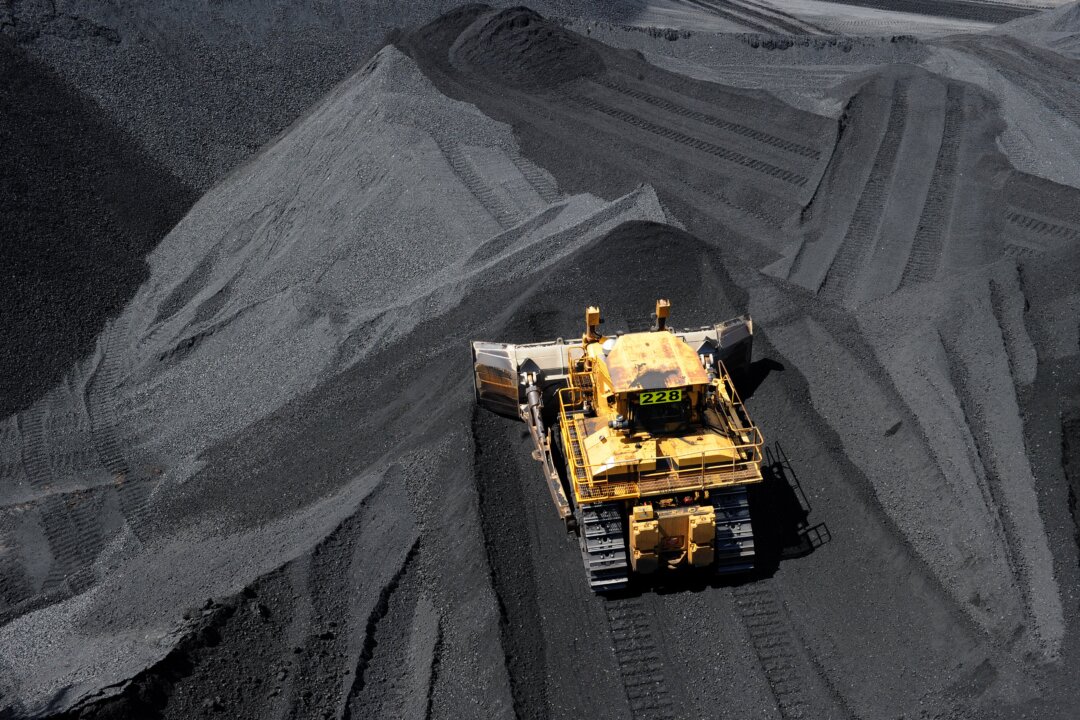

Coal is stockpiled before being loaded on to ships at the RG Tanner Coal Terminal in Gladstone in Queensland, Australia on Jan. 20, 2012. The Terminal plays a vital role in delivering coal supplies to foreign markets. AAP Image/Dave Hunt
Treasury officials acknowledge smaller Australian miners could struggle to attract investment under the federal government’s sweeping changes to capital gains tax (CGT).
Junior mineral exploration companies are typically small, early-stage businesses that set out to discover new mineral deposits prior to mines being established.
The industry is heavily reliant upon investor funding to carry out actions like drilling and geological surveying.
The issue was raised by One Nation Senator Tyron Whitten during the Senate Economics Legislation Committee hearing on Oct. 28, where he questioned how much consultation the government had with the sector before introducing its contentious tax changes.
“The CGT changes came as quite a shock to a lot of investors,” Whitten said.
Susan Bultitude, Acting First Assistant Secretary Corporate and International Tax Division, said the government had consulted with multiple industries, including junior mineral exploration.
“Yes, there are quite a lot of individual investors who, if they’re investing directly, would be impacted by the CGT changes,” she said.
“The sector does also attract some investment from institutional investors.
“So if those are corporate investors, for instance, they’re not impacted by the CGT changes and if they’re superannuation funds —and that includes individuals who may choose to invest in a self-managed super fund—they’re also not impacted by the changes.”
Bultitude also argued the sector could still attract investment through the strength of high commodity prices, with copper and gold attracting “a significant amount” of interest in the sector.
But Whitten said the junior exploration was more likely to attract individual investors.
“I would suggest that a lot of people who invest in junior explorers are pretty well gambling,” he said.
“So, given that … over 60 percent of mineral discoveries were made in recent decades, and given we have a declining manufacturing sector, we’re increasingly relying on our mineral exports.
“If we don’t have investment in our exploration, we’re in danger of declining mineral sector.”
The Labor government will replace the existing 50 percent discount on CGT, which is taxed on the profit from the sale of an asset held for longer than 12 months.
Instead, Labor’s new model involves a flat 30 percent tax on the profit, as well as an extra cost adjusted to inflation. The changes kick in from July 1, 2027.
But advocates for the junior mineral exploration sector say it is caught in the crosshairs of the reforms, relying heavily on capital gains to attract investment.
The Minerals Council of Australia has called for the industry to be exempt from CGT changes—like the tech start-up sector—estimating it could cut investor returns by 19 percent.
The impacts of CGT on the industry also come after the federal government failed to renew its Junior Minerals Exploration Incentive in 2025, an Australian Tax Office scheme that provided tax benefits for investors who put money into the high-risk explorations.
Whitten said junior explorers relied heavily on investors willing to take substantial risks, with capital gains often their only potential financial reward.
“Your only upside potential is capital gains,” he told Treasury officials, questioning whether investors would continue backing the companies under the new arrangements.




Chinese Company to Produce Compact SUV in Bulgaria as Analysts Warn of Possible EU Internal Divide
China’s Great Wall Motor Co. (GWM) will produce its Ora 5 compact...

Man Arrested in Quebec After Fatal BC Hit and Run in 2025 Near Oliver
An RCMP collar tab pin is seen in Edmonton, on Feb. 5,...
ANU Says CCP Seizure of Academics’ Passports a ‘Misunderstanding’
Australian National University (ANU) officials say a 2024 incident where the passports...



BC NDP Caucus Names Whiteside Interim Leader After Sweeping Election Loss
Then-Minister of Mental Health and Addictions Jennifer Whiteside speaks during a news...
