Beijing Targets Soccer Star Mbappe to Distract From Economic Woes: Analyst
 Jarvis LimUpdated 18 hours Ago5 Mins read
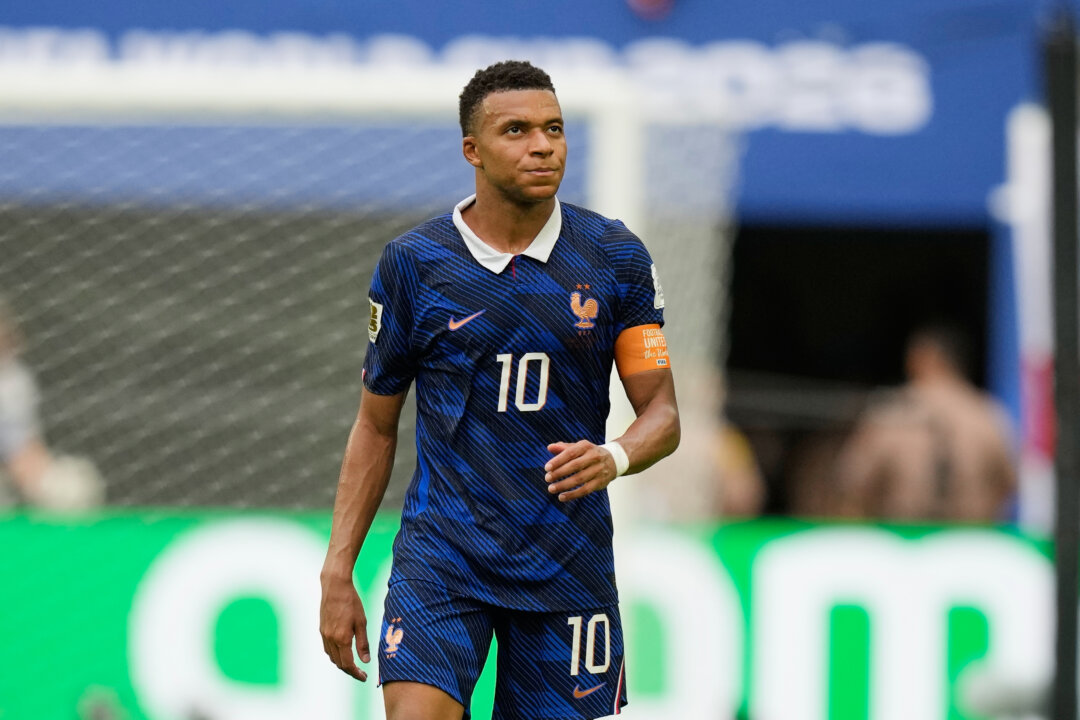
Beijing is turning soccer star Kylian Mbappe into a nationalist target to distract from economic woes and bury words it fears could catch on and threaten its rule, analysts say.
Javier Tebas, president of Spain’s top professional soccer league La Liga, said on X on Oct. 28 that he has met with Chinese Ambassador Yao Jing to find solutions to the controversy surrounding Real Madrid’s French forward.
The uproar
began
after a video resurfaced online on Oct. 26 in which Mbappe, describing an online meme that puts his face on an image of late Chinese communist leader Mao Zedong, called the figure “a Chinese dictator,” prompting China’s state-run broadcaster China Central Television (CCTV) to stop airing all La Liga matches and Chinese brands to drop him.
Guo Jiakun, a spokesperson for China’s Foreign Ministry, claimed at a regular press briefing on Oct. 27 that any rhetoric or action that “hurts the feelings of the Chinese people will naturally be rejected across the sectors in China.”
Tseng Chien-yuan, an adjunct associate professor at Taiwan’s National Central University, said the Chinese Communist Party (CCP) is “using nationalism, or patriotism, to divert attention from China’s economic and social problems and stir up tension with the outside world.”
Tseng said the aim is to force the public to back the regime, a “well-worn political trick” in the Party’s playbook.
“It pulls people’s focus away from the real problems they face and toward national pride,” he told The Epoch Times.
China’s urban jobless rate for people aged 16 to 24, excluding students, stood at 18 percent in September, up from 17.7 percent a year earlier, according to data the country’s National Bureau of Statistics released on Oct. 21.
The bureau also reported on Oct. 19 that China’s economy grew 4.5 percent year on year in the third quarter, up from 4.3 percent in the second. In the first three quarters, fixed-asset investment fell 7.2 percent, real estate investment
plunged
20.6 percent, and retail sales rose just 1.1 percent in September.
Tseng said many Chinese people likely “have no idea what happened,” because their priority is simply getting by, yet Beijing is passing off the Party’s own grievance as theirs.
Under a Chinese social media post condemning Mbappe, one user complained that despite all the criticism, no one had made clear what he said.
Another replied, “Because what he said is the truth.”
A third wrote, “All I can think about is that I’m nearly starving to death, so people can say whatever they want,” according to a screenshot from an Oct. 30 article in The Epoch Times’ Chinese-language edition.
Frank Tian Xie, the John M. Olin Palmetto chair professor of Business and Marketing at the University of South Carolina–Aiken and an expert on China’s business landscape, said the regime’s response reveals how deeply it fears dissenting voices.
“Mbappe has a huge following in China. If his remark became widely known or accepted, it would pose a grave threat to the Party’s grip on power,” Xie told The Epoch Times.
Mbappe apologized in an Oct. 27 post on X, writing in French, Chinese and English that his comment was “ill-judged” and that he now understood it had hurt many people in China and in Chinese communities around the world.
Remaking Mao
Mao seized power with the Chinese communist regime in 1949 and ruled it until he died in 1976. Historians estimate that the Cultural Revolution, a bloody decade-long political
movement
Mao launched in 1966, caused at least 2 million deaths.
Yet Bilibili, a Chinese social platform whose users average around 26 years old, has long been awash with posts glorifying Mao.
Such praise may partly reflect China’s heavy online
censorship
, but Tzeng Wei-feng, an associate research fellow at the Institute of International Relations at Taiwan’s National Chengchi University, said changes in how Beijing’s propaganda portrays Mao also play a role.
“In the 1980s, under then-leader Deng Xiaoping, the official line stopped putting Mao on a pedestal. The Party even admitted he made mistakes,” Tzeng told The Epoch Times.
“But under Chinese leader Xi Jinping, Mao’s image has been remade, so it’s no surprise young people back him to some degree.”

A Chinese performer dresses in the Communist revolutionary “Red” guard uniform, points a mock gun at a statue of a prisoner wearing a placard which says, “Beat down the landlord group,” at a theme village depicting a “Cultural Revolution” rehabilitation camp, in Yinchuan, northwest China’s Ningxia region on Oct. 24, 2009. AFP/AFP via Getty Images
Where Deng judged Mao “70 percent right and 30 percent wrong,” Xi, who took power in 2012, has defended the Mao era. In January 2013, he said the decades of rapid growth after Mao’s death must not be used to discredit that era, and vice versa.
Xie said Mao’s appeal in China stems entirely from CCP “propaganda and brainwashing” and is bound up with the country’s economic malaise.
“Chinese people, especially those 65 and older, wrongly believe that under Mao, everyone was equally poor and officials were at least cleaner than they are now,” Xie told The Epoch Times.
“With growth this weak, many miss Mao’s call to strike down the landlords, and today’s landlords are the Party’s elite.”
Weighing the Cost
Two Chinese companies, drinks maker Dongpeng Beverage and dairy giant Mengniu Dairy, ended their partnerships with Mbappe on Oct. 27. The deals were worth about 50 million yuan ($7.5 million) combined, according to French newspaper Le Monde.
Mbappe is not the first to face such a backlash in China.
In October 2019, then-Houston Rockets general manager Daryl Morey tweeted support for Hong Kong’s pro-democracy protests. Chinese sponsors
cut
ties with the Rockets over the post, and CCTV responded by suspending NBA broadcasts for a year.
In October 2021, then-Boston Celtics player Enes Kanter, who now goes by Enes Kanter Freedom,
called
Xi a “brutal dictator” for the regime’s repression in Tibet. By the next day, Tencent, the NBA’s broadcast partner in China, had wiped all Celtics games from its platform.

Enes Kanter Freedom, human rights advocate and former NBA basketball player, speaks during the annual rally calling for the end of the Chinese Communist Party’s ongoing persecution of Falun Gong in China, at the Lincoln Memorial in Washington on July 23, 2026. Madalina Kilroy/The Epoch Times
However, Tzeng Wei-feng said Beijing’s political red lines may not deter international businesses.
“Profit comes first. If they can steer clear of Chinese politics, they will,” he said.
“Mbappe’s endorsement fees show how much money there is to be made in China. No business would give that up.”
Offering a contrasting view, Tseng Chien-yuan said that after the Mbappe case, international businesses will weigh whether appeasing Beijing by compromising their core values could cost them in other ways.
“If companies abandon their conscience and principles for the sake of the Chinese market, consumers may boycott them,” he said.
“For example, any company that still backs Xinjiang cotton today risks being seen as an accomplice in the CCP’s abuses against the Uyghurs.”
The U.S. government and human rights groups have repeatedly
accused
the Chinese regime of detaining more than 1 million Uyghurs and other minorities in “re-education camps” in China’s northwestern Xinjiang region and forcing them into labor, including in the cotton industry.
In November 2024, German automaker Volkswagen said it would
sell
its Xinjiang operations after years of investor pressure over human rights concerns, though the company cited economic reasons.
Tseng said multinationals now believe they can recoup sales lost to Beijing’s political red lines, for instance by passing on costs, but cannot bend on what they stand for.
“Once a company’s overall image is damaged, it becomes part of the public’s collective memory,” he said.
“Trading reputation for the Chinese market is a bad bargain. Sooner or later, companies will pull out.”


Chinese Cities Tighten Halloween Security as Young People Satirize Social Issues
The Chinese regime stepped up security in the cities of Beijing, Shanghai,...
China’s Military, Universities, and Tech Giants Tighten Belts Amid Economic Strains
China’s economic slowdown is prompting the military, universities, and major technology companies...
Taiwan Accuses China of Cognitive Warfare Amid Coast Guard Incursions, Military Activity
Taiwan has accused Beijing of waging cognitive warfare by asserting maritime jurisdiction...
Defence Flags Possible Exemptions From Impending AI Rules
Australia’s Department of Defence says it may need exemptions from the federal...