Fate of Chinese Police Presence in Solomon Islands Unclear After Security Pact With Australia
 Arthur ZhangUpdated 25 minutes Ago2 Mins read
The Solomon Islands has agreed to prohibit foreign-controlled military and security bases under a newly signed treaty with Australia, without disclosing the future of its existing policing arrangements with Beijing, which have brought successive deployments of Chinese police officers to the Pacific island nation.
Australian Prime Minister Anthony Albanese and Solomon Islands Prime Minister Matthew Wale signed the treaty in Canberra on Nov. 25, establishing Australia as the island nation’s primary security partner.
Under the agreement, the Solomon Islands commits to protecting sensitive infrastructure, including ports, airports, energy facilities, and telecommunications networks, against militarization, foreign interference, and unauthorized access.
The agreement leaves room for security cooperation with countries outside the Pacific Islands Forum, a regional organization that does not include China, when its members cannot meet particular security needs. Such cooperation is subject to prior consultation with Australia.
Asked about his country’s existing agreements with Beijing, Wale cited confidentiality restrictions.
“Unfortunately, there is a non-disclosure clause in the treaty with China, the Security Pact and the policing agreement,” Wale said at a joint press conference, adding that discussions with Beijing were continuing.
The Wale government intends to introduce legislation implementing the Australian treaty, which has yet to enter into force, in January or February 2027.
Wale announced a review of the Chinese security agreement in June after taking office.
Beijing has not publicly confirmed whether the agreement will be terminated. Asked about its status on Nov. 25, Chinese Foreign Ministry spokesperson Guo Jiakun reiterated Beijing’s position that cooperation with Pacific island countries should not target third parties, without directly answering the question.
The Epoch Times sought clarification from the governments of Australia, the Solomon Islands, and China but received no responses by publication time.
The Solomon Islands, an archipelago northeast of Australia, has been a focus of U.S. security concerns since it signed a security agreement with Beijing in April 2022. The State Department warned at the time that Washington would respond to any steps toward establishing a permanent Chinese military presence or military facilities on the islands.
China’s Police Presence
China’s security cooperation with the Solomon Islands has extended from maritime policing to the protection of senior government officials.
On Jan. 13, China handed over two speedboats to the Royal Solomon Islands Police Force (RSIPF) to strengthen its maritime policing capabilities.
In July, 30 local officers responsible for protecting senior officials completed specialized training jointly delivered by the China Police Liaison Team in Honiara, the country’s capital.
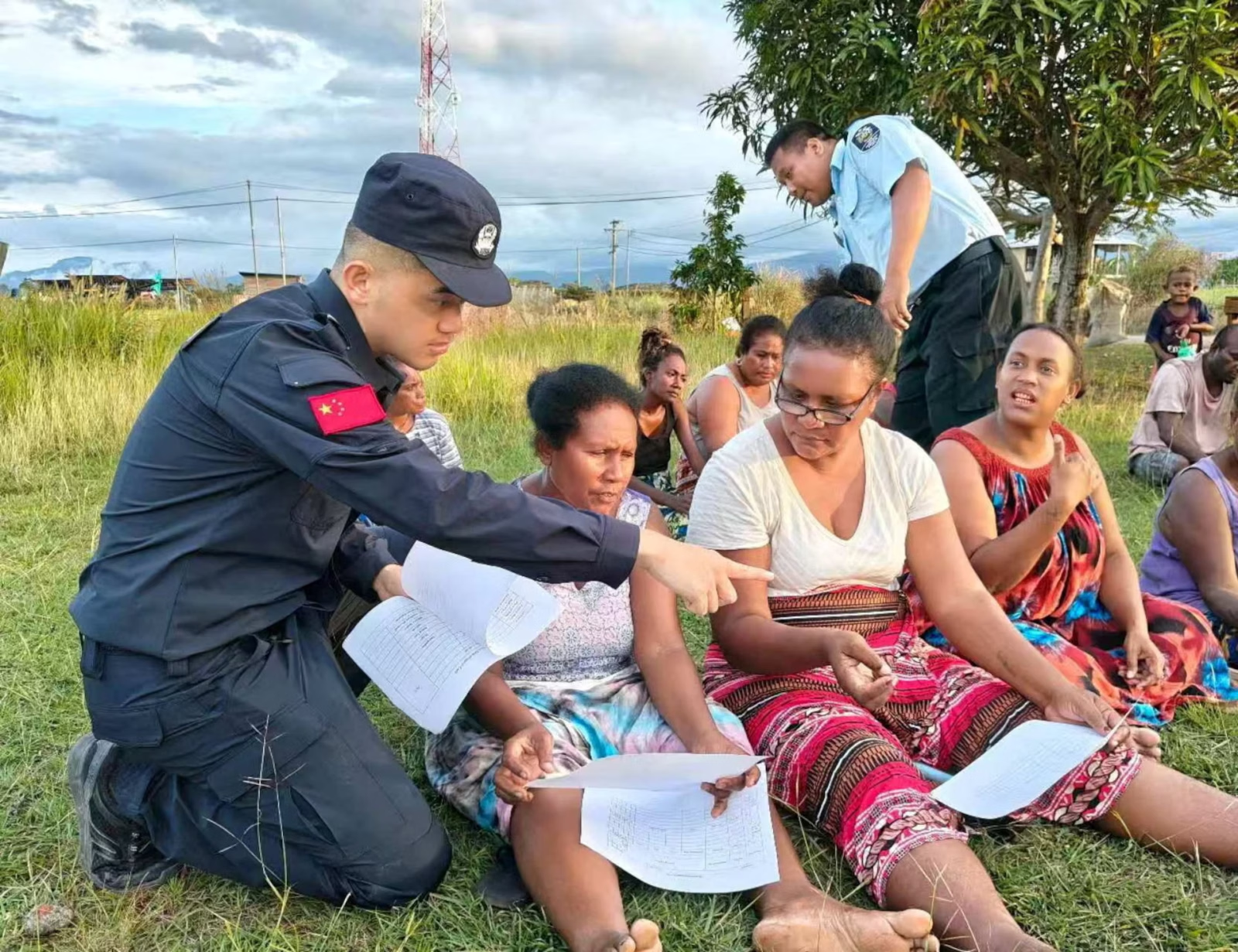
Four Chinese officers completed six-month deployments in August, during which they participated in criminal investigations, tactical training, and community outreach, according to the RSIPF.
Five days before the Australian treaty was signed, the Chinese Embassy hosted a meeting involving Ambassador Cai Weiming, Solomon Islands’ acting police commissioner, local law enforcement representatives, members of the Chinese community, and Chinese businesses. Participants discussed public security, work permits, and the business environment.
The current number of Chinese police officers deployed in the Solomon Islands remains unclear.
Exporting the CCP’s Policing Model
Chinese police have also introduced methods of population monitoring used by the Chinese Communist Party (CCP).
In September 2025, Solomon Islands police announced the launch of a pilot project in the Fighter One community in Honiara, where Chinese officers provided instruction on household registration, population data collection, community mapping, fingerprinting, and palm printing.
As The Epoch Times previously reported, the policing model, known as the Fengqiao experience, originated during Mao Zedong’s rule, when residents were mobilized against so-called class enemies. It has since been revived under Chinese leader Xi Jinping.
When the project was launched in September 2025, Chinese police inspector Lin Jiamu described Fighter One as the first trial of a program intended to expand across the Solomon Islands.




China Tests Floating Bridge Made of Civilian Ships in Military Landing Drills
Chinese militia ships are seen as Philippine ships conduct a resupply mission...

Italy Chastises Ukraine for Strike on Russian Warship at Libyan Naval Base
Italian Prime Minister Giorgia Meloni reprimanded Ukraine over its destruction of a...

CRTC Orders Bell, Rogers, and Telus to Stop Charging Prohibited Cellphone Fees
Canada’s telecommunications regulator has ordered the country’s three largest wireless service providers...

Sylvain Charlebois: Ottawa Must Come Clean on Chinese Dairy Subsidies
Dairy cows rest at a farm in Eastern Ontario, in a file...