Beijing Bets on Proxies to Subvert Taiwanese Democracy: Analysts
 Jarvis LimUpdated 20 hours Ago3 Mins read
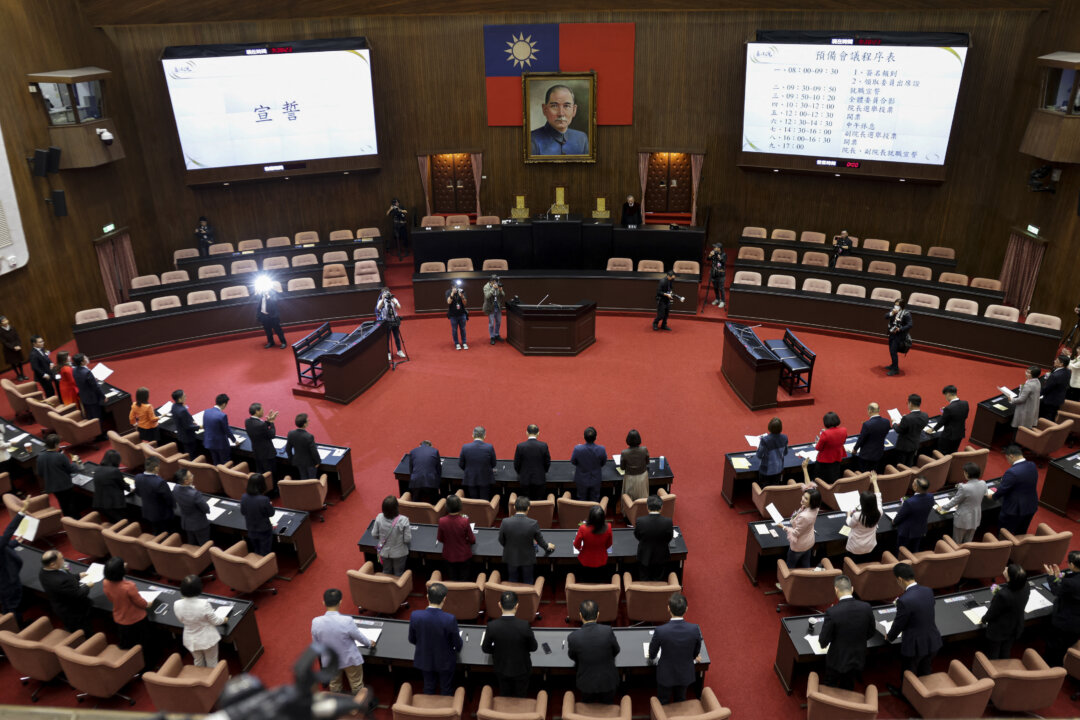
The Chinese regime is exploiting the run-up to Taiwan’s local polls to plant agents and undermine the island’s democracy, analysts warn.
The concerns come ahead of Taiwan’s Nov. 28
elections
for posts from mayor to village chief.
Taiwan’s ruling Democratic Progressive Party (DPP) said in a Nov. 8 Facebook post that Beijing’s hidden hand may be reaching deep into Taiwan’s grassroots to sway its elections and policymaking. The DPP listed the Chinese regime’s four main tactics, from hospitality and cash that buy connections to spending that warps public perception.
“Beijing’s meddling has shifted from insisting its favored candidates must win to cultivating homegrown collaborators of its own choosing,” Arthur Zhin-sheng Wang, secretary general of the Asia-Pacific Elite Interchange Association, told The Epoch Times.
Wang said Beijing won’t pass up even the indirect sway that local contests offer.
He said building a network of proxies on the island echoes the “patriots governing Taiwan” concept—a slogan floated in October 2025 under which only Chinese Communist Party (CCP) loyalists would run Taiwan if Beijing ever took control.
“China’s calculation is that if it ever manages to ‘unify’ Taiwan, the forces it has nurtured there can step in and take charge,” he said.
“That turns these elections into a dress rehearsal for the CCP.”
Taiwan is a self-governed democracy that the Chinese regime has never controlled but has vowed to
annex
by force.
Yeh Yao-yuan, professor of international studies at the University of St. Thomas in Houston, said Beijing’s meddling also aims to divide Taiwanese society.
“The CCP wants people [in Taiwan] to lose faith in democracy,” Yeh told The Epoch Times.
“Every operation adds to its playbook, and the point is to pit Taiwanese against one another.”
Chinese leader Xi Jinping said at a Nov. 12 gathering in Beijing that “resolving the Taiwan question” is a historic mission for the CCP, according to China’s state-run Xinhua News Agency.
Legal Blind Spots
Wang said Taiwan has trouble proving Chinese meddling because it lacks laws like the ones the United States has on
foreign agents
and overseas funding.
“China’s transnational repression is a case in point. Those who help carry it out can only be charged with lesser offenses because no statute specifically targets them,” he said.
Taiwanese comedian Huang Yi-hao, who lampoons Xi on stage, was injured in a car crash in September. Local prosecutors
alleged
in an Oct. 21 indictment that five men set it up at a Chinese national’s behest in a scheme aiming to disable Huang and stop him from performing.
A day later, Taiwan’s Mainland Affairs Council, a government agency that handles cross-strait affairs, acknowledged that current laws don’t address the CCP’s involvement in
transnational repression
and said it would propose amendments soon, according to Taiwan’s national broadcaster Radio Taiwan International.
Wang said Taiwan’s Anti-Infiltration Act—which bars anyone directed or funded by hostile foreign forces such as Beijing from making political donations, lobbying, or campaigning—is too narrow and may leave an enforcement loophole.
“Between elections, the act doesn’t cover much of the paid work people do for the CCP,” he said.
Yeh said the lack of rules to counter Beijing’s disinformation could leave some Taiwanese wrongly convinced that their democracy is “a mess of partisan infighting.”
“This kind of cognitive warfare is hard to guard against. The proposed Digital Intermediary Services Act was meant to tackle exactly this, but the bill was shelved,” he said.
“For now, the only way to limit the damage is to build media literacy and have the government and civic groups fact-check false claims.”
Taiwan’s National Communications Commission unveiled the digital intermediary draft in June 2022 to hold large online platforms accountable for illegal content but suspended it that August after critics warned it could curb free speech.
Stealthier Tactics
Taiwanese prosecutors on Nov. 6 indicted legislator Kao Chin Su-mei on charges of taking money from the Chinese regime to build a network in Taiwan and following its orders to sway the legislature. They sought a 14-year prison term under the National Security Act and other laws.
Yeh said a single prosecution won’t stop Beijing from meddling in Taiwan.
“Beijing moves cash into Taiwan through paid go-betweens to extend its reach and wage cognitive warfare,” he said.
“It’s a trick that never gets old, because big money always finds takers.”
Wang agreed but said the regime could turn to stealthier ways of interfering in Taiwan’s elections and democracy.

Supporters of Taiwan’s President Tsai Ing-wen from the ruling Democratic Progressive Party (DPP) display a placard during a rally in Taipei on Jan. 10, 2020, ahead of the Jan. 11 presidential and parliamentary elections. Sam Yeh/AFP
“Buying off lawmakers has become too blatant. The next step could be using underground betting rings to buy votes,” he said.
Taiwan bans gambling on political races, but illegal bookmakers thrive during campaign season. Taiwan’s Ministry of Justice said such operators manipulate odds to sway public opinion and skew results.
Wang said Beijing could also
enlist
Chinese spouses in Taiwan, buy temple endorsements with donations, or route contributions to Taiwanese businesspeople through third-party companies abroad.
“Taiwan’s rules on disclosing foreign money may not go far enough, and that gives China an opening,” he said.
“Unless the law is thoroughly tightened, this will remain a key vulnerability for Taiwan.”





Former Hubei Party Chief Wang Zhonglin Under Investigation, Family Members Also Probed
Former Hubei Province Party chief Wang Zhonglin is under investigation for suspected...

Is Autumn Glow the Next Winx? Inside the Making of a Racing Superstar
Autumn Glow now has six Group 1 victories—and she is fast becoming...
Womens’ Rights Advocate to Run for One Nation in NSW
Former Liberal candidate for Warringah Katherine Deves waits for Prime Minister Scott...

MP Marks ‘Positive Moment’ in Recovery Following Car Ramming Attack Outside Office
Australian independent Member of Parliament Helen Haines speaks to journalists in the...