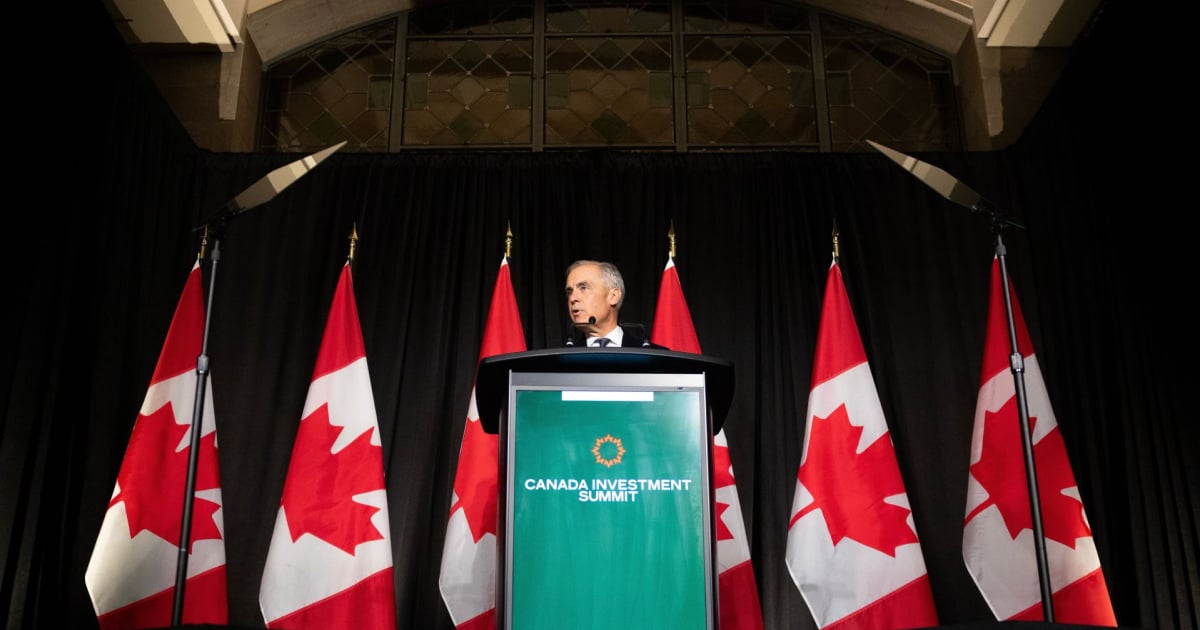
Global investors and executives got a closer look at more than 160 projects at Canada’s first investment summit on Tuesday, as Ottawa seeks to lure $1 trillion in funding over five years.
Prime Minister Mark Carney’s pitchbook spans mining, LNG, pipelines, wind power, advanced manufacturing, ports, rail – and Canada’s first commercial spaceport.
Here are project highlights:
Clean Energy
Nova Scotia’s Wind West tops a list of 31 clean energy projects spanning solar and wind power, battery storage, e-fuels, hydrogen and, curiously, natural gas.

The US$44 billion offshore wind megaproject could supply more than a quarter of Canada’s total power demand once built. Nova Scotia expects to open bidding for offshore wind leases before the end of 2026, with seven developers already competing publicly.
Nova Scotia, the country’s most active market for clean energy deals, is home to nearly a third of the clean energy projects in the pitchbook. They include a tidal power project, a closed-loop energy storage system in a former gold mine, a battery storage facility, and a renewable energy park.
Several bioenergy projects aim to turn forest, farm and organic resources into e-fuels, including a sustainable aviation fuel project in Vegreville, Alta.
A handful of hydrogen projects are billed as a “major growth opportunity,” despite a wave of global cancellations or delays due to high costs and weak demand. Soaring oil prices from the US-Iran war, though, may be reviving interest in clean hydrogen.
Other projects raised eyebrows. Capital Power is expanding its natural-gas fuelled Genesee Energy Campus near Edmonton to serve heavy industrial users and data centres, including Meta’s new AI facility.
“The Genesee Energy Campus expansion, 1800MW of new unabated fossil gas electricity generation is listed under Clean Energy?” Adam Scott, Executive Director of the environmental group Shift, asked in a LinkedIn post, also questioning the viability of e-fuel, green hydrogen and ammonia technologies.
Conventional Energy
LNG export facilities, a cross-Canada gas pipeline, and the new Alberta-BC oil pipeline are among the 11 conventional energy projects on the list.
The US$28.5 billion Ksi Lisims LNG terminal and pipeline is billed as “one of the world’s lowest-emission” LNG export facilities, powered by hydroelectricity and future electrification. Still, the project has faced financial and climate warnings.
Investors in Toronto should take a hard look at the global gas market when evaluating the LNG projects pitched at the summit, the Institute for Energy Economics and Financial Analysis (IEEFA) said last week.
“Without a clear-eyed look at underlying market dynamics, Canada and institutional capital risk walking into a classic market ‘bull trap’ — mistaking brief or transient market conditions for lasting, structural shifts in long-term fundamentals,” IEEFA senior analyst Mark Kalegha said.
Metals and Minerals
There are 63 projects in the mining category, including critical minerals Ottawa says the world needs for clean technologies, electronics and defence.

Carney has rolled out multi-billion-dollar funds and strategies over the past year to boost mineral development and open new markets. But Canada is playing catch-up in the global critical minerals race, experts say, with large-scale industrial projects not expected until the early 2030s.
The projects span Canada’s 34 critical minerals. Strange Lake, Ashram, Nechalacho and Wicheeda are early stage deposits of rare earth elements used in virtually all modern technology.
Battery materials are well represented, from lithium to cobalt and graphite, alongside copper and nickel. The latter includes a US$2 billion Crawford nickel, cobalt and chromium mine in Ontario, new copper projects, and an expansion of Manitoba’s Thompson nickel mine.
Other entries include a 100-per-cent First Nation-owned nickel and magnesium project in Manitoba, a prairie initiative to develop high-purity silica for solar, battery and semiconductor uses, and a Yukon tungsten mine backed by the US Defense Dept.
The pitchbook also tries to address a processing gap that industry experts have highlighted for years.
Saskatchewan’s rare earths processing facility proposes a US$170 million Canadian-controlled minerals-to-magnets supply chain, producing permanent magnets for defence, cleantech and EVs in a market currently dominated by Chinese firms.
In Quebec, the US$267 million Bécancour Battery Material Plant would convert locally produced graphite into battery-grade active anode material for lithium-ion batteries.
Power and Utilities
Canada’s electricity demand could double by 2050 as transportation, buildings and industry electrify and power-hungry AI data centres come online.
Nuclear power is at the core of Ottawa’s plans to deliver affordable electricity and reach net-zero emissions by 2050. But battery, solar and wind costs have also fallen far enough to challenge fossil fuels on price and performance.
Adding more power means doubling Canada’s grid capacity by 2050, replacing outdated utility rate-basing models and streamlining multi-agency reviews with single-permit approvals, industry experts say.
Two nuclear power stations are among the 11 projects in this category.
Bruce C would add up to 4,800MW of electricity generation capacity at the existing Bruce Power site, which operates eight reactors. Wesleyville, a 10,000MW large-scale nuclear generating station, has fuelled pushback in nearby Port Hope.
Energy experts and environmental advocates cite long timelines, high costs, environmental impacts and the financial risk of large nuclear projects, arguing in favour of lower-cost alternatives such as wind, solar and battery storage.
Also on the list: Novatron Energy’s US$36 billion, 10GW onshore and offshore wind project with two high voltage transmission corridors linking Atlantic Canada to Quebec and US markets.

The $2.5 billion Labrador West Transmission Expansion Project is part of a $70 billion clean energy pact between Newfoundland and Labrador and Quebec that could pave the way for an industrial rush in the Labrador Trough. The transmission line and terminal station will connect Churchill Falls, NL to Labrador West, enabling increased production of high-purity iron ore and critical minerals.
Advanced Manufacturing
These 19 projects include life sciences technology, mass timber construction, and PowerCo’s US$5 billion battery plant in Ontario due to open in 2027 despite troubles at parent company Volkswagen.
Defence and Aerospace are also priorities. Project Arrow Defence is a tie up between South Korea’s Hanwa and the Auto Parts Manufacturers Association (APMA) to build military armoured vehicles in Canada.
In aerospace, a $250 million spaceport in Nova Scotia will be Canada’s first commercial facility enabling small and medium launch vehicles to place satellites into low Earth orbit.
The project has contracts with Canada’s Department of Defence and Germany’s Isar Aerospace, which is aiming for first orbital launches from Nova Scotia in 2028.
“Access to space is critical infrastructure for any sovereign nation,” Alexandre Dalloneau, Isar’s Vice President Mission and Launch Operations, said on Monday.