

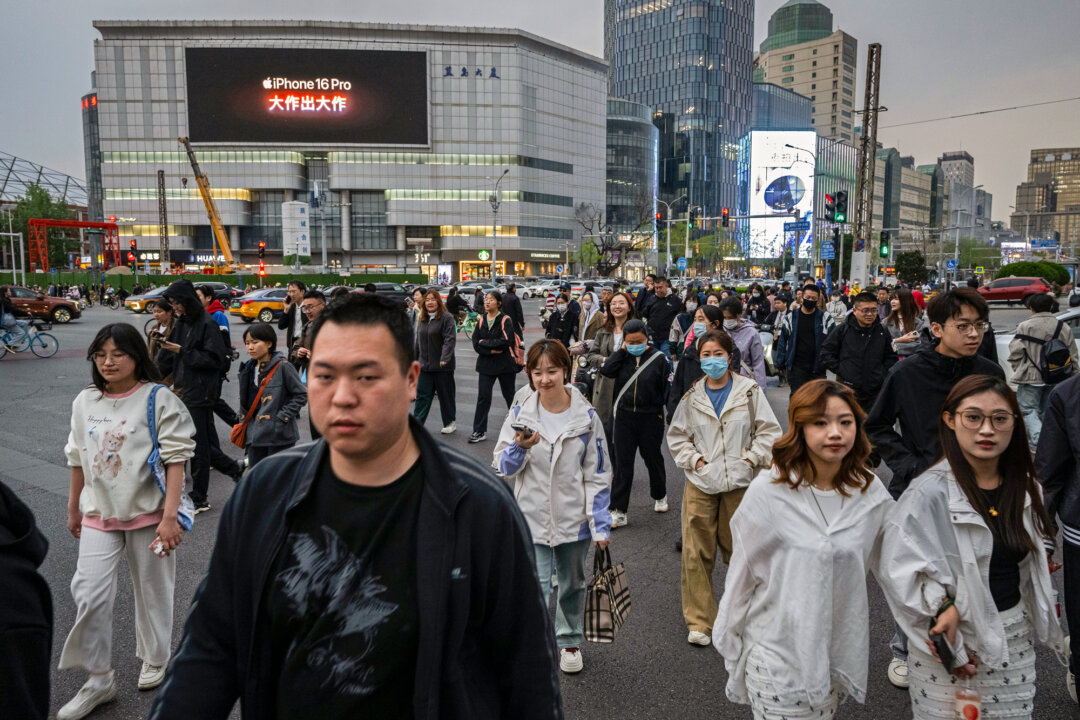

The COVID-19 outbreak in mainland China rose from a low level to a medium prevalence level in the week of July 13–19, according to the latest data released by Chinese health authorities.
The highest number of infections occurred among the 15–59 age group, rather than among children and the elderly, according to the data, while the south has seen significantly higher positive rates than the north, which deserves special attention, experts told The Epoch Times.
According to the data on nationwide sentinel surveillance for acute respiratory infectious diseases released by the Chinese Center for Disease Control and Prevention (China CDC), during the 29th week of the year (July 13–19), among the top three pathogens detected in respiratory samples from patients with influenza-like illness at sentinel hospitals nationwide, SARS-CoV-2 overtook the influenza virus to claim the top spot.
The test positivity rate for SARS-CoV-2 stood at 16.3 percent, an increase of 4.3 percentage points from the previous week, while the positivity rate for influenza was 12.6 percent, a decrease of 0.9 percentage points. China CDC also advised the public to wear masks and take medicine as soon as possible.
Earlier, for the 28th week of 2026 (July 6–12), the COVID-19 epidemic in China was “generally at a low level of prevalence,” according to the China CDC, despite 79,000 cases of infection being reported in June and the number continuing to rise in July.
Peng Jie, deputy director of the Department of Infectious Diseases at Nanfang Hospital, Southern Medical University, told Chinese media outlet Sina on July 25 that recent trends indicate a significant lengthening of the COVID-19 epidemic cycle. It is likely that the epidemic will see “uninterrupted cases and persistent sporadic outbreaks” in the whole year of 2026. He also called on the public not to panic regarding the epidemic rising to a medium prevalence level.
The new official data show that mainland China is entering a distinct summer surge of COVID-19, Xiaoxu Sean Lin, former U.S. Army microbiologist and associate professor of biomedical science at Fei Tian College Northern Campus, told The Epoch Times.
“The fact that officials only raised the level from ‘low prevalence’ to ‘medium prevalence level’ in Week 29 typically implies that actual community transmission had already begun to expand at an earlier stage,” he said.
The official wording itself has already revealed the pressure from the scale of epidemic, Lin said.
“In Week 29, China CDC acknowledged a ‘recent upward trend’ nationwide, a ‘medium prevalence level,’ rates in the south that were ‘significantly higher than in the north,’ and the highest incidence among the 15–59 age group; it also recommended wearing masks in crowded places, on public transport, and when seeking medical care,” he said.
He said the language appeared to describe a situation that is “more serious than the ‘sporadic outbreak.’”
Lin also noted that the rate of increase is significant, as shown in the official data.
“Among outpatient and emergency cases presenting with influenza-like illness, the COVID-19 positivity rate rose from 11.9 percent to 16.3 percent in a single week—an increase of 4.3 percentage points—while the influenza positivity rate fell from 13.7 percent to 12.6 percent,” he said.
“This is not simply a situation of ‘all respiratory pathogens rising simultaneously’; rather, it reflects a marked increase in the relative proportion of COVID-19 cases among respiratory illnesses, indicating that community transmission is expanding.”
Lin also pointed out that the official data looks strictly at hospital samples, “but it doesn’t tell you directly how many people are infected across the country.”
“Nowadays, many people are not tested for mild cases, do not go to the hospital, and do not report self-test results, so the true number of infections must be far higher than the number that this sentinel sample can reflect,” he said.
Dr. Feng, a medical doctor working within China’s disease control and prevention sector who only gave his last name out of fear of reprisal, told The Epoch Times that the surge of COVID-19 infections in China is not caused by the waning of herd immunity, as “herd immunity only lasts for a few months.”
Feng said of the summer surge earlier that the Chinese population has had multiple cumulative infections, and they’ve reached a critical tipping point.
“The outbreak in China hasn’t yet reached the deadly pandemic level as in 2022 is simply because the Omicron variants that are circulating now are not very deadly and a more deadly strain hasn’t emerged yet,” Feng said.

Patients on beds set up in the atrium area of a busy hospital in Shanghai, China, on Jan. 13, 2023. Kevin Frayer/Getty Images
More Cases in the South
Last summer, there was a disparity between the North and the South regarding COVID case numbers in China; however, this year, that gap appears to have widened significantly, according to the official data, Taiwanese infectious disease specialist Cheng Yuan-yu told The Epoch Times.
The reasons for this warrant further analysis—for instance, whether the economic gap between the North and the South has expanded is a factor, he said.
The reason the outbreak might be more severe in hot regions could be the following sequence, Cheng said: “High outdoor temperatures drive people flocking to air-conditioned environments, which leads to spending extended periods in enclosed indoor spaces and has increased risk of indoor airborne transmission.”
“This actually aligns with the data that the highest test-positive rates in China were found among the 15–59 age group; this demographic fits the pattern of transmission described above,” Cheng said.
Regarding the 15–59 age group becoming the main group of being infected in the official report, Lin said it’s the result of multiple reasons, “such as people going to work while sick, the confined environments of commuting, waning immunity, biases in testing and health care-seeking behavior, and differences in pathogen profiles and health care pathways between this group and children and the elderly.”

Pedestrians wear face masks, in this file photo. Anthony Wallace/AFP via Getty Images
Floods in the South
There is a popular saying in traditional Chinese belief: “A major epidemic follows a major disaster.”
This summer, several provinces in southern China have experienced major floods, including a reservoir collapse, causing many villages to be submerged and numerous deaths. The ruling Chinese Communist Party (CCP) reported dozens of deaths from the floods. However, based on the accounts of local residents who have posted videos and images on social media, the real death toll could be much higher.

A view of submerged buildings and roads after heavy rain caused flooding in Rongan in China’s southern Guangxi region, on June 9, 2019. STR/AFP/file/Getty Images
Cheng said that based on the official death toll, although there have been floods in the south, the size of the affected population is likely not large enough to alter the overall ratio of infected individuals between the south and the north. However, “if the affected population by the floods reaches hundreds of thousands or millions, it would significantly impact the statistical figures for the hundreds of millions of people living in the south and north,” he said.
Lin said that if flooding leads to population displacement, centralized sheltering, poor ventilation, overcrowded medical facilities, and compromised nutrition and rest, it could facilitate the spread of respiratory diseases such as COVID-19, influenza, adenovirus, and RSV.
“What has been officially acknowledged represents only the tip of the iceberg. The true scale of the COVID-19 outbreak is likely greater than what the reports indicate. However, there is currently insufficient public evidence to suggest that it has reached the level of the huge wave nationwide seen between 2020 and 2022,” Lin said.
Luo Ya contributed to this report.