


At the end of 2024, roughly 180 million Chinese residents were receiving benefits under China’s basic pension program for rural and non-working urban residents, with recipients collecting an average of just 246 yuan ($36) per month—roughly 8 yuan ($1.18) per day.
Chinese scholars interviewed by The Epoch Times said such payments leave many rural seniors unable to meet even basic living expenses, arguing that the Chinese Communist Party’s (CCP’s) pension system disproportionately disadvantages rural retirees compared with urban workers. They spoke on condition of anonymity for fear of reprisal.
A July 24 report published by Chinese financial media outlet Caixin said the average monthly benefit under the urban and rural residents’ basic pension insurance program stood at about 246 yuan as of the end of 2024.
Based on China’s 2023 per capita disposable income for rural residents, the pension replacement rate—the share of pre-retirement income replaced by pension benefits—was only about 13.6 percent, according to the report.
The pension program primarily covers rural residents and unemployed urban residents who are not enrolled in the more generous employee pension system.
Inadequate Support for Rural Seniors
Related Story
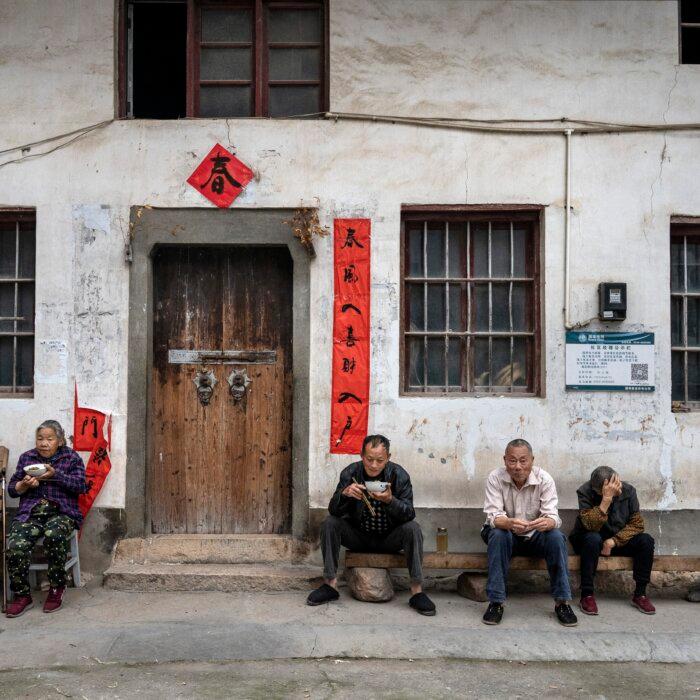
A Chinese scholar who studies the country’s rural affairs told The Epoch Times that the reported 246 yuan figure represents the nationwide average of all pension payments received by beneficiaries, but still falls far short of providing meaningful retirement security.
“In rural China, the regime’s treatment of elderly people is extremely harsh—almost exploitative,” he said. “Many seniors never qualified for employee pensions. They spent their lives supporting the country’s urban development, yet now they struggle to support themselves. With only about 8 yuan a day, they often avoid seeing a doctor for minor illnesses and cannot afford treatment when serious diseases strike.”
The rural affairs scholar said the gap between pensions for urban workers and those for rural residents remains substantial.
Official statistics from China’s Ministry of Human Resources and Social Security show that 538.3 million people were enrolled in the urban and rural residents’ basic pension insurance program at the end of 2024. Of those, 180.39 million were receiving benefits. The pension fund paid out 532.2 billion yuan ($78.6 billion) during the year.
A Chinese scholar in the country’s social security system told The Epoch Times the program has long operated on a “low contribution, low benefit” model that disadvantages participants.
“The CCP’s priority is keeping control of the money,” he said. “Supporting retirees’ livelihoods generally is not among its primary concerns.”
The social security scholar said the system differs sharply from the employee pension program, which is jointly funded by employers and workers. By contrast, pensions for rural and unemployed urban residents rely primarily on individual contributions supplemented by government subsidies.
“When China’s economy was doing well, participants never received the level of protection they deserved,” he said. “Now that economic conditions have worsened, their benefits are under even greater pressure.”
Small Local Subsidies Draw Criticism
China’s local governments have introduced supplemental payments for older beneficiaries, but the increases are too small to make a meaningful difference.
In Bengbu, a city in eastern Anhui Province, insured retirees aged 65 to 74 received an additional 2 yuan ($0.30) per month, while those 75 to 84 received an additional 5 yuan ($0.70), and those 85 and older received an additional 10 yuan ($1.48) in 2024.
The social security scholar said such increases are unlikely to have any meaningful impact on retirees’ daily living expenses.
Another Chinese scholar, surnamed Yuan, told The Epoch Times the marginal increases are too small to incentivize people to remain in the system.
“In recent years, both urban and rural residents have become less willing to contribute to social insurance,” he said. “People feel they’re better off saving the money themselves and using it when needed. They don’t believe the system provides a reasonable return or can solve their retirement problems.”
In recent years, the Chinese regime has repeatedly raised the nationwide minimum basic pension for urban and rural residents. The minimum monthly payment increased from 143 yuan to 163 yuan ($21 to $24) in 2026. The figure differs from the reported average monthly payment of 246 yuan because it refers only to the national minimum benefit rather than the average amount recipients actually receive.
Yuan said official efforts to promote an optimistic narrative about living conditions cannot change the reality facing China’s rural population.
“No matter how much the CCP tries to paint a rosy picture,” he said, “the facts show that Chinese farmers remain among the country’s most disadvantaged groups.”
Wu Ting contributed to this report.