Chinese State-Linked Firms at Investment Summit Pose Risk to Canada, Analysts Say
 Paul Rowan BrianUpdated 4 hours Ago3 Mins read
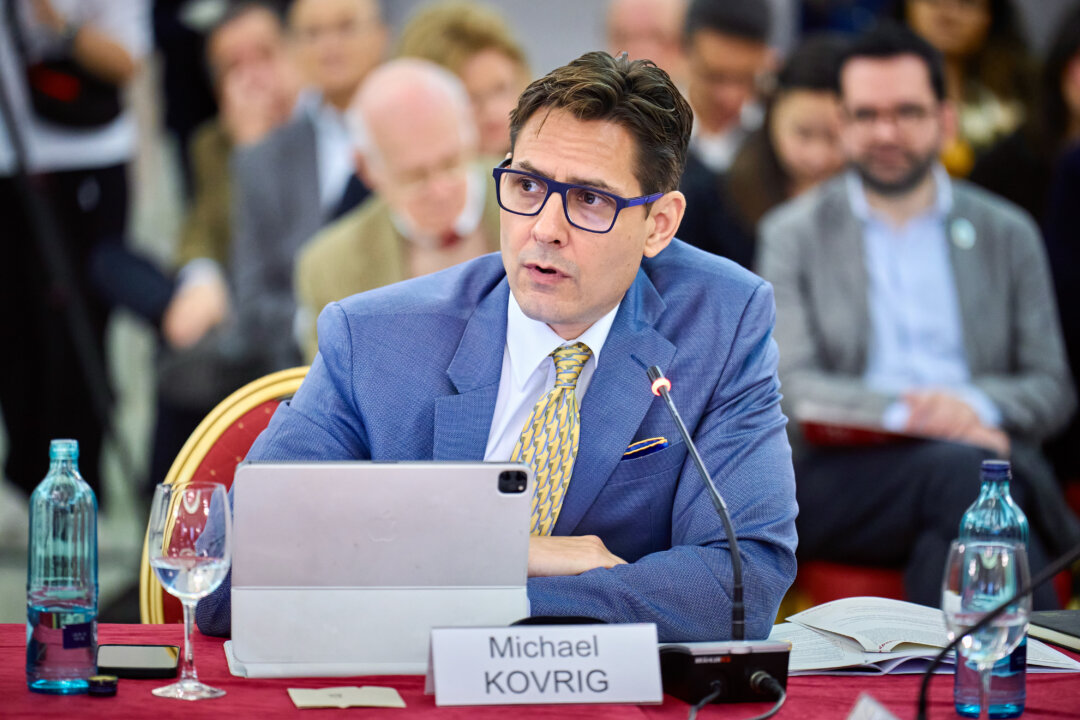
China analysts Michael Kovrig and Patricia Xavier say three Chinese state-linked financial institutions attending a major investment summit in Toronto are likely seeking to increase Beijing’s “political influence” in Canada.
Kovrig, a scholar and former Canadian diplomat who was arbitrarily detained in China, and Xavier, a Chinese politics researcher, said that the Chinese firms are likely seeking minority stakes in key Canadian infrastructure and energy projects in order to boost Chinese political leverage in Canada.
“Money is a diplomatic tool,” the authors write in a Sept. 14 analysis, adding that “strategically, investment does double duty as a lock on the political thaw with Ottawa plus a wedge to complicate relations with Washington.”
The Canada Investment Summit running from Sept. 14 to 15 in Toronto is a gathering of investment firms, business leaders, and government representatives. The event is part of the government’s stated goal of attracting $1 trillion in total investment to Canada over the next five years.
Kovrig and Xavier write that for China, the conference could represent the chance to gain further leverage in influencing Canada’s government.
“The domestic political impact is the main battlefield,” they write, stating that provinces, projects, and unions who get Chinese investment would then plausibly become more favourable to China and oppose any future toughening of Ottawa’s relations with Beijing.
The authors point to particular areas of Chinese investment interest being ports, pipelines, power grids, clean energy initiatives, and liquefied natural gas projects.
‘Quiet Minority Stakes’
Kovrig and Xavier caution that the China Investment Corporation may seek “quiet minority stakes” in Canadian infrastructure and energy projects or try to set up a joint investment fund with Canadian pension funds or other large investors.
They further state that the other two Chinese state-linked firms could assist in brokering deals and enabling a smoother flow of Chinese capital into Canada.
China Investment Corporation is China’s sovereign wealth fund whose sole shareholder is the Chinese Ministry of Finance, and oversees more than US$1.3 trillion, while China International Capital Corporation is an investment bank run via China’s state financial system and is 40 percent controlled by Huijin Investment, which acts directly on behalf of the Chinese regime.
The third financial institution, the Hong Kong Monetary Authority, is in charge of Hong Kong’s Exchange fund, which is under the authority of Hong Kong’s financial secretary but is politically influenced by Beijing, according to Kovrig and Xavier.
Case Studies
Kovrig and Xavier reference several case studies of Chinese state-linked investment that they say have led to Beijing gaining increased influence abroad, citing Italy and the U.K.
China Investment Corporation purchased minority stakes in the British companies that own Heathrow Airport and Thames Water in 2012. Kovrig and Xavier note that relations between the U.K. and China were not measurably improved in the wake of the sale, with Britain later banning Chinese telecommunications giant Huawei from using its 5G wireless networks.
This case from the U.K. shows how Chinese investment can interfere with domestic politics, they say.
“Chinese investment buys no stability,” they write, adding that often “the stakes become a mess in your own domestic politics.”
In the case of Italy, Kovrig and Xavier point to research indicating Beijing accrued key support among Italy’s business community in the lead-up to Italy joining China’s Belt and Road Initiative in 2019.
Italy later walked this back, withdrawing from the Belt and Road initiative in 2023 and restricting the influence of Chinese state-owned minority shareholder Sinochem over Italian tire manufacturer Pirelli due to national security concerns involving strategic technology and sensitive company information.
“Italy is the one place where Chinese money is credited with a policy turn, but that turn lasted exactly one government,” Kovrig writes.
Beijing–Ottawa Relationship
Kovrig and Xavier’s warnings come as Ottawa seeks closer ties with Beijing amid its ongoing trade dispute with Washington.
After calling China Canada’s “biggest security threat” in the 2025 election campaign, Prime Minister Mark Carney went on nine months later to state that Ottawa seeks a “strategic partnership” with Beijing that “sets us up well for the new world order.”
His comment during a January 2026 visit to China involved the signing of eight memoranda of understanding between Ottawa and Beijing, including relaxing tariff rate quotas on Chinese-made electric vehicles, increasing Canadian-Chinese law enforcement cooperation, and seeking more Chinese investment in Canadian energy, agriculture and consumer products.
Earlier this month, Ottawa and Beijing also held their first military talks since 2018, where China said the two countries agreed to boost “practical exchanges and cooperation” between their militaries.
Recommendations
In their analysis, Kovrig and Xavier say that Chinese investments in Canadian critical minerals, ports, infrastructure, and electricity grid-linked assets merit concern and scrutiny.
Kovrig and Xavier recommend “five indicators” to watch with any Chinese investment that can act as red flags, namely whether investments come along with more control or access rights, sectors with particular Chinese investment interest, any weakening of investment screening rules, American opposition, or signs Beijing is using trade or market access to gain political or economic leverage over Canada.
“If any of the five indicators turns red, increase the whole risk assessment,” the two wrote.



Hanson Stands Firm After Calling Indigenous Culture ‘Primitive’
Pauline Hanson has refused to apologise for comments calling Indigenous Australians the...
Energy Minister to Travel to Saudi Arabia to Secure Further Fuel Supplies
Federal Energy Minister Chris Bowen speaks to the media during a press...
Man Injured by 3-Pronged Spear in Northern Territory Unrest
Signage on a Police vehicle in Alice Springs, Northern Territory, Sept 4,...
China’s New Law ‘Wake-Up Call’ for Pentagon; Trump Weighs Risks: China, Self-Improving AI
A change in Chinese law could allow Beijing to seize certain Western...