
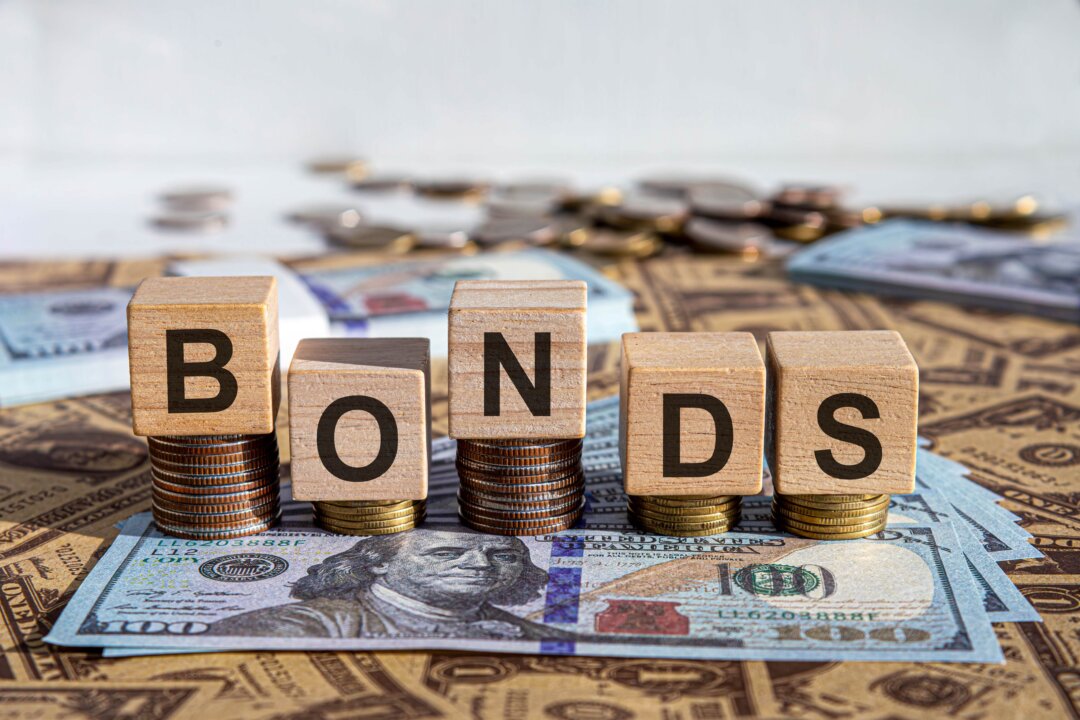

Strictly speaking, the underlying dollar value of most bonds won’t appreciate. With few exceptions, a bond’s price at maturity (also known as par value) will never increase; it remains fixed throughout the bond’s lifetime. Because the coupon payments and par value are contractually obligated, they don’t have any potential for growth.
The historical record underscores this lack of growth. To illustrate this, I looked at price returns (a proxy for capital appreciation) versus total returns (which include reinvested income payments) for several sets of bond indexes with returns going back to the 1970s (or early 1980 in one case). In each case, the price returns were close to zero, meaning that virtually all of their total returns were from yield.
While a bond’s par value at maturity is fixed, bond prices can increase (or decrease) during the interim in response to changes in market interest rates over shorter periods.
As market interest rates increase, a bond’s price decreases, with the magnitude of the decrease driven by duration, which estimates the change in value of an investment for a 1 percent change in interest rates. A bond with a 5-year duration, for example, would be expected to lose roughly 5 percent if interest rates were to rise by 1 percent and gain the same amount if interest rates were to fall. The longer the duration, the greater the sensitivity to interest rates.
In 2022, when the Federal Reserve made a series of aggressive interest rate hikes, long-term Treasuries suffered price declines of more than 30 percent, while other types of bonds saw price declines of 12 percent or more.
The same pattern works in reverse when market interest rates decrease. In 1982, for example, the Fed reduced rates by nearly 5 percentage points, leading to dramatic price gains for bonds. Prices for long-term Treasuries surged by about 26 percent, and other types of bonds also saw double-digit price gains.
Another factor that has an impact on bond price is credit quality, especially if there’s a concern that the bond issuer won’t meet its obligations. If buyers are less confident about a bond’s credit quality after it is first issued, they’ll typically buy the bond only if it’s priced at a discount to its par value. Buying at a lower price, in turn, means there’s a potential for the price to appreciate if worries about credit quality turn out to be overblown. On the flip side, someone who purchases a bond close to its par value might see the price decrease if credit quality deteriorates.
At the portfolio level, a manager could buy bonds at a discount and sell after they appreciate, thereby capturing some capital appreciation over time. But even successful portfolio managers are playing a game of inches. If they’re consistently successful, they might end up adding small amounts of value versus a benchmark index—most likely less than a percentage point per year. Fidelity Investment Grade Bond FBNDX, for example, has generated annualized returns of 2.28 percent for the trailing 10-year period through April 2026, compared with 1.6 percent for the Morningstar Category index. But overall, any capital appreciation from bonds is generally marginal.
That said, it’s true that bonds have historically outperformed cash. Since 1926, intermediate-term bonds have generated annualized returns of about 4.9 percent, compared with 3.3 percent for cash. But that performance advantage almost entirely stems from the fact that bonds usually have higher starting yields.
Where bonds really shine is their ability to generate income and moderate a portfolio’s risk level. For capital appreciation, stocks are the best place to go.
By Amy C. Arnott of Morningstar
The views and opinions expressed are those of the authors. They are meant for general informational purposes only and should not be construed or interpreted as a recommendation or solicitation. The Epoch Times does not provide investment, tax, legal, financial planning, estate planning, or any other personal finance advice. The Epoch Times holds no liability for the accuracy or timeliness of the information provided.