
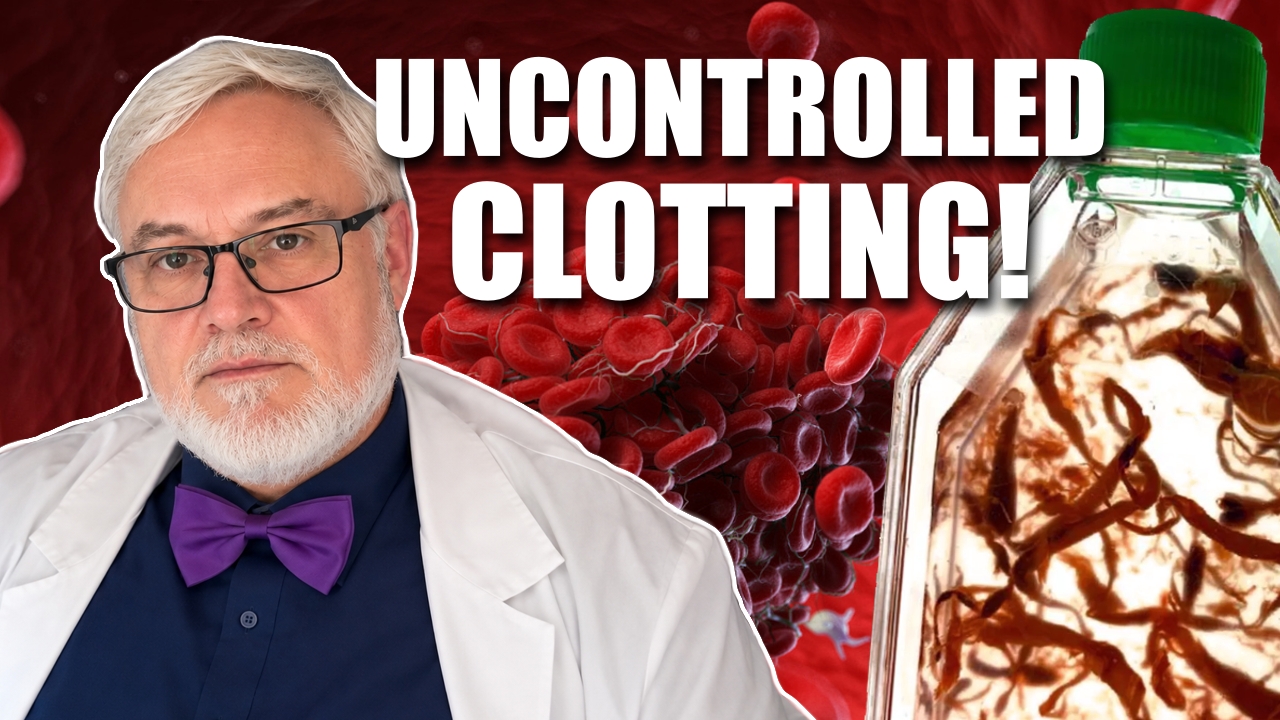

Part 2 of 4 — Dr. Bruce Rapley examines the biological mechanisms behind the anomalous intravascular casts (“calamari clots”) observed since the COVID-19 vaccine rollout.
Building on the morphology, histology, elemental, and proteomic findings from the research trilogy, he explains how normal clotting works, why these structures are fundamentally different, and the processes — including vascular injury, abnormal fibrin accumulation, and platelet changes — that may be driving their formation.
If our work resonates with you and you value independent medical investigation, informed consent, and health sovereignty, please consider supporting our ongoing work at DrTrozzi.news.
Dr. Bruce Rapley is an interdisciplinary applied biologist and systems scientist with expertise spanning human health, environmental science, biophysics, and complex biological systems.
Trained in medical and applied microbiology, his early research explored the biological effects of electromagnetic fields and acoustic stress. He later specialized in psychoacoustics, occupational noise exposure, and infrasound. For the past six years, Dr. Rapley has focused on the morphology, histology, elemental chemistry, and proteomics of anomalous white intravascular casts (commonly known as “calamari clots”) observed in the post-COVID-19 era.
He approaches scientific questions with careful observation, rigorous skepticism, and a systems-oriented perspective.

-
Normal blood clotting is a localized, temporary repair process involving platelets, fibrin, and eventual breakdown by plasmin. The anomalous “calamari” casts do not follow this pattern.
-
These casts show little to no plasmin, meaning the normal clot-dissolving mechanism is severely impaired or absent.
-
The casts form inside blood vessels (often attaching to vessel walls) and can grow extensively — sometimes spanning from groin to ankle and branching into multiple vessels.
-
Formation appears driven by microvascular injury, abnormal fibrin accumulation, and reduced platelet regulation, leading to uncontrolled, rubbery structures unlike conventional clots.
-
The casts are produced by the body itself (predominantly human proteins, especially fibrin/fibrinogen) rather than being foreign material. No spike protein was detected in the structures.
-
Large visible casts likely represent only a small fraction of the total vascular burden, suggesting widespread microvascular obstruction throughout the body.
-
Intramuscular injections distribute systemically via blood and lymphatic circulation, contradicting claims that injected material remains localized at the injection site.
-
The consistency of these findings across samples points to a novel, systemic pathological process that warrants urgent independent investigation.