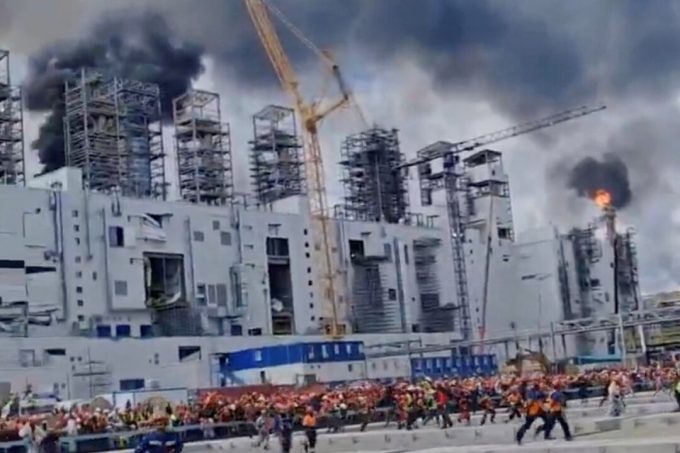

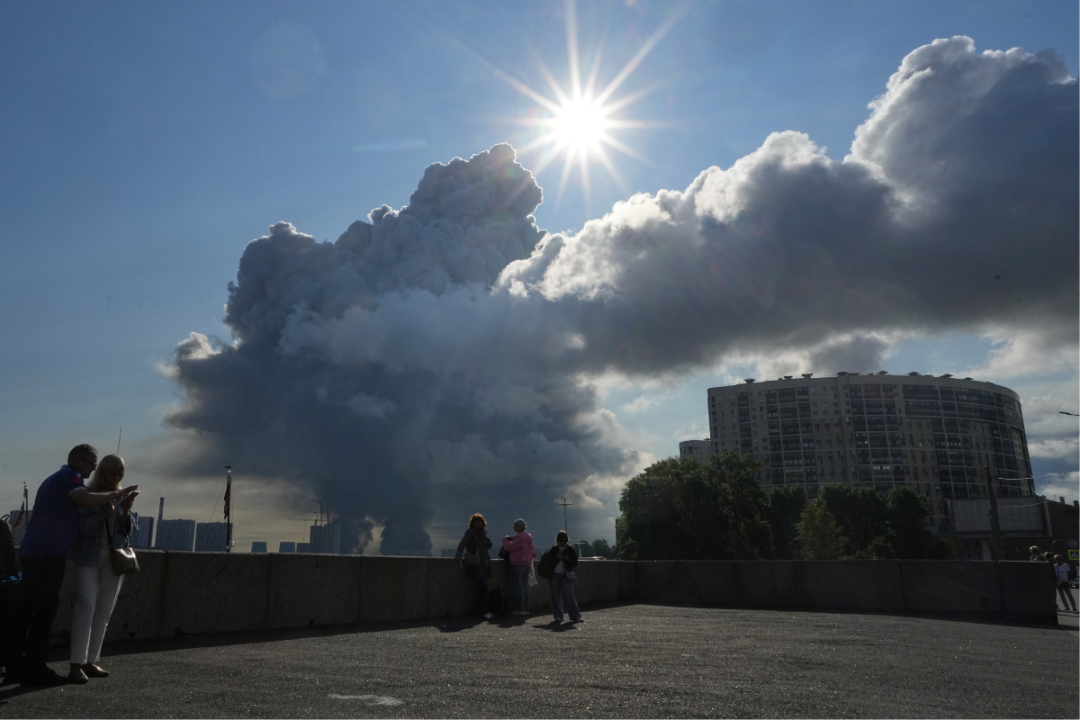
A fire has “completely destroyed” a Wildberries warehouse following a Ukrainian drone attack, a regional official has said, as Kyiv continues to disrupt the Russian economy by targeting online retailers.
Evgeniy Pervyshov, governor of Russia’s Tambov region, said in an Aug. 26 post on Telegram that during the overnight strike, Russian forces had managed to destroy 16 unmanned aerial vehicles (UAVs), but that another three had got through, striking the warehouse in Kotovsk.
He added that two people were wounded during the attack.
Ukrainian forces have been hitting facilities belonging to Wildberries—Russia’s largest online retailer—in a series of drone attacks since mid-July and have since broadened their strategy in recent days to include the country’s second-largest e-commerce platform, Ozon.
Ukraine has
described
the targets as hubs responsible for supplying Moscow’s military with components for weaponry such as drones.
In an Aug. 23 post on X, Ukrainian President Volodymyr Zelenskyy said that his forces have targeted Wildberries “because it involves both the supply of military goods and big money for Russia.”
Zelenskyy said that it was Russia’s initial strikes against civilian businesses and logistics since 2022 “that led us to respond in kind.”
Moscow and the targeted retailers deny the accusations.
Critical Infrastructure Decree
The targeting of retailers has prompted Moscow to issue a decree allowing the state to temporarily take over critical infrastructure if private owners are considered to have failed to properly protect their assets against the risk of damage by drone attacks.
The decree, which came into effect on Aug. 24, also allows the Russian state to administer an entity if an owner fails to restore its functioning in a timely manner.
Critical infrastructure named within the measures includes fuel and energy complexes, industrial facilities, communications facilities, logistics infrastructure, and other facilities deemed essential to the economic security and stability of the Russian Federation.
Moscow has also approved state financial aid for sellers operating on Wildberries whose businesses have been affected by drone attacks.
Prime Minister Mikhail Mishustin signed the resolution on Aug. 26, according to a Russian government statement.
The measure will allow for the “deferment of the payment of a number of taxes and insurance premiums, as well as the suspension of inspection activities” for affected businesses whose loss exceeded 5 percent of their annual income, the statement said.
Attacks on at least 20 of Wildberries’s sites have sparked major fires, destroyed entire warehouses of stock, and disrupted the retailer’s vast logistics network across Russia since July.
Ukraine Hits Lukoil Refinery
Ukraine has also ramped up its attacks on oil facilities and military installations, as part of its broader long-range UAV strike campaign.
The General Staff of the Armed Forces of Ukraine said in an Aug. 26 post on Facebook that overnight it had struck the LUKOIL-Nizhegorodnefteorgsintez oil refinery—one of Russia’s largest oil-processing enterprises—in Kstovo in the Nizhny Novgorod Oblast.
In a separate post on the social media site, the General Staff said it also hit a number of military targets in Russian-controlled territories of Ukraine, including a radar station in Kasta, Crimea; a UAV training center in Luhansk; and ammunition depots in Donetsk.
Russia Strikes Cargo Ships
Russia has been targeting Ukrainian infrastructure in recent days.
On Aug. 25, the Russian defense ministry said its forces hit three cargo ships carrying supplies for the Ukrainian military, as well as a tanker at the Black Sea port of Pivdennyi.
The ministry also said it had hit another cargo vessel in the port of Odesa, port infrastructure in Pivdennyi and Odesa, and fuel storage facilities at the port of Chornomorsk.
The Institute for the Study of War (ISW) said in its Aug. 25 campaign assessment that Moscow is “escalating strikes against Ukrainian-Moldovan border infrastructure in conjunction with its campaign against Ukrainian port and maritime infrastructure.”
The ISW said that this month, the Russian military has increased its targeting of infrastructure along the border that Kyiv uses to conduct imports and exports with the rest of Europe.
“Russian forces are likely intensifying such strikes as part of a dual effort to both isolate Ukraine from Europe and degrade Ukraine’s ability to export grain and other exports, while also creating an environment of insecurity to dissuade Moldova, Romania, and international shippers from using these crossings,” the institute said.
Reuters contributed to this report.