‘Ghost Airports’ Emerge in China
 Alex WuUpdated 28 minutes Ago2 Mins read
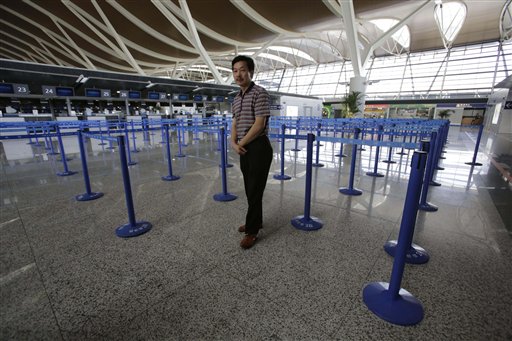
Some regional airports in China didn’t receive a single flight so far this year, while others served fewer than 10 passengers per day on average, the latest data show.
The data show that small and medium-sized airports in China are facing the predicament of a sharp decline in flights and passengers. However, these “ghost airports” receive huge government subsidies to stay open.
Data from China’s Flight Manager DAST, from January to October show that Chongqing Xiannushan Airport recorded zero passenger flights, however, it is slated to receive a subsidy from the Civil Aviation Administration of China of 8.58 million yuan ($1.28 million) in 2026, with a further subsidy of 6.36 million yuan ($0.95 million) earmarked for 2027, according to the agency’s subsidy budget.
Yunnan Ninglang Lake Luguhu Airport in southwest China also recorded zero passenger flights, and it will receive a subsidy of 9.87 million yuan ($1.48 million) for 2026, with a further 8.07 million yuan ($1.21 million) budgeted for 2027.
During the same January–October period, Hubei Shennongjia Hongping Airport in central China handled only 58 flights with a passenger throughput of 2,594, It will receive a subsidy of 5.88 million yuan ($0.88 million) in 2026, with a further 5.8 million yuan ($0.87 million) earmarked for 2027.
Sichuan’s Jiuzhai Huanglong Airport, which opened in 2003, had a peak annual passenger throughput of 1.75 million in 2012. But by 2025, this figure had fallen to approximately 32,000—a decline of about 98 percent. From January to October this year, the airport handled a total of 304 flights, down 41.5 percent year-on-year, while passenger throughput stood at just 19,934—a year-on-year decrease of 35.8 percent.
In late October, the airport saw a temporary suspension of all scheduled passenger flights due to seasonal flight schedule adjustments for the winter-spring season. Subsequently, the airport announced that, effective Nov. 7, the route between Chengdu Tianfu and Jiuzhai Huanglong would resume, with Sichuan Airlines operating one round-trip flight per week.
As of the end of 2025, China had 270 certified civil transport airports, according to the Civil Aviation Administration of China. Of these, 191 airports—71 percent of the total—each handled fewer than 2 million passengers annually. Together, they accounted for only 6 percent of the country’s total passenger throughput.
The subsidy budget for small and medium-sized airports for 2026, as announced by the Civil Aviation Administration of China, has reached 2.584 billion yuan—an increase of approximately 80 percent compared to 2017.
Yang Xite from the Macroeconomic Research Center of China-based think tank Anbang, told China Business News that construction of some local airports across China is ahead of actual demand, which is contributing to the current operational difficulties facing some small- to medium-sized airports.
U.S.-based China analyst Li Linyi told The Epoch Times the reckless development of many regional airports across China are an inevitable consequence of the structural flaws within the ruling Chinese Communist Party’s (CCP) system, which are resulting in persistent financial losses.
High costs in the construction projects are linked to the career advancement of local CCP officials and often involve corruption, Li said. Furthermore, these multi-billion-yuan airport projects are often launched without transparent cost-benefit hearings or effective media oversight, he said.
“Even if a completed project ends up as a ‘ghost airport’ or suffers year after year of massive losses, the officials who authorized it have typically already been promoted to higher positions and won’t be held responsible.”
Meanwhile, amid China’s persistently sluggish economy, many people are opting for more economical means of transportation, such as China’s old green trains, which are cheaper than flights and high-speed trains.
This has also led to some abandoned and empty high-speed train stations, which are also the result of government-led overbuilding in regional parts of China.
Tang Bing contributed to this report.







Taiwan Disputes Chinese Media Claim That Trump Opposes Taiwan Independence
Taiwan's Mainland Affairs Council Minister Chiu Chui-cheng speaks during an interview with...

America in Brief
Suspect Guilty of Palisades FireThe federal arson suspect accused of igniting a...

Labor Reinforces Heartland Seats as Election Loss Looms
A beleaguered state Labor government has taken its election campaign to formerly...
Analysts Say Trump–Xi–Putin Summit Exposed Deep Divide
The first-ever trilateral summit between the leaders of the United States, China,...