Inside Nvidia’s Ecosystem—and Why It Matters
 Panos MourdoukoutasUpdated 19 minutes Ago5 Mins read
News Analysis
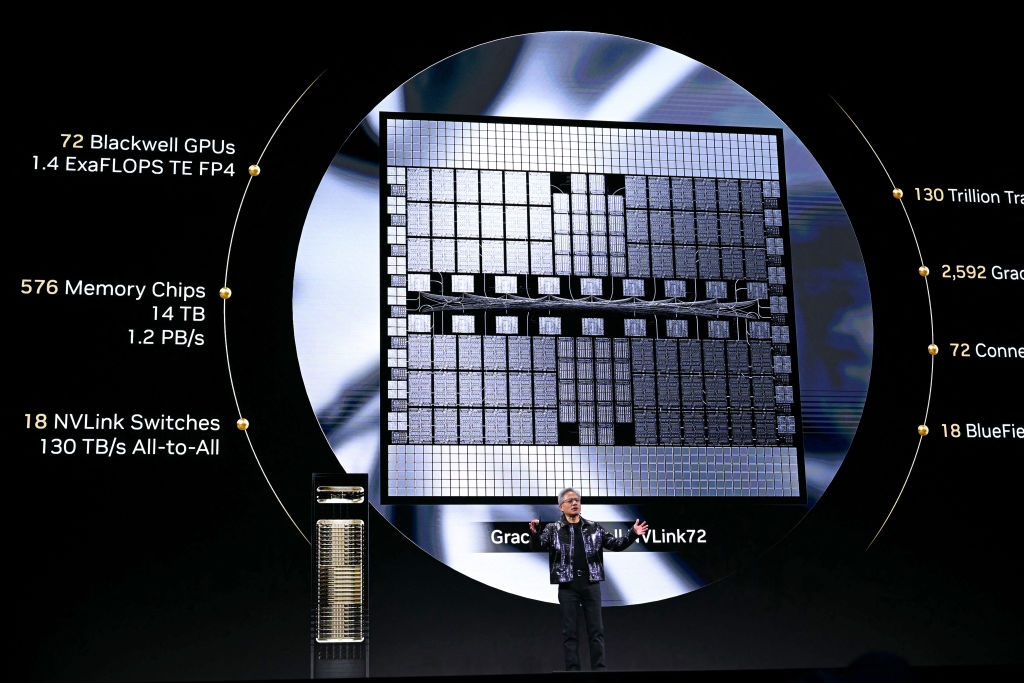
Wall Street and the rest of the world know Nvidia for its chips that are hard to buy. But industry experts argue its biggest advantage is something harder for competitors to purchase: an ecosystem that allows the company to offer a full stack of products.
Nvidia’s product offering resembles a pyramid with several levels. At the bottom are the chips. Above them is the networking that links thousands of chips into one system. Next come the server racks and complete machines. Nvidia sells every layer.
Of these, the software is the hardest to copy. It is called Compute Unified Device Architecture (CUDA).
CUDA: The Software Core
CUDA is a programming platform that Nvidia launched in 2006. It lets developers write software that runs on Nvidia’s chips. Over two decades, developers have built tools, programs, and habits around it.
According to Nvidia’s annual report, more than 7.5 million developers use CUDA and Nvidia’s other software tools. The platform supports about 6,000 applications. More than half of Nvidia’s engineers work on software.
“Nvidia stopped being a chip company years ago. It sells an entire AI factory now. The GPUs, the networking that ties thousands of them together, the racks, and above everything else the software,” Arnold Platz, founder and CEO of General Future Holding, told The Epoch Times.
Platz sees this as a competitive moat, a lasting advantage that is hard for rivals to cross.
“A competitor can match a chip in two or three years. Getting a whole generation of developers off 20 years of CUDA is a different, slower problem,” he said.
David Wang, COO of Tetrate, a networking and security company based in San Francisco, said Nvidia has long known how to build software ecosystems.
“The software ecosystems being built today are much more sophisticated than in the early days of game development. Now look at how CUDA is central to all the AI ecosystems. Nvidia is involved in everything from serving models to security to what we do, which is traffic routing and efficiency,” Wang said.
Layers Around the Software
CUDA occupies the top of a large supply chain. Nvidia relies on a wide group of partners: cloud providers, original equipment manufacturers (OEMs), original design manufacturers (ODMs), software vendors, system integrators, add-in board makers, distributors, automakers, and tier-1 suppliers.
Simply put, these are the companies that build the servers and computers, assemble the systems, sell the products, and supply the parts.
“Our supply chain is a strategic advantage,” Debora Shoquist, executive vice president of operations at Nvidia, said in a recent press release.
“Our work with these partners builds on our manufacturing foundation for long-term growth, expanding capacity across components, advanced packaging and system production to deliver the accelerated computing platforms our customers need.”
Nvidia’s business has two segments: Compute & Networking, and Graphics.
Compute & Networking covers data center chips and networking, AI software, and technology for cars, including self-driving systems. Graphics covers GeForce chips for gaming and PCs, and Quadro/Nvidia RTX chips for professional workstations.
According to Nvidia’s most recent filings with the U.S. Securities and Exchange Commission, each segment depends on many partners. They handle manufacturing, packaging, and delivery.
In Compute & Networking, Taiwan Semiconductor Manufacturing Co. (TSM) makes Nvidia’s GPUs and networking chips. SK Hynix supplies high-bandwidth memory, a fast type of memory that feeds data to AI chips. Amkor Technology (AMKR) supplies advanced packaging, which assembles chips into finished, connected units, along with testing.
Broadcom (AVGO) supplies Ethernet switching chips, which direct data traffic, and other networking semiconductors. Marvell Technology (MRVL) provides optical interconnects, which move data using light, as well as network chips and data center connectivity.
In Graphics, ASUS makes the ROG and TUF GeForce graphics cards. Other makers of GeForce gaming cards include Micro-Star International (MSI), ZOTAC, PNY Technologies, Palit Microsystems, GALAX, and Inno3D.
Global Network: a Strength, and a Source of Risk
AI systems are complex. Building one takes information, skills, and equipment spread across many companies, industries, and countries.
One way to describe this is “collective entrepreneurship.” A central company works with a group of partners, and they share the risks and rewards.
Nvidia’s network includes chip factories, memory makers, packaging companies, networking suppliers, server makers, and software and technology partners. It reaches from the United States to South Korea, Taiwan, and Japan. That makes it a major driver of growth for U.S. regional and global economies.
Platz said the whole industry plans around Nvidia’s release schedule.
“Cloud providers, server makers, Taiwanese suppliers, startups, governments. A new generation ships and everyone swaps hardware on that beat, every three to five years,” he said.
Nvidia’s performance is closely linked to trends in the U.S. and global chip industries. Nvidia’s shares, the iShares Semiconductor ETF (SOXX), and the Korean and Taiwan stock exchanges have moved closely together.
The ETF is a fund that holds many chip stocks, and the two exchanges are home to many of Nvidia’s suppliers. Investors call this pattern the AI trade: AI-linked companies bought and sold as a group.
In recent weeks, those markets have fallen together. SOXX is down 25 percent, South Korea’s Kospi is down 14 percent, and Taiwan’s main index, the Taiex, is down 17 percent. Nvidia’s shares are down 32 percent.
Nvidia’s customers include CoreWeave, Google Cloud, Microsoft Azure, Oracle, and Nebius, which are running racks of Vera Rubin, Nvidia’s newest generation of data center systems. Meta, OpenAI, and Anthropic are also customers.
The Financial Commitments
Nvidia is also helping pay for the AI build-out. It commits money and takes on obligations so that customers and partners can build the data centers that use its products.
In August, for instance, Nvidia gave guarantees on a large data center project in Ohio. A guarantee is a promise to cover payments if a customer fails to do so. The guarantees cover the land, power, and building shell for about 4.25 gigawatts of capacity, a measure of electric power, across nine buildings at SB Energy’s PORTS-Pike Technology Campus and are capped at $105 billion. The total of all Nvidia’s guarantees is $118 billion.
Nvidia has also committed to buy large amounts of supplies in advance. A more recent SEC filing shows that supply commitments rose from $279 billion last quarter to $390 billion. Most of the increase is for memory, bought under multiyear contracts.
Nvidia also rents cloud computing and data center space for its own use. The filing explains what that pays for.
“Our cloud service agreements and data center lease commitments together of $102 billion, an increase from last quarter’s $74 billion, provide the physical and cloud infrastructure that powers our research and development,” the filing says.
These arrangements have made Nvidia a major financial backer of the AI industry. That brings risk. If partners cannot pay, Nvidia’s balance sheet could suffer. In a rare, severe shock that few expect, often called a “black swan” event, trouble at one company could spread to others.
A Strategic Asset
A.K. Pradeep, an AI and workplace compliance expert and CEO of Sensori.AI, said Nvidia’s network has built up millions of developer-years of work and a tightly connected industrial base. He believes this creates a competitive moat not just for Nvidia but for the United States.
“This is an extraordinary American competitive advantage, and increasingly a strategic national asset,” he told The Epoch Times.






Shanghai Party Chief’s Detention Exposes Power Struggles Ahead of China’s 2027 Leadership Reshuffle
The sudden removal of Politburo member and Shanghai Party chief Chen Jining...

Thanksgiving Online Spending Hits Record $7.1 Billion: Adobe
Families passed the gravy for the turkey and mashed potatoes—and credit cards...

Ukrainian Laser Downs Russian Jet Drone in World First, Kyiv Says
Ukraine said on Wednesday that it had used a laser to shoot...
Stellantis Says High Energy Costs Threaten Italian Car Production
The European head of Stellantis warned on Nov. 26 that maintaining vehicle...