

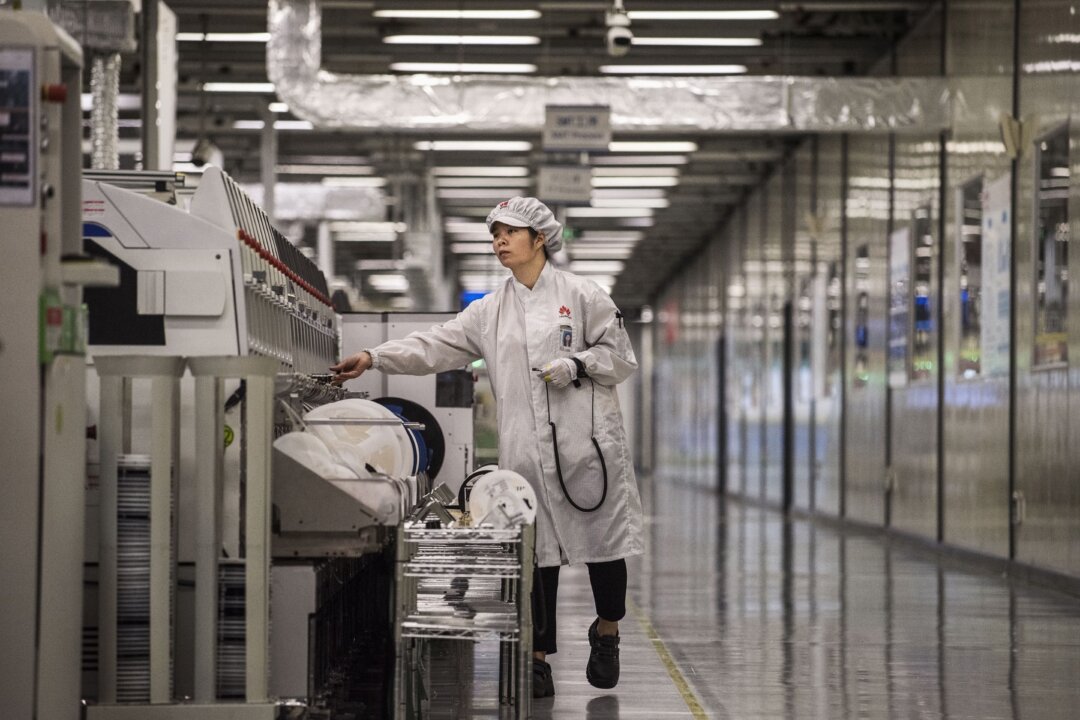
The recent shutdown of a three decade-old Hong Kong-funded electronics manufacturer in Shenzhen, China, which cited shrinking orders, rising operating costs, and persistent losses, adds to signs of mounting pressure on private manufacturers in China, people familiar with the industry told The Epoch Times.
After operating for more than three decades, Weiliheng Electronics (Shenzhen) Co. Ltd. announced on Aug. 5 that its Hong Kong-based shareholder, Weiliheng Electronics Co. Ltd., had decided to dissolve the company ahead of schedule and end its operations, according to an Aug. 14 report published by the Shenzhen Cross-Border E-Commerce Association on Chinese news portal NetEase.
The company said it would complete existing orders and hand over work before halting production, with the employment contracts of all remaining workers terminated by Aug. 8.
The closure underscores the challenges facing older manufacturing companies in the Pearl River Delta, a region that includes Shenzhen and was once a major hub for Hong Kong- and Taiwan-funded factories serving China’s export economy.
Industry professionals and observers say declining orders, higher production costs, and a difficult financing environment have increasingly squeezed manufacturers. They spoke to The Epoch Times on condition of anonymity out of fear of reprisal.
A former technician at an electronics factory in Shenzhen, surnamed Chen, said some electronics manufacturers in the Pearl River Delta are finding it increasingly difficult to secure orders and are responding by continually downsizing.
“What many factory owners are worried about now is that they are renting factory buildings and supporting workers, but they cannot get orders to follow up,” Chen said. “The profit margin in electronics processing was already thin. In the past, labor costs in Guangdong were low, and factory rents were low. Now electricity costs are high and financing is difficult.”
Founded in 1994, Weiliheng manufactured electronic products including radios, audio equipment, and other devices. Its factory included production lines for injection molding, screen printing, surface-mount technology, and assembly. The company operated through the Pearl River Delta’s rise as a major global manufacturing center before facing changing industrial patterns, weaker orders, and rising production costs.
Chen said the pressure has spread beyond individual companies.
“Recently, many factories have taken several months of vacation, and some have chosen to shut down,” he said. “Several large factories in Dongguan have closed.”
Policy Shift Adds Pressure on Manufacturers
A Chinese scholar based in Guangdong, surnamed Zhu, said China’s economic downturn has made it increasingly difficult for electronics and manufacturing companies to survive amid intense competition.
“The Chinese Communist Party’s (CCP’s) policies are more inclined to support high-tech fields and state-owned enterprises, and many orders have already been monopolized by state-owned enterprises,” Zhu said. “They are carrying out the advance of the state sector and the retreat of the private sector. What they are targeting is private enterprises.”
The difficulties facing manufacturers come as some of China’s largest technology and electric-vehicle companies continue to expand overseas.
A businessman from Zhejiang, surnamed Yao, said the problems confronting China’s manufacturing sector also go beyond changes in production costs.
“In the past, manufacturing’s biggest advantages were a large market, abundant orders, and a complete supply chain. Now all three of these conditions are changing,” Yao said. “Domestic unemployment is increasing, consumption is downgrading, companies do not dare to invest, and foreign investment is also gradually withdrawing.”
He said that factory closures and the disposal of industrial equipment receive little attention in Chinese media.
“The media never reports on the most grassroots reality of China’s economy, such as factories closing, machines being sold, and workers returning home,” Yao said. “Officials always say that they are working for the people, but even complaining online will get your account banned.”
Sun Luo contributed to this report.