Predatory Lending in Canada: A Legalized Crisis
 HeraklesUpdated 3 days Ago3 Mins read
Overview
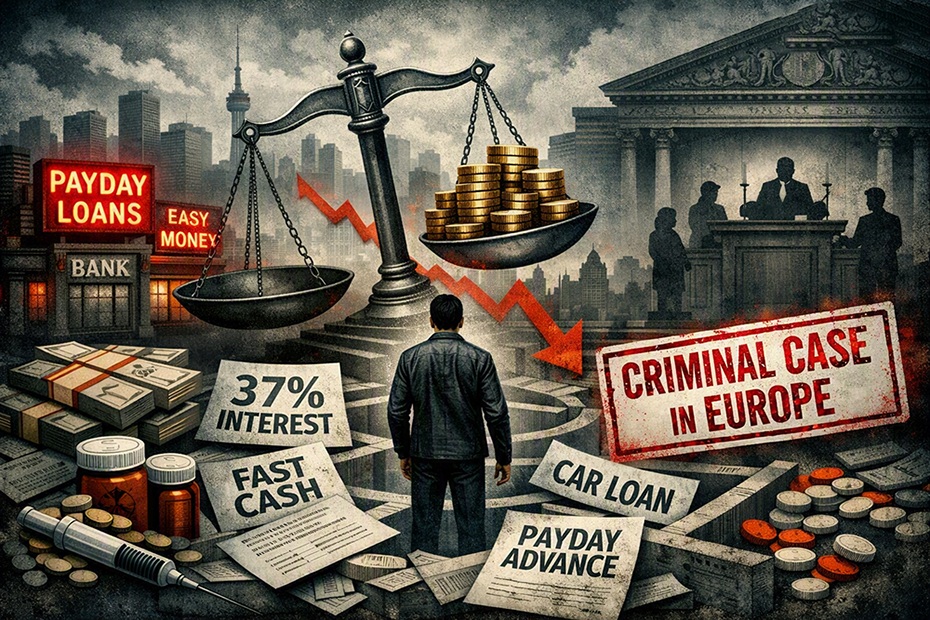
Canada’s lending market — from car loans to payday advances — has evolved into a system that many economists describe as legally sanctioned usury. Interest rates reaching 37% and beyond are not rare; they are routine. What would be considered a criminal act in most of Europe is, in Canada, a thriving business model protected by loopholes and weak enforcement.
1. The Legal Framework That Enables Exploitation
Criminal Code vs. Reality
Under Canada’s Criminal Code (Section 347), charging more than 60% annual interest is technically a criminal offense. Yet lenders routinely bypass this limit through:
- Fees disguised as service charges or insurance premiums
- Compounded interest structures
- Short-term rollover loans
- Lease-to-own schemes
The result: borrowers often pay effective annual rates exceeding 100%, even though the nominal rate appears below the legal threshold.
Provincial Loopholes
Each province regulates payday loans separately. For example:
- Ontario caps payday loan fees at $15 per $100 borrowed, equivalent to 391% APR.
- British Columbia allows similar structures.
- Alberta and Manitoba have slightly lower caps, but still far above global norms.
These provincial exemptions effectively neutralize federal criminal interest laws.
2. The Car Loan Trap
Subprime Auto Financing
Car dealerships across Canada partner with subprime lenders who target consumers with poor credit. These loans often feature:
- Interest rates between 25% and 37%
- Hidden fees and inflated vehicle prices
- Aggressive repossession practices
In Europe, such contracts would violate consumer protection and usury laws. In Canada, they are marketed as “credit rebuilding opportunities.”
The Illusion of Ownership
Many borrowers never own the vehicle outright. After years of payments, repossession or refinancing resets the debt cycle — a perpetual treadmill of liability.
3. Fast Loans and Payday Advances: Legalized Extortion
The Business Model
Payday lenders thrive on desperation. They offer instant cash with minimal verification, targeting low-income workers and newcomers. The typical borrower:
- Takes $300–$500 for two weeks.
- Pays $45–$75 in fees.
- Often rolls over the loan multiple times.
This creates an effective annual interest rate between 300% and 600% — rates that would trigger criminal prosecution in France, Germany, or the Netherlands.
Corporate Scale
Major payday chains like Money Mart, Cash Money, and EasyFinancial operate nationwide, often backed by large private equity funds. Their profits depend on repeat borrowing — not repayment.
4. Comparison: Europe’s Criminal Thresholds
| Region | Legal Interest Cap | Typical Enforcement |
|---|---|---|
| France | ~20% APR | Usury is criminally prosecuted |
| Germany | ~15–20% APR | Contracts voided if exploitative |
| Netherlands | ~14% APR | Strict consumer protection |
| Canada | 60% (nominal) / 300–600% (effective) | Rarely enforced |
In most European jurisdictions, charging above 20% is considered criminal exploitation. Canada’s tolerance for triple-digit rates is therefore an international anomaly.
5. The Human Cost
Debt Traps and Mental Health
Studies by the Canadian Centre for Policy Alternatives show that payday loan users are:
- Twice as likely to experience food insecurity.
- Three times more likely to face eviction.
- Four times more likely to report anxiety or depression linked to debt.
Economic Inequality
Predatory lending disproportionately affects:
- Low-income households
- New immigrants
- Indigenous communities
- Young adults with limited credit history
These groups often lack access to traditional banking, leaving them vulnerable to high-cost lenders.
6. Why Reform Stalls
Lobbying and Political Influence
The payday and subprime lending industry spends millions lobbying provincial governments. Their argument: high rates reflect “risk.” In reality, default rates are built into profit models — the system profits from failure.
Regulatory Fragmentation
Canada’s decentralized approach means no unified national oversight. Each province sets its own rules, creating regulatory arbitrage that lenders exploit.
7. Toward Ethical Lending
Experts propose reforms:
- National cap of 20% APR for all consumer loans.
- Mandatory transparency on total cost of borrowing.
- Ban on rollover loans and hidden fees.
- Public microcredit programs for emergency needs.
Without these changes, Canada risks cementing its reputation as a haven for legalized financial exploitation.
Conclusion
In most of the developed world, charging 37% interest on a car loan or 400% on a payday advance would be a criminal case. In Canada, it’s business as usual. The country’s lending market has become a paradox — a system that criminalizes usury in theory but institutionalizes it in practice.
Until Canada aligns its consumer protection laws with international standards, predatory lending will remain one of the nation’s most tolerated forms of economic injustice.







USA: 250 Years as a Beacon of Liberty and Refuge from Tyranny
AdvertorialSince its founding 250 years ago, the United States of America has...

iPhone Owners Can Submit Claims in Apple’s $250 Million Settlement
Millions of iPhone customers can now submit claims of up to $95...

New BC Conservative Leader Says Eby Will ‘Regret’ Early Election Call
The BC Conservatives’ newly appointed leader Lorne Doerkson criticized NDP Leader David...

ABC’s Four Corners Program Found in Breach of Standards Over Use of Anonymous Sources
The Australian Broadcasting Corporation (ABC) logo is seen in the press gallery...