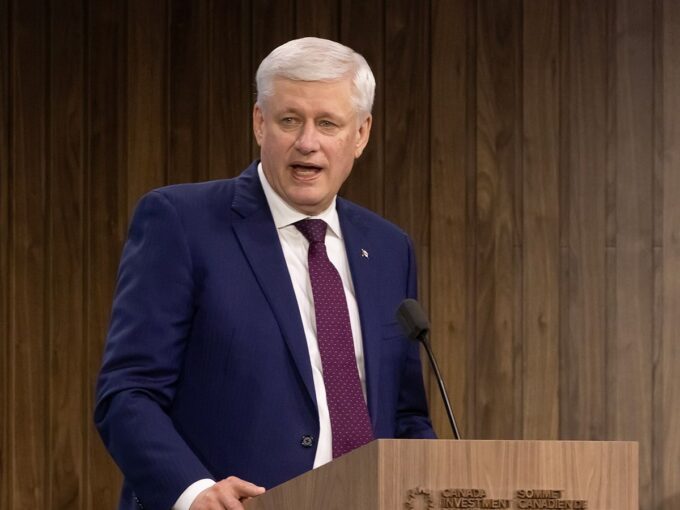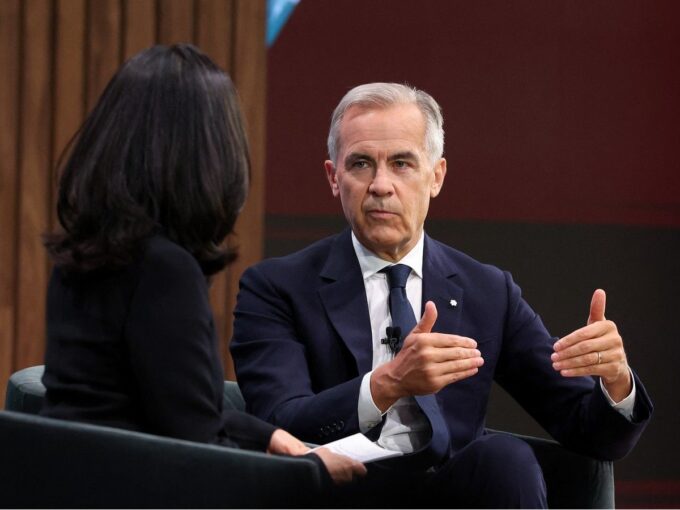
Prime Minister Mark Carney unveiled a sweeping tax overhaul at the inaugural Canada Investment Summit in Toronto that will allow businesses to write off a sizable slice of the cost of investment on a wide range of large-scale projects.
The federal government’s Productivity Mega-Deduction, which will apply to assets including new oil and gas pipelines, mines, fibre-optic cables, rail, bridges and roads, as well as aircraft and vehicles, is designed to help position Canada as the “most tax-competitive country for new business investment” in the G7 group of industrialized nations, he said.
“Our goal is to catalyze $1 trillion in investment in Canada over the next five years — in energy, transportation, data, defence and beyond,” Carney said, making the opening address to summit delegates, who collectively manage over $120 trillion in global assets.
The new tax incentive, which will take effect immediately, will cover “more than four times” as many assets as are eligible today, the prime minister said.
The ‘mega-deduction’ builds on the Productivity Super-Deduction launched yesterday which entitles businesses to immediately deduct 100 per cent of the cost of new investments in machinery, equipment, and technology.
The government estimates the incremental cost of the measure at $36 billion over five years, beginning in the 2026-27 fiscal year.
Investment dollars ‘will go further’
Canada’s marginal effective tax rate on new business investment, according to Finance Canada, would drop from around 13 per cent to 6.4 per cent, making it the lowest of any major economy in the world — half the US’ 16.9 per cent, and roughly one-third of the OECD average of 19 per cent.
“Put simply, investment dollars will now go a lot further in Canada than anywhere else in the world,” Carney said.
“This is the sort of fundamental change that could have the biggest impact over time,” he said.
Representatives from over 200 financial institutions and funds attending the summit were given a “pitchbook” outlining 167 projects ranging over eight industrial sectors including energy, mining, ports, grids and data.
The government’s latest tax write-off is part of a wider package of measures designed to provide “greater certainty” to investors by “lowering risk and helping speed up” large projects.
Finance Canada yesterday announced the Canada Revenue Agency will now prioritize requests for an advanced income tax ruling linked to investments of $1 billion or more, giving financiers a binding decision on how tax law will apply to a deal before they commit capital.
Federal modelling calculates that the $8.5 billion in average annual support provided by the tax deductions will generate up to $22 billion in economic output and long-term employment for 80,000 jobs a year.
Airport privatization on the runway
Along with energy, natural resources, data, and defence, transportation infrastructure is being opened up to a wave of capital investment.
Carney revealed Canada’s Toronto, Vancouver, Montreal and Calgary airports would see private interests take stakes in their operation, with “unlocked” capital injected into modernizing these aviation hubs as well as into regional airports nationwide that had suffered from “long underinvestment.”
“I’m announcing today that we will see private investment through long-term concessions to operate Canada’s largest airports,” Carney said, stressing that the federal government would retain full ownership of the “underlying land and physical assets” and would be overseen by Transport Canada.
“We will unlock their true value by bringing in new capital and expertise to their operations and growth,” Carney said.
He noted that Canada’s pension funds “already successfully invest in and manage airports around the world” and it was “time to bring that same expertise back home to directly benefit Canadians’ needs.”
September 15th 2026