
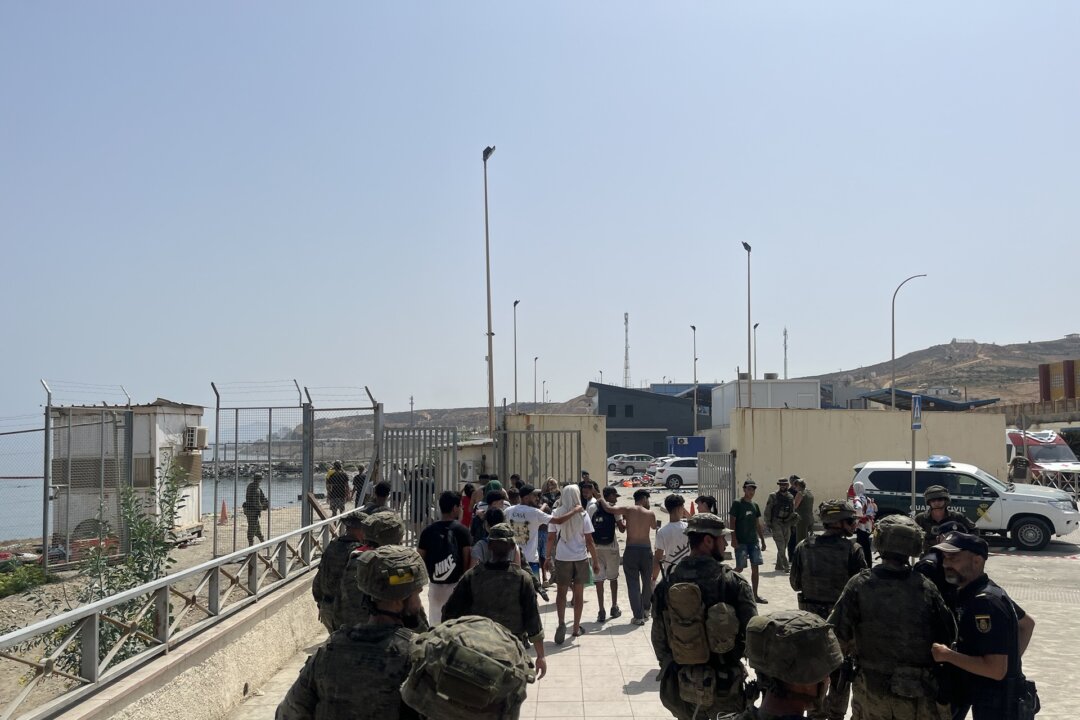

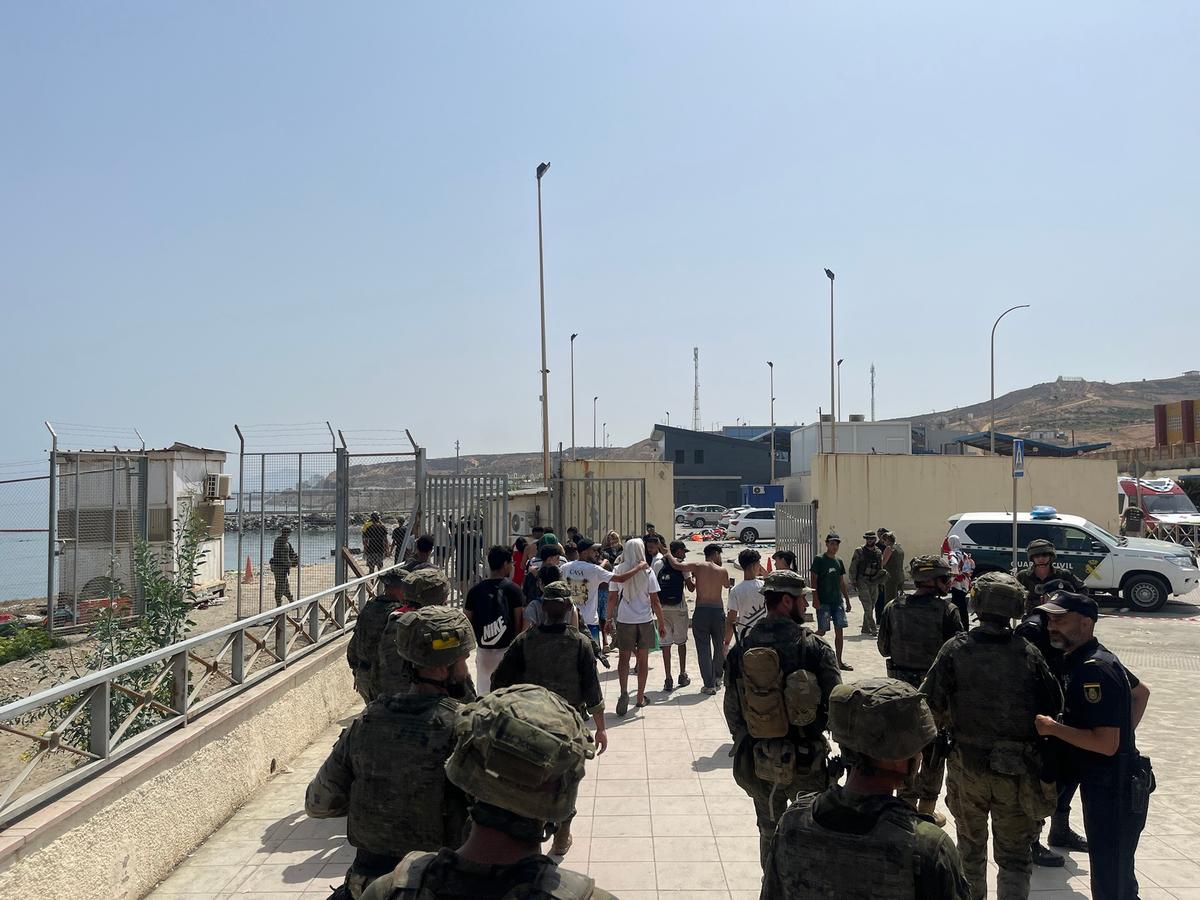
Spanish soldiers and Guardia Civil officers escort a group of young migrants back toward Morocco near the coastal border in Ceuta, Spain, on Aug. 1, 2026. Etienne Fauchaire/The Epoch Times
CEUTA, Spain—By Saturday, Aug. 1, the beach where tens of thousands of illegal immigrants came ashore in Ceuta stood largely empty and patrol boats idled beside 500 meters of floating containment barrier that had gone up only that morning.
But the impact of the mass influx of humans on the city of 84,000 was not over.
While some had returned across the border to Morocco, others had moved inland. Masses of illegal immigrants remained scattered across the city, waiting in doorways, side streets, and outlying neighborhoods, with no clear answer on how long sending them all back would take.
The city’s President Juan Jesús Vivas, appearing Saturday alongside People’s Party leader Alberto Núñez Feijóo, welcomed the return of many of the illegal arrivals but said “Ceuta has not achieved normality,” with several thousand still to be sent back amid a climate of unease.
Residents who spoke with The Epoch Times blamed Prime Minister Pedro Sánchez’s government for the breach and doubted the remaining removals would be quick, with several saying the scenes were reminiscent of events from 2021.
Soldiers and local police spent Saturday sweeping neighborhoods where small encampments of illegal immigrants had formed, directing them back toward the border and making clear that no regularization of such arrivals from Morocco was coming.
The Civil Guard was also assigned to watch El Tarajal beach to deter fresh arrival attempts and to limit the risk of drownings, a soldier posted nearby said.

The newly installed 500-meter floating barrier off Tarajal beach at the Ceuta–Morocco maritime border on Aug. 1, 2026. Etienne Fauchaire/The Epoch Times
Only the previous evening, The Epoch Times had witnessed illegal immigrants, far fewer than at the peak, still swimming into Ceuta unimpeded.
Sánchez’s Government Under Pressure