Spain’s Canary Islands Reel From Surge of Migrants From Africa
 Etienne FauchaireUpdated 7 hours Ago5 Mins read
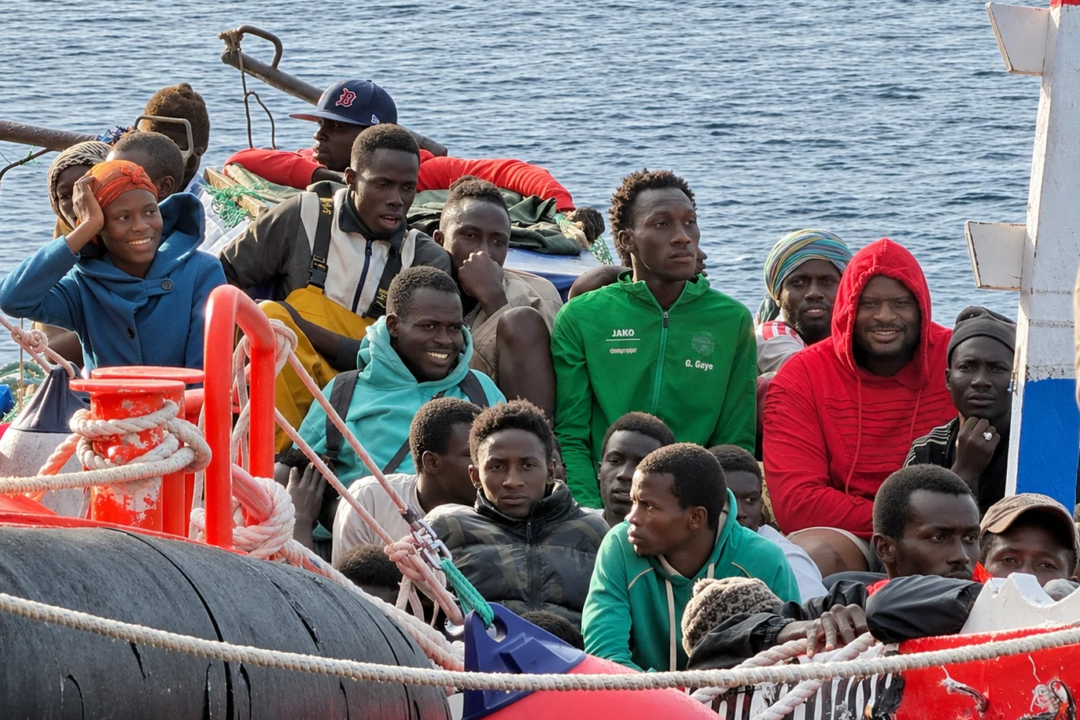
EL HIERRO, Spain—Shortly before noon on Sunday, a wooden fishing boat carrying hundreds of African migrants was brought into the small harbor of La Restinga, on the southern tip of the Spanish island of El Hierro.
About half an hour later, a second boat arrived with dozens more on board. An hour after that, hundreds more followed.
In total, El Hierro received 1,261 migrants aboard seven boats on Sunday alone, topping 1,000 arrivals for the second consecutive day, according to Spanish news agency EFE. The smallest and westernmost of Spain’s main Canary Islands, in the Atlantic off northwest Africa, it has about 12,000 residents.
So far this year, about 17,000 illegal migrants have landed there, out of roughly 27,000 for the whole archipelago, Territorial Policy Minister Ángel Víctor Torres told reporters on Sunday during a visit to La Restinga.
Since Nov. 1, the island has received 96 migrant boats, compared with 66 in the first 10 months of the year, EFE reported. Most of Sunday’s boats had left Senegal or Gambia, two majority-Muslim African countries, five to eight days earlier.
The new migration crisis has stoked tensions on the island, where many residents call the situation untenable and blame the policies of Socialist Prime Minister Pedro Sánchez.
“This is not emigration, it’s an invasion, same as Ceuta,” Severo, 79, a retiree born on El Hierro, told The Epoch Times.
“Sánchez has a big responsibility in this situation,” Severo said. “His policies create a pull effect.”
The illegal arrivals come two weeks before the Nov. 29 general election, with conservative opposition parties accusing the Socialist government of failing to control the country’s borders. They point to the Canary Islands and to Ceuta, the Spanish enclave on the North African coast, where tens of thousands of migrants crossed from Morocco in late July.

Migrants wrapped in Red Cross blankets stand behind a fence at a sports complex being used to accommodate overflow from an overcrowded migrant reception center on El Hierro, Spain, on Nov. 14, 2026. Etienne Fauchaire/The Epoch Times
Residents Protest at the Dock
On Nov. 13, as the election campaign opened, residents gathered at the La Restinga dock to denounce what they called “an invasion.”
The village’s neighborhood association has called daily 5:30 p.m. gatherings at the port and launched a petition to demand action from the authorities.
Maria, a resident at the protest, told The Epoch Times the situation was “chaotic.”
“We have been left without doctors many times, without ambulances, and they have everything,” she said.
About a third of the roughly 30 beds in the island’s hospital are occupied by migrants, Torres said on Sunday.
Maria said that the dock and the village beach were closed to residents, that holiday rentals were being canceled, and that people from other parts of the island no longer came to La Restinga for the day.
The local council said in a statement on Nov. 8 that it closed the beach as a precaution due to efforts to remove abandoned migrant boats and the risk of potential spills into the sea during the operations.
Regarding the plans to transfer the migrants to mainland Spain, Maria said the problem “has to be fixed over there, in their own country,” with help from the European Union and the Catholic Church.
Arrivals Move From Dock to Reception Center
On the La Restinga dock, Red Cross teams give each migrant water, food, a blanket, and dry clothes and record where they come from, Dácil León, who heads the organization’s emergency unit in Santa Cruz de Tenerife, told The Epoch Times.
People step off the boats wet, dehydrated, and sometimes with abrasions on their skin after days at sea, she said.
“In the end, they come looking for a better life,” León said.
Regarding relations with residents, León said the Red Cross works inside the dock and “tries to be on good terms with the population.”
“What our humanitarian work comes down to is helping those who need it most, and so we understand that we all have to respect one another,” she said.
There are nonetheless some tensions with some residents. “A Red Cross official tells us, a lady and me, that he is more afraid of the people of the village of La Restinga than of the immigrants,” Maria said at the protest, adding: “That is just not right.”
The Epoch Times could not verify the exchange.

A Red Cross worker assists a migrant at the port of La Restinga on El Hierro, Spain, on Nov. 13, 2026, amid a surge in migrant arrivals from West Africa. Etienne Fauchaire/The Epoch Times
From La Restinga, migrants are taken by bus about 16 miles uphill to San Andrés, where a temporary police-run reception center has tents and cabins. A nearby sports hall has also been turned into a shelter.
On Sunday, 1,606 migrants were staying at these facilities and Red Cross centers, said Alpidio Armas, the president of the Cabildo de El Hierro, the island’s governing body. About 900 were expected to leave the island that day, with more transfers planned for Monday.
Migrants Name France, Italy, and Germany as Destinations
Several migrants housed at San Andrés told The Epoch Times that they want to travel on to other European countries.
Among them, Amadou, 29, from Senegal, explained on Saturday that he had arrived in a group of 215 people and had been at the center for a week. He said he had worked for a French company in Senegal.
“The quality of life in Senegal is not very good,” he said. “That is why we decided to come here, for work.”
People leaving Senegal pay smugglers between 300,000 and 500,000 CFA francs ($510 to $850) for a crossing that takes five to seven days, he said.
Several others said they had paid 400,000 CFA francs ($680), even though at one point, another man walked up and insisted that “we paid nothing.”
Amadou said the migrants had been told at the center that they would be sent on to mainland Spain. It would be “cool” if he could reach France, he said.

Migrants wrapped in Red Cross blankets line up inside a migrant reception center on El Hierro, Spain, on Nov. 14, 2026, amid a surge in arrivals from West Africa. Etienne Fauchaire/The Epoch Times
Yacou, 27, who told The Epoch Times he was a baker, also wants to go to France. Three men in their 20s who said they had been fishermen named Italy, another man named Germany, and others said they hoped to stay in Spain.
About 90 percent of those reaching the island come from Senegal, according to Armas.
Opposition Blames Sánchez Ahead of Vote
No end has been announced to the transfers and arrivals, which continue to fuel debate on the island.
Sánchez said in a television interview on Nov. 9 that the surge was “quite usual at this time of year” because of calm Atlantic seas, and argued that illegal arrivals in the Canary Islands had dropped by 70 percent over the past year.
El Hierro’s island council declared a social emergency on Nov. 6. Four days later, the central government declared a migration emergency in the Canary Islands and approved 15.18 million euros ($17 million) for reception places and transfers, plus 1 million euros ($1.1 million) for the Red Cross.

A Spanish maritime rescue vessel alongside a boat carrying migrants at the port of La Restinga on El Hierro, Spain, on Nov. 13, 2026, amid a surge in migrant arrivals from West Africa. Etienne Fauchaire/The Epoch Times
With the election approaching and Sánchez already facing heavy criticism over the situation in Ceuta, Spain’s conservative opposition parties have stepped up their attacks on the Socialists’ handling of this new migration crisis.
Vox leader Santiago Abascal wrote on X on Nov. 7 that El Hierro was living through “another invasion,” accusing Sánchez and the regional government of seeking to quickly spread the migrants across Spain.
In an interview on Antena 3, Popular Party leader Alberto Núñez Feijóo said on Nov. 11 that Spain has “had an absolute lack of immigration policy for a long time” and that government decisions, including a mass regularization of hundreds of thousands of migrants, have created a pull effect.







Is Autumn Glow the Next Winx? Inside the Making of a Racing Superstar
Autumn Glow now has six Group 1 victories—and she is fast becoming...

Womens’ Rights Advocate to Run for One Nation in NSW
Former Liberal candidate for Warringah Katherine Deves waits for Prime Minister Scott...

MP Marks ‘Positive Moment’ in Recovery Following Car Ramming Attack Outside Office
Australian independent Member of Parliament Helen Haines speaks to journalists in the...

How a Secret Chinese Police ‘Liaison’ Officer in Vancouver Contacted a Student to Conduct ‘Ideological Work’
When a Chinese student in Vancouver stopped speaking to his parents, an...