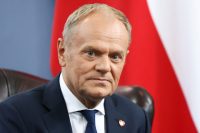




Conservative MP Michael Chong rises during question period on Parliament Hill in Ottawa, April 14, 2026. The Canadian Press/Adrian Wyld
Conservative MP Michael Chong is calling on the federal government to provide Canadians with greater transparency about its spending, echoing concerns recently raised by Canada’s former associate deputy minister of finance.
Chong, the Tories’ shadow finance minister, made the comments in a July 30 statement following a National Post interview with Don Drummond, a former TD Bank chief economist and former associate deputy finance minister, who said he had “never seen such a lack of transparency” in a federal budget.
In his remarks, Drummond cited a lack of information around how the Liberal government reached its NATO defence spending target of 2 percent of GDP. While Drummond said he assumed the figure was 2 percent by 2030, Prime Minister Mark Carney had suggested in May that defence spending would hit 4 percent of GDP by that year, which implied current spending is closer to 2.5 percent.
Chong also cited a recent report by Desjardins Deputy Chief Economist Randall Bartlett, who said new federal commitments could add $40 billion in spending over the next decade, beyond what Ottawa was announced in the last fiscal update in April. Prior to the release of that fiscal update, Carney said nearly half of its measures were based on affordability for Canadians, and that Canada had the strongest fiscal position in the G7.
Since that update, Carney has announced new spending initiatives such as a food security strategy, a national AI strategy, and a cooperative prosperity agreement with British Columbia.
Chong said that for every dollar Carney spends that has not been budgeted for, “a dollar must be borrowed, adding to the federal debt.” Chong noted that Fitch Ratings
warned a year
ago that a rise in Canada’s deficits and debt-to-GDP ratio could lead to a credit rating downgrade. Last November,
the ratings agency warned
that Canada’s finances “run a high risk of further deterioration.” Fitch continues to give Canada an AA+ credit rating.
The Parliamentary Budget Office (PBO) estimated in a June report that the government’s budget deficit for 2026 would be $4.6 billion higher than it projected in its spring economic update.
While the federal government’s April update had projected a $66.9 billion deficit for the 2025-26 fiscal year compared to the November budget’s projection of $78.3 billion, the PBO forecasted a $72 billion deficit “as modest revenue growth is outpaced by growth in expenses.”
Chong also noted that the PBO has warned the government against abandoning “longstanding definitions of capital and operational spending.” The PBO said in October that the government’s definition of capital spending was “overly expansive.”
The government’s Budget 2025 set two fiscal anchors: balancing operating spending with revenues by 2029, and maintaining a declining deficit-to-GDP ratio. Unlike previous budgets, it did not include a declining debt-to-GDP ratio.
Carney has called the budget an attempt by his government to “spend less so the country can invest more” and eventually achieve a “declining level of debt.”
At a NATO Summit in Turkey
in July,
Carney said his government would commit to “lay out—in the budget—an update with the decisions we’re taking, where the fiscal track is, where the defence spending is.”