

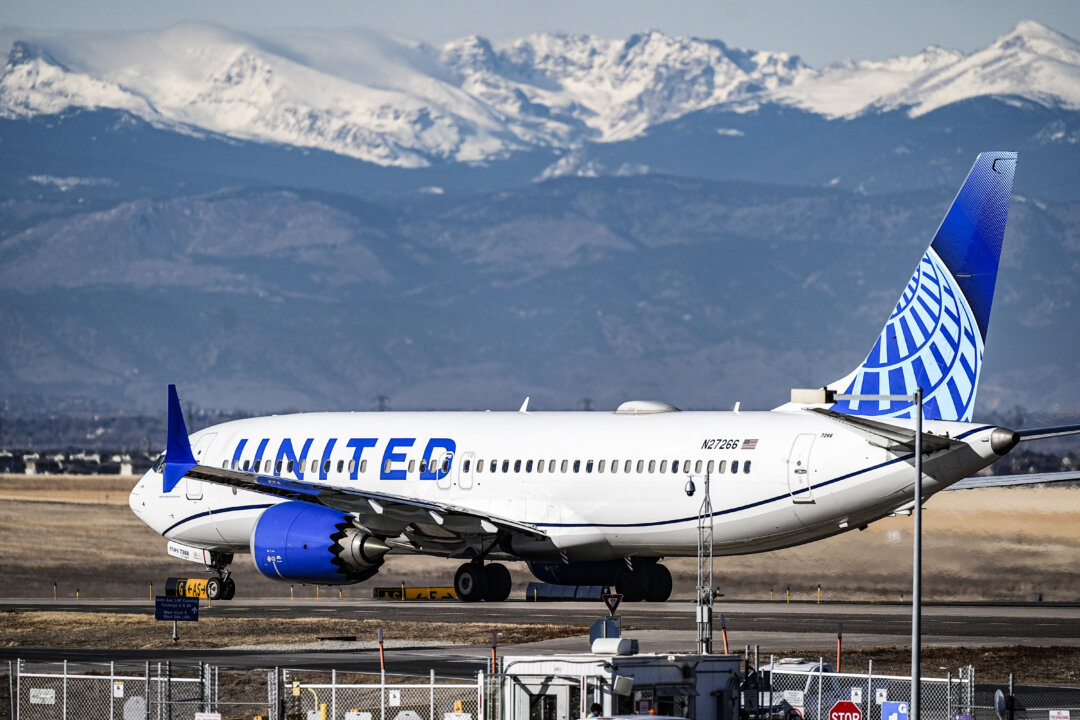
United Airlines has announced flights to 10 new international cities beginning next year, with nine of the locations in Europe.
Beginning as early as March 2027, United will provide flights from San Francisco International Airport to Okinawa, Japan. From Washington Dulles International Airport, flights will be offered to Toulouse, France.
From Newark Liberty International Airport, eight flights will be offered: to Luxembourg City in Luxembourg, Marseille in France, Terceira in Portugal, Ljubljana in Slovenia, Ibiza and Valencia in Spain, and Olbia and Catania in Italy, United said in an Aug. 25 statement.
Except for the two Italian cities, United is the only American airline to offer nonstop flights from the United States to the other eight cities, according to the company.
In addition to the new destinations, United announced it would add flights from Denver to Paris; Washington, D.C., to Milan, Italy; and Los Angeles to Osaka, Japan. The airline also plans to restart service from San Francisco to Tel Aviv, Israel.
This is the “largest international network expansion” in the company’s history, United said. “The announcement builds on nearly a decade of international growth, with United adding 58 international destinations to its route map since 2017.”
United now flies to more than 160 international destinations.
The expansion was announced by United at an event at Newark Liberty International Airport, where the company also debuted the newest aircraft added to its fleet—the A321XLR model from Airbus. Flights to Toulouse, Luxembourg City, Marseille, Ibiza, and Valencia will use the A321XLR model.
According to Airbus, the A321XLR has a maximum seating capacity of 244 passengers and offers 11 hours of nonstop flight time. It has 30 percent lower fuel burn and carbon dioxide emissions per seat.
“We offer the most flights across the Atlantic and Pacific and Newark is the best Atlantic gateway in the country—so far this year, it’s the most on-time airport in the New York City area,” Scott Kirby, CEO of United Airlines, said in the statement.
“We’re going to keep building on that momentum as we welcome the new A321XLR to our fleet.”
According to the company, United will serve more destinations in France, Italy, Portugal, Spain, and Japan than any other American carrier.
This is one of the latest service expansions unveiled by United. On June 29, the airline announced new nonstop service from Houston and Washington, D.C., to Cartagena, Colombia, scheduled to begin on Dec. 17. The company will be flying a Boeing 737 on this route.
Other airline operators have also announced new flights in recent months. On Aug. 7, Delta Airlines said it plans to launch a new nonstop service between Seattle-Tacoma International Airport in the United States and Tokyo-Narita International Airport in Japan beginning March 2027.
On May 21, American Airlines announced the launch of four new flight routes to Europe. Two services connected Dallas-Fort Worth to Athens, Greece, and Zurich, Switzerland. The remaining two connected Philadelphia to Budapest, Hungary, and Prague, Czech Republic.
Q2 Results
United’s announcement of 10 new international destinations comes as the company last month reported second-quarter 2026 profits that “exceeded expectations,” according to a July 15 statement from the airline.
Total operating revenue was up 16 percent from the second quarter (Q2) of 2025, with the company achieving its best customer satisfaction scores for a second quarter since 2021. United served 240 airports in the United States and Canada during the quarter. Fuel expense in the second quarter was up 84 percent year over year.
“United is built to thrive in every environment, and when oil prices spiked in March, we quickly and decisively acted to adjust our schedules, while simultaneously doubling down on our customer investments,” Kirby said in the statement.
Meanwhile, United
on March 24 that it expects to take delivery of more than 250 new aircraft by April 2028. This includes 47 Boeing 787-9 Dreamliners with new, premium-heavy cabins and 28 Airbus A321XLRs, which will replace some of the Boeing aircraft.