Majority of Canadians now see U.S. as an enemy, and Trump is the reason: poll
 Kenn OliverUpdated 4 hours Ago8 Mins read

Canadians may start to realize that a change at the White House, even to a Democratic president, won’t fix the ‘basket case’ the U.S. has become
Published Sep 05, 2026
Last updated 14 hours ago
8 minute read

Article content
For as long as anyone can remember, Canada and the U.S. have arguably been the world’s closest of allies and friends. The sibling settler-colonial nations sharing the world’s longest undefended border are deeply linked, culturally and economically, with any differences historically resolved respectfully.

THIS CONTENT IS RESERVED FOR SUBSCRIBERS
Enjoy the latest local, national and international news.
- Exclusive articles by Conrad Black, Barbara Kay and others. Plus, special edition NP Platformed and First Reading newsletters and virtual events.
- Unlimited online access to National Post.
- National Post ePaper, an electronic replica of the print edition to view on any device, share and comment on.
- Daily puzzles including the New York Times Crossword.
- Support local journalism.
SUBSCRIBE FOR MORE ARTICLES
Enjoy the latest local, national and international news.
- Exclusive articles by Conrad Black, Barbara Kay and others. Plus, special edition NP Platformed and First Reading newsletters and virtual events.
- Unlimited online access to National Post.
- National Post ePaper, an electronic replica of the print edition to view on any device, share and comment on.
- Daily puzzles including the New York Times Crossword.
- Support local journalism.
REGISTER / SIGN IN TO UNLOCK MORE ARTICLES
Create an account or sign in to continue with your reading experience.
- Access articles from across Canada with one account.
- Share your thoughts and join the conversation in the comments.
- Enjoy additional articles per month.
- Get email updates from your favourite authors.
THIS ARTICLE IS FREE TO READ REGISTER TO UNLOCK.
Create an account or sign in to continue with your reading experience.
- Access articles from across Canada with one account
- Share your thoughts and join the conversation in the comments
- Enjoy additional articles per month
- Get email updates from your favourite authors
Sign In or Create an Account
or
Article content
But as the trade war initiated by U.S. President Donald Trump drags on, getting uglier every day, a growing number of Canadians have a very different view of America: our “enemy.”
Article content
Article content
Article content
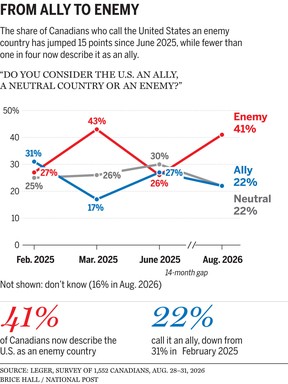
New polling by Leger found a strong plurality of Canadians (41 per cent) consider the U.S. an enemy country before an ally or neutral (both at 22 per cent).
Article content
By signing up you consent to receive the above newsletter from Postmedia Network Inc.
Article content
“Donald Trump, man, he can move public opinion like nobody’s business,” Leger vice-president Andrew Enns told National Post in an interview.
Article content
More than half (51 per cent) of those 55 or older perceived the U.S. as an enemy, only 13 per cent of whom see it as neutral. Meanwhile, Quebecers were the Canadians most likely (49 per cent) see the U.S. in that light and the least likely to consider it an ally (17 per cent) or neutral (20 per cent), one of several times an “exclamation point” appeared on some Quebec results.
Article content
Enns said they related to the province’s election this fall, which the Trump factor has unavoidably entered into.
Article content
“It’s helping, I would suggest, some of those federalist parties,” he said. “It’s probably creating some grief for the PQ, the front-runner in that election, as they’re trying to sort of navigate this.”
Article content
Article content
Even with the recent sharp movement in how Canadians characterize the U.S, Leger’s results indicate most still distinguish between America the country and the Trump administration ruling it. When asked if his leaving office would change their impression, 64 per cent said yes, 21 per cent said it wouldn’t and 14 per cent were unsure.
Article content
Article content
Results indicate Quebecers and women would be most open to a change of heart, with 72 and 71 per cent saying Trump’s departure would alter their impression of the U.S. and only 16 per cent, respectively, saying it wouldn’t change a thing. British Columbians (30 per cent) and men (27 per cent) were the least amenable to a new way of thinking.
Article content
Article content
Brian Rathbun, a professor of international relations and political science at the University of Toronto’s Munk School of Global Affairs and Public Policy, said that while Canadians may recognize that most Americans don’t support the way Canada’s being treated, it’s important to remember that Americans, simply as a function of their larger economy and population, are somewhat indifferent to Canadians.
Article content
“But at some point, I think Canadians will start to get frustrated if this persists, even if it’s not what the American public wants,” Rathbun told National Post in an interview.
Article content
“They can say, ‘Why is it that no one’s standing up to this particular bully?’ Then I think that you could get into something like a deeper problem that couldn’t be fixed by kicking this guy out.”
Article content
Rathbun, himself an American who moved to Canada in April 2024 from southern California, said Canadians may be starting to realize that a change in leadership — “even with a Democratic president” — won’t fix the “basket case” the U.S. has become.
Article content
“It’s become something of an ungovernable country,” he said.
Article content
Leger landed on enemy as a “black and white” catch-all against ally or neutral for people who felt negatively towards the U.S., Enns explained, acknowledging it could mean something different to some, including those who legitimately fear the U.S. will try to invade Canada.
Article content
It’s not the first time they’ve felt this way.
Article content
Article content
Last March, after months of enduring Trump’s jabs at Canada and two weeks into Prime Minister Mark Carney’s “Elbows Up” bid to see the Liberals retain government, 43 per cent saw the U.S. as an enemy. But that number dropped precipitously to 27 per cent in a poll last June after it seemed as though cooler heads might prevail.
Article content
Fast forward to this summer, noted Enns, and Trump’s “really, really deliberate comments around Canada” have permeated into “a pretty broad sentiment across the country.”
Article content
Article content
Rathbun isn’t surprised by the 41 per cent who see the U.S. as an enemy, and reasoned that, unlike Russia, for example, many “Canadians feel like American policy is more malicious vis-à-vis Canada” because it’s more direct.
Article content
Both he and Enns agree the freshly stoked rhetoric from Trump and his administration — some of it entirely separate from the trade discussion — is only making things worse. This week alone, aside from Trump blasting Canada on Truth Social, U.S. Treasury Secretary Scott Bessent took a shot at the Canadian Navy’s aging submarine fleet and Secretary of Defence Pete Hegseth was accused of body-shaming Canadian cadets.
Article content
Enns said the proportion seeing the U.S. as an enemy could climb if Trump and his ilk continue to “double down” on disparaging Canada.
Article content
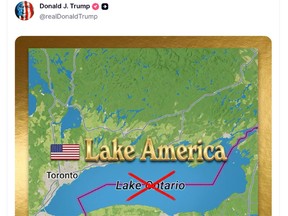
Rathbun highlighted the Lake Ontario-Lake America discussion as a “classic example.”
Article content
“It’s entirely unimportant what the Americans call Lake Ontario, and yet, at the same time, it probably galls us more than softwood lumber tariffs, unless we’re in the softwood lumber industry,” he said. “Why? Because it’s indicative of a lack of respect, and respect is so basic to our self-understanding of ourselves as people.”
Article content
Article content
Article content
Leger also sought to gauge Canadians’ feelings on tariffs — both those initiated by Trump and those Canada has launched or promised to in retaliation.
Article content
A large majority (87 per cent) of Canadians expect Trump’s tariffs will have some level of impact on their personal financial situation, whether small (24 per cent), moderate (40 per cent) or major (24 per cent), and 38 per cent are somewhat (22 per cent) or very (16 per cent) concerned about losing their job in the next 12 months — especially in Ontario (49 per cent) and among 18-34-year-olds (46 per cent).
Article content
As for Canada’s latest economic riposte, Ottawa announced “new countermeasures on $27.6 billion in products imported from the U.S.” effective Sept. 8. The 15 to 50 per cent levies will apply to U.S. steel, aluminum, dishwashers, refrigerators, video game consoles, cheese, beauty products, plywood, paper products and clothing, among others.
Article content
Almost three-quarters of Canadians (74 per cent) agree with the counterattack, with only 13 per cent dissenting and the remaining 13 per cent unsure or preferring not to answer.
Article content
Solidarity with Canada’s reprisal peaked among the 55-plus crowd (83 per cent) and in B.C. (80 per cent), but wasn’t far off in Quebec (78 per cent). Respondents in Manitoba and Saskatchewan were most likely to disagree (22 per cent).
Article content
Canadians by and large (78 per cent) expect Ottawa’s retaliation will result in higher prices paid by Canadian consumers, but 66 per cent agree with Canada’s clapback, with the strongest support from those 55-plus (76 per cent), men (71 per cent), and people in B.C. (72 per cent). Just over a fifth of respondents (21 per cent) are against the retaliation.
Article content
Enns said the results tell him there “are some conflicting opinions within the Canadian public and at some point, the ‘Ra-Ra, Canada-proud, sticking to the American with some tariffs,’ could start to soften if it becomes really painful for households’ pocketbook.
Article content
“If this thing just sort of settles and all of a sudden we’re into the fall going into the winter, we’re not talking necessarily about Donald Trump and maybe his insults aren’t making the front pages,” he said. “But what might be making the front pages is suddenly the impact on food prices.”
Article content
Article content
Article content
That’s a topic already on respondents’ minds, evidenced by the 35 per cent who cited inflation and rising cost of items as the top issue facing Canadians. Trump, his tariffs and U.S. aggression were the second biggest (24 per cent), followed by health care (10 per cent) in a distant third.
Article content
Enns and Rathbun warned the conflict of tariffs and the cost of living could put some heat on Carney and the Liberals.
Article content
“The big question is, and the big challenge for a leader, is how long you can persist in that course and basically how much resolve ordinary Canadians will have? We don’t know,” said Rathbun. “Because it’s easy to say this now because we haven’t really paid the price yet.”
Article content
Still, he said the “childish” and “bullying” behaviour from the U.S. side is only emboldening Canadians and likely helping Carney’s cause.
Article content
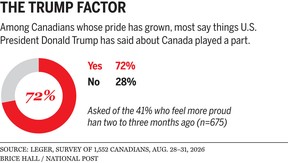
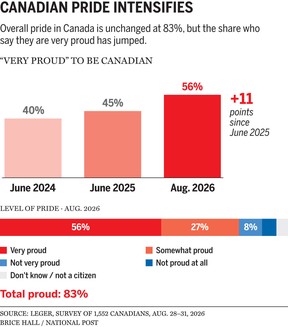
Canadians may be willing to endure blows in the trade war because national pride has surged since it began, according to polling data.
Article content
A plurality of Canadians (83 per cent) say they are proud to be Canadians, but the proportion who feel very proud (56 per cent) increased by 11 points since polling last June, and up from 40 per cent in 2024. Only 13 per cent said they weren’t very proud (eight per cent) or not proud at all (five per cent).
Article content
Article content
“The overall pridefulness of Canadians hasn’t wavered much since we started asking that question around when all this sort of stuff started happening in 2025, but the intensity really, really jumped up,” Enns said.
Article content
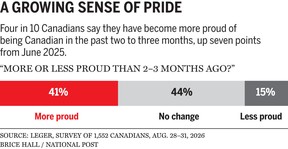
Since the trade war hit a fever pitch this summer, 41 per cent told Leger they feel more proud, including 45 per cent of Ontarians and men. Only 15 per cent are less proud and 44 per cent said their level of pride hasn’t changed.
Article content
Article content
Overall net pride was highest in Ontario and B.C. (85 per cent, respectively), among women (86 per cent) and 55-plus Canadians (88 per cent). And while Quebecers were the most likely to say they are not proud to be a Canadian (17 per cent), 79 per cent of them still expressed pride.
Article content
Rathbun said that sense of nationalism is understandable and offered a different perspective.
Article content
“It’s also understandable that Canadians feel more pride, even though nothing about Canada has changed — it’s the Americans that are essentially reducing American pride,” he said, “So that pride is really just a reaction to something that they don’t like somewhere else.”
Article content
Canadians also remain steadfast against becoming the 51st state (85 per cent opposed), again with Quebecers (89 per cent) and the 55-plus group (93 per cent) opposed. British Columbians (13 per cent) and the 18-34 crowd (14 per cent) showed the most support.
Article content
The survey of 1,552 respondents in Canada was conducted by Leger between Aug. 28-31. For comparison purposes, a probability sample of 1,552 respondents would have a margin of error no greater than plus or minus 2.48 per cent, 19 times out of 20.
Article content
Our website is the place for the latest breaking news, exclusive scoops, longreads and provocative commentary. Please bookmark nationalpost.com and sign up for our newsletters here.
Article content







Three discoveries that transformed how we understand nutrition
When we think about nutrition, we almost always picture the same key...

The EU’s repair policies are changing the way tech is designed
In the late 1970s, concerned by resource use and scarcity, German industrial...

Why it’s so hard to apologise sincerely in a foreign language
When people apologise, they do more than acknowledge a mistake. They also...

Mass Migration and the Expanding State
By Liam DeBoer |BlendrNews.com Western governments have many incentives for mass migration....