Article content
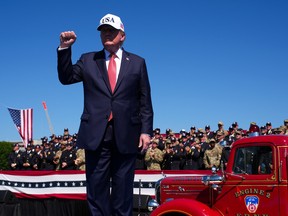
WASHINGTON, D.C. — Canada-U.S. trade tensions are at a fever pitch after U.S. President Donald Trump unveiled a series of executive orders on Tuesday banning some alcoholic beverages and dairy products from being imported to the United States.

THIS CONTENT IS RESERVED FOR SUBSCRIBERS
Enjoy the latest local, national and international news.
- Exclusive articles by Conrad Black, Barbara Kay and others. Plus, special edition NP Platformed and First Reading newsletters and virtual events.
- Unlimited online access to National Post.
- National Post ePaper, an electronic replica of the print edition to view on any device, share and comment on.
- Daily puzzles including the New York Times Crossword.
- Support local journalism.
SUBSCRIBE FOR MORE ARTICLES
Enjoy the latest local, national and international news.
- Exclusive articles by Conrad Black, Barbara Kay and others. Plus, special edition NP Platformed and First Reading newsletters and virtual events.
- Unlimited online access to National Post.
- National Post ePaper, an electronic replica of the print edition to view on any device, share and comment on.
- Daily puzzles including the New York Times Crossword.
- Support local journalism.
REGISTER / SIGN IN TO UNLOCK MORE ARTICLES
Create an account or sign in to continue with your reading experience.
- Access articles from across Canada with one account.
- Share your thoughts and join the conversation in the comments.
- Enjoy additional articles per month.
- Get email updates from your favourite authors.
THIS ARTICLE IS FREE TO READ REGISTER TO UNLOCK.
Create an account or sign in to continue with your reading experience.
- Access articles from across Canada with one account
- Share your thoughts and join the conversation in the comments
- Enjoy additional articles per month
- Get email updates from your favourite authors
Sign In or Create an Account
or
Article content
Trump’s announcement came in response to Canadian retaliatory tariffs that went into effect this week on nearly $28 billion worth of U.S. imports, which were part of a tit-for-tat escalation in the trade war between the two countries.
Article content
Article content
Article content
National Post reached out to Charles Benoit, trade counsel for the Washington-based Coalition for a Prosperous America, a U.S. advocacy group that champions tariffs and industrial protection. Benoit argues that more home market protection — not freer trade — would benefit both the United States and Canada.
Article content
By signing up you consent to receive the above newsletter from Postmedia Network Inc.
Article content
The following Q&A has been edited and condensed for clarity.
Article content
From your perspective, why did the Canada-U.S. trade talks break down?
Article content
Charles Benoit: What they’ve really coalesced around is harmonization of the steel, aluminum, and automotive tariffs. Ambassador (Jamieson) Greer was explicit about this in his big interview with CBC — that’s the U.S. line. And Prime Minister (Mark) Carney has made this about Canada’s ability to have other trade deals, which lines up with what Greer was more specific about: harmonized steel, aluminum, and automotive.
Article content
Those were the three big Section 232 actions that were launched back in the first Trump administration, so it makes sense why those three sectors were chosen.
Article content
I think the big thing to look at is — what has Mexico done that Canada hasn’t? Mexico’s not negotiating any new FTAs (free trade agreements). Canada’s still negotiating an FTA with India, for example.
Article content
Article content
At one point, the language of the (now scuppered Canada-U.S. interim deal was), “At least consult with us before you commit to duty-free cars, steel and aluminum tariffs in new FTAs,” and that seems to have been too far for Carney.
Article content
If you had to really pick one thing that caused Canada to walk away, I think it’s that. I think that they wanted the ability to offer unlimited duty-free on steel, aluminum, and automotive, specifically in their India FTA.
Article content
Your coalition campaigned against a prospective deal to reduce U.S. tariffs on Canadian downstream aluminum. Why?
Article content
A core constituency of our group is metal fabricators. We represent all sorts of industry and also agriculture, but we’ve got this backbone of metal fabricators.
Article content
At the end of the day, cross-border price competition doesn’t work when metal costs a lot more in the United States. For aluminum, it’s off the charts. We made the decision as a country to tariff primary aluminum, and as a result, aluminum is a dollar a pound more in the United States than in Canada or Mexico. You just can’t compete with that spread.
Article content
One of the things that was on U.S. offer in the Canada deal was reducing the tariff on downstream aluminum goods. From what was reported, the tariff concession went from 50 per cent to 25 per cent for Canadian aluminum goods.
Article content
If an aluminum extruder, or anyone working with aluminum in America, is paying a dollar a pound more, 50 per cent on the downstream product — on an aluminum billet or can sheet or whatever — just barely gets you to even competition with Canada and Mexico, because you’re paying so much more for the metal.
Article content
Cutting the tariff to 25 per cent for Canada — and if Canada got that deal, Mexico would get the deal — would have been immediate offshoring of all downstream aluminum fabrication in America. So, 100,000 jobs gone. That’s what drove us to be a vocal opponent.
Article content
Do you see tariffs on Canada primarily as leverage to win concessions from Ottawa, or as long-term protection for U.S. industry?
Article content
The point is not to get concessions from Ottawa. Chasing exports is a bad policy.
Article content
To win market access, you’re inevitably sacrificing one producer’s home market sales for another producer’s export sales. Any time you win market access for one of your producers, the other country inevitably demands the same. You’re trading away one domestic producer’s ability to sell in their own market for another producer’s ability to sell to export.
Article content
Article content
Take Canada dairy: I don’t want to see Canadian dairy farms close so that Stellantis can maybe get another few years out of that Brampton facility for exports. It’s a terrible trade for Canada.
Article content
I’m trying to explain why both sides lose from free trade. Free trade drives global consolidation. If Canada gives up more dairy access, the dairy farmers aren’t going to win. They’re just going to go out of business immediately.
Article content
In the same way, when aluminum is a dollar a pound cheaper in Canada, if we give up access on aluminum extrusion, we’re just offshoring our guys. That’s all it is. It’s consolidation to where costs are lowest, and that’s a race to the bottom that hurts both countries.
Article content
But many Canadian firms have U.S. plants, and U.S. manufacturers rely on Canadian inputs. Why target Canada rather than focusing tariffs on China or other non-market competitors?
Article content
We do not support retaliatory tariffs. We support sectoral tariffs for protection. We don’t support the 338 action. We don’t want that. It’s making reshoring more difficult, and a lot of our members are being hurt.
Article content
Article content
No manufacturer is making investments because they expect retaliatory tariffs to stick around. They freeze up economic activity, or they cause some sort of rush which then leads to a lull. It’s all bad.
Article content
Canada’s retaliatory tariffs are really bad. Appliances are a big one. Canada doesn’t make appliances. Why are they tariffing American appliances? It comes at a really bad time for American appliances because if you walk into a Costco, a lot of them are from China or they’re Chinese brands from third countries.
Article content
The tariff war is bad. We do not support retaliation. We don’t support chasing exports.
Article content
Is the Trump administration’s approach a negotiating tactic, or a broader rejection of the old North American free-trade model?
Article content
I really lament the situation. Canada has been badly served by free trade, like the United States. They’ve both been done terribly.
Article content
Automotive is the easiest example. In the United States, we were down to only half the cars sold here being assembled here. Canada has lost almost 50 per cent of its vehicle assembly in just the last decade. Canada has similarly lost over a million vehicles, which is way more significant for Canada.
Article content
We’re both losers here. The U.S. decided enough’s enough. Now, that’s really tough for Canada. Canada has lost so much to Mexico, and then to have the U.S. say, “Well, we’re done. We’re tired of losing” — it’s a very, very tough position for Canada to be in.
Article content
The (United States Trade Representative) was willing to give Canada a better deal on automotive. Reportedly, the deal that was on offer to Canada was the same 15 per cent that applies to Europe, Korea and Japan, but with a carveout for U.S. content. That’s technically a better deal. It probably wasn’t enough to sustain vehicle production in Canada. I accept that. So, that’s a really tough spot.
Article content
If I’d been Carney, I would have said, “Look, if we accept this deal, we’re just losing all vehicle assembly. We can’t do that.” I would have asked for something like 600,000 cars a year, where it’s a one-to-one number and it’s duty-free.
Article content
That would have been the move for Canada. We didn’t oppose the automotive deal with the U.K. last year, which had a similar quota structure. With quotas, you understand exactly what we’re giving up and what we’re gaining.
Article content
Article content
So what should Ottawa do now?
Article content
Dial it way down.
Article content
I would have told the provinces to knock it off with the formal (alcohol) ban, because that’s clearly really irritated (the United States Trade Representative), and I understand it. California wine growers are not anyone to be trifled with.
Article content
I would have sought a quota deal for as many units — whether it’s 600,000, 700,000 — as they could be truly duty-free to the U.S. as possible. That’s what I would’ve done if I was Carney. I think Canada would be in a much better place.
Article content
Canada could get so many economic wins by capturing its own market. Stelco is Canada’s second-largest steel mill, and most of the Canadian steel market belongs to overseas Asian imports. Why doesn’t Canada try to get some of that back for its own mills?
Article content
Hyundai and Kia, the European OEMs, do a lot of business in Canada, but have no Canadian assembly. If I were prime minister, that would be unacceptable.
Article content
You’ve got a top Canadian steel mill and a top Canadian steel fabricator begging the government: “We’re dying from Asian imports. Why don’t we try to get some of our own market?” All these new pipelines, they’re going to be made with Chinese steel. If it’s not Chinese, it’ll be Korean.
Article content
Article content
What would an off-ramp from the current tariff conflict look like?
Article content
I would support the president just saying, “Canada’s had enough,” and removing the whole 338 action right away. I don’t think it’s helping anything.
Article content
I have the same advice for Canada: drop the retaliation. Unilaterally drop it. I know it’s probably politically harder for Carney to do, but I do kind of think it’s a mess of his own making.
Article content
Both sides should just unilaterally decide that they’re above this mess and drop retaliatory actions.
Article content
The U.S. needs its sectoral tariffs, and much like with U.K., a quota deal on autos seems reasonable for both countries. I would urge Canada to hold the line on dairy.
Article content
You are a tariff advocate, but you oppose some tariffs, including the U.S. tariff on primary aluminum. How do you decide where tariffs make sense?
Article content
You take everything product by product.
Article content
For aluminum, I think we should abolish the tariff on primary aluminum. We’re not getting the smelters without a long-term government power deal. Or unless the government builds them.
Article content
That’s the only reason we ever had a competitive domestic industry — in the 1940s, the government built 10 smelters, and they became Reynolds Aluminum and Kaiser Aluminum and so forth.
Article content
Quebec got it right. They offer the power deals, which they can do because they own the hydro. The Massena smelter in New York only exists because it gets a public-power deal from the New York Power Authority, which owns the dams.
Article content
So, for aluminum, no tariffs on primary. For steel, the tariffs are working, although there’s always room for improvement. The administration needs to roll up its sleeves and dive into these things product by product.
Article content
Critics say tariffs become permanent protection for incumbent companies without necessarily delivering investment or competitiveness. What safeguards would you want?
Article content
Domestic market competition is so important.
Article content
The steel tariffs are easy because we’ve got competition up and down. Thanks to electric-arc furnaces and mini-mills, we’ve got over 100 market actors just in primary. And thousands of fabricators. We’ve got a competitive market in steel, and we don’t need to offshore metal fabrication for any metal.
Article content
Primary aluminum is the other side of the spectrum. That’s one where competition policy matters. You need a domestic competitive home market. That’s the goal. But it’s a long ways off.
Article content
Article content
I want an abundant, prosperous country, so I look at real output. For aluminum, we’re at a 75-year low — less than 700,000 metric tons of aluminum smelted. Four smelters. That’s terrible, and it’s not getting better. As for steel, how many tons of steel are melted and poured in the U.S.? Down over a decade. How many cars have we assembled? A million less.
Article content
Those are the hard numbers. You have to look sector by sector.
Article content
What is your broader vision for Canada-U.S. trade?
Article content
Top line, I would love to see both countries pursue economic self-reliance.
Article content
We got along extremely well in the latter half of the 19th century and the early 20th century when we both kind of agreed that we don’t want to trade with each other. That was not an antagonistic time. It’s modern global rules-based trade that creates all this antagonism, where people are trained to think of tariffs as a sanction.
Article content
Both countries should pursue economic self-reliance. To the extent we have trade deals, I think they should be managed trade — outcome-focused. Like the U.K. automotive deal.
Article content
Canada has done us a solid by offering the template. In NAFTA and USMCA, people don’t appreciate this, but the U.S. and Mexico went duty-free on everything. Canada didn’t, mainly because of dairy and supply management.
Article content
Article content
That’s why, if you look at the text of USMCA, there’s an Appendix 1. Canada said a hard no on supply management. Because Canada kept milk, and I believe eggs and a couple of things; the U.S. kept its sensitive things like sugar and peanuts. We still have a hard quota on Canadian peanut butter imports, for example, just like Canada has its dairy quota.
Article content
That’s great. That’s the model. To the extent we have agreements managing trade, it should look like USMCA Appendix 1.
Article content
National Post
Article content
Our website is the place for the latest breaking news, exclusive scoops, longreads and provocative commentary. Please bookmark nationalpost.com and sign up for our newsletters here.
Article content