
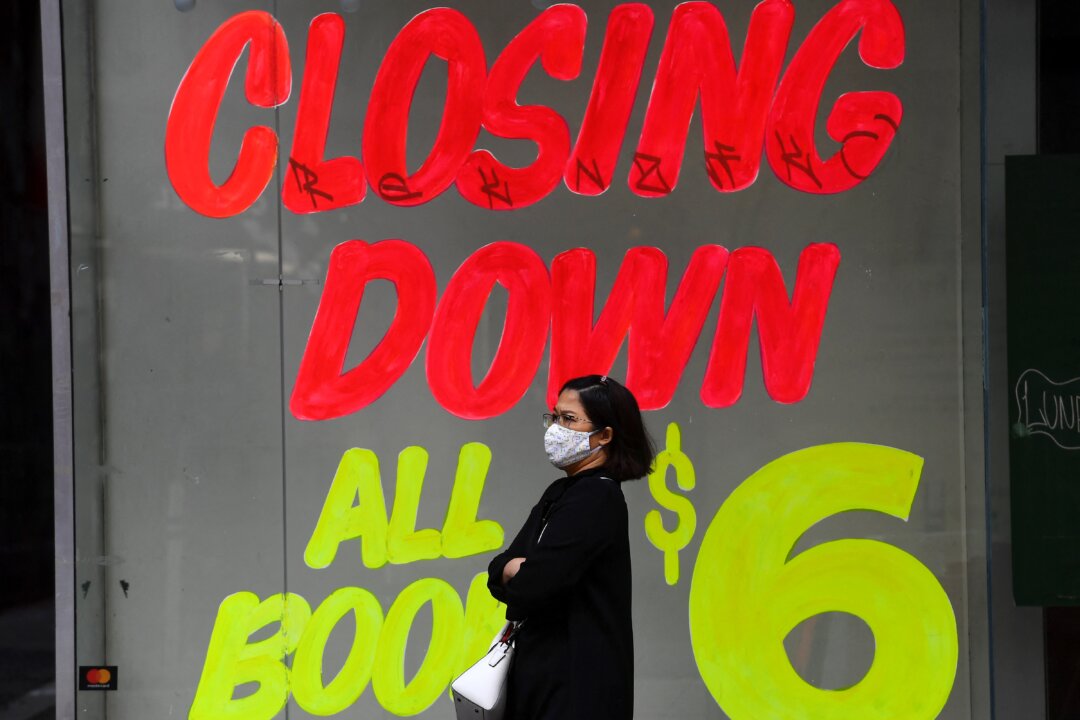


A woman walks past a closing down sign on an empty shop in Melbourne’s central business district, on June 3, 2020. William West/AFP via Getty Images
The number of businesses going into administration or voluntary liquidation remained at near record levels, according to figures from the Australian Securities and Investments Commission (ASIC).
In the 2025–26 financial year, 14,011 companies entered administration, slightly down from a peak of 14,722 in 2024–25.
However, the figures have yet to drop to anywhere near pandemic levels when 4,912 businesses became insolvent in 2021-22.
Since then, there’s been a year-on-year increase in the number of businesses struggling to stay afloat.
Construction the Top Industry
Construction continued to shoulder the brunt of the administrations with 3,472 companies waving the red flag, a 3.4 percent decrease from the previous financial year.
Accommodation and food services ranked second, with 2,078 companies entering administration, down from 2,476 in 2024–25—a decline of 16 percent.
These two industries, along with other services, retail trade, and professional, scientific and technical services, rounded out the five most affected sectors.
[Flourish infographic]
Increased Pressures for Businesses
According to the Reserve Bank of Australia (RBA), the parlous state of business in the country was a reflection of economic conditions.
Businesses have faced weaker consumer demand as households reduce discretionary spending in response to high inflation and rising interest rates.
At the same time, many firms have continued to grapple with higher labour costs, as well as increased input and financing costs.
In its most recent Financial Stability Review in March, the central bank says insolvencies in the construction industry could be partly explained by “ongoing wage and input cost” pressures.
It also found a notable increase in the number of companies that had unpaid taxes of over $1 million (US$700,900) owing to the Australian Taxation Office (ATO). This number had increased from 5 percent in 2021 to 9 percent in 2025.
Furthermore, the RBA identified cash flow constraints and labour shortages as key challenges for the retail, manufacturing, and transport sectors. Energy price shocks have also increased cost pressures on energy-intensive industries.