

Ukrainian President Volodymyr Zelenskyy’s decision to replace the country’s defense minister, Mykhailo Fedorov, has sparked rare wartime public protests in the capital and other cities across the country.
Fedorov was ousted this week in a government overhaul that also saw the dismissal of Prime Minister Yulia Svyrydenko. Zelenskyy said on Sunday that the government and law enforcement agencies needed “renewal.”
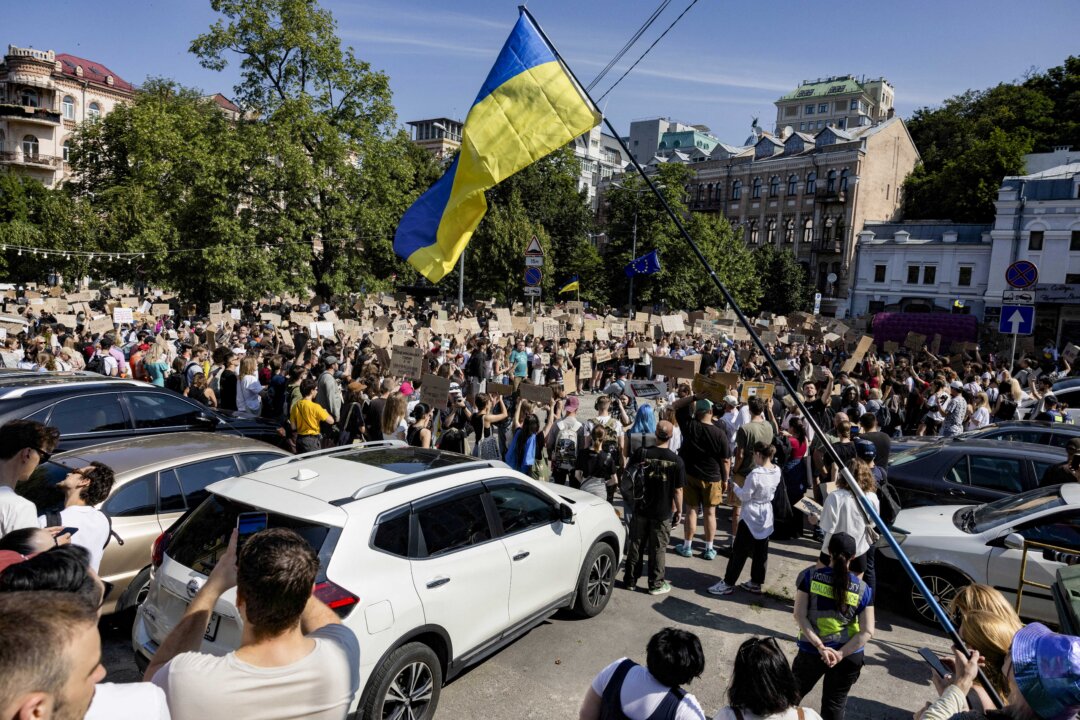
In Kyiv, more than 1,000 people gathered outside of Zelenskyy’s office on July 16 to demand Fedorov be reappointed.
Protesters chanted, “Shame!” and carried placards with phrases such as “For what?” and “The Russians are celebrating.”
One protester, who identified himself as Ali, said, “We’re in favor of an upgrade, not a downgrade.”
The scenes were reminiscent of protests in July 2025, when people took to the streets over Zelenskyy’s reforms to the country’s anti-corruption agencies, changes that were later reversed.
Fedorov, 35, has been credited with reshaping the Ukrainian army into a more effective fighting force and championed implementing the use of drone technology on the battlefield. The use of unmanned aerial vehicles has helped Ukraine see gains in its war with Russia in recent months as Kyiv focuses on targeting Moscow’s armaments production sites and fuel infrastructure in a bid to disrupt its military capabilities.
His dismissal has also prompted the resignation of the deputy commander of the Ukrainian air force, Pavlo Yelizarov.
Yelizarov, a key leader in Ukraine’s drone warfare operations, said he was resigning in response to Fedorov’s removal.
Fedorov Criticizes Syrskyi
The ousting revealed the tensions between the former minister and Ukraine’s top military commander, Gen. Oleksandr Syrskyi.

People gather to denounce President Volodymyr Zelenskyy’s decision to dismiss Defense Minister Mykhailo Fedorov after six months in the post, in Kyiv, Ukraine, on July 16, 2026. Danylo Antoniuk/AP Photo
Addressing a news conference on Thursday, Fedorov accused the general of deliberately undermining him.
“We hit a situation where all the initiatives we proposed were blocked, and Syrskyi, considering all the problems we discussed today, is not ready to look [me] in the eye and talk openly about the problems,” Fedorov said.
“Instead of working out how to asymmetrically defeat Russia … he has worked out how to split the country.”
Syrskyi, 60, did not comment on any of Fedorov’s remarks. In a statement, he called for a focus on Ukraine’s war effort and thanked the minister for his work.
Zelenskyy Appoints Khmara
Fedorov previously served as Ukraine’s first digital transformation minister and took charge of the military in February 2024 after Zelenskyy ousted his predecessor, Valeriy Zaluzhnyi.
He was credited with cutting bureaucracy and using new technology to transform the war effort, including the use of drone warfare and a data-driven strategy in operations against Russia.
He has also been criticized for failing to deliver on his pledge to rapidly reform recruitment to the armed services in a bid to address manpower shortages.

People protest against Ukrainian President Volodymyr Zelenskyy’s decision to replace Mykhailo Fedorov as defense minister, amid Russia’s attack on Ukraine, in Lviv, Ukraine, on July 16, 2026. Roman Baluk/Reuters
On July 16, Zelenskyy announced the appointment of Yevhenii Khmara, who is the acting head of the domestic Security Service of Ukraine (SBU), as acting defense minster.
“Yevhenii Khmara has gained extensive and, in many respects, unprecedented experience with technological combat operations,” the Ukrainian president said in a post on X. “This is exactly where our defense efforts should be focused during this war.”
The SBU’s Alpha team, which Khmara had previously led, has played a leading role in the long-range drone attacks on Russian oil infrastructure and the defense industry in recent months.
Zelenskyy said that he would ask MPs to support Khmara’s nomination for the post permanently.
Reuters contributed to this report.