“Europe’s space effort is split across too many national programmes” was the blunt diagnosis Andrius Kubilius, the EU Commissioner for Defence and Space made at the recent International Space Summit in Paris. Sovereignty was the word on everyone’s lips over the two-day event. But look past the rhetoric at what the summit produced, and a sharper story emerges. Europe is not choosing between sovereignty and partnership. It is learning to build the former via the latter.
Nearly 120 foreign delegations travelled to Paris for the summit. On its first day alone, the event produced close to 50 new partnerships and agreements, worth an estimated €20 billion, according to President Emmanuel Macron. That is not the arithmetic of a continent withdrawing into self-reliance. It is the arithmetic of a continent trying to secure its independence by multiplying the partners it can call on, some European, some not.
The guest list matters here as much as any speech. The summit drew delegations from across Europe and beyond, including the UK, Japan, India, South Korea, Canada and the UAE. That spread says something about who Europe now counts as allies in space. So did the absences.
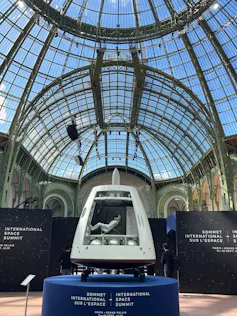
Days before the summit, SpaceX and Blue Origin pulled out, reportedly under pressure from the White House, alongside two smaller US start-ups. It was a reminder of where the pressure is really coming from: not only China’s reusable launchers or India’s push to fly its own astronauts, but a US administration now building parallel infrastructure of its own, down to the newly announced US Space Academy.
Three scales of independence
Strip away the summit staging, and Europe is pursuing this independence at three different levels at once, and not always with the same partners.
At the institutional level, the logic is about pooling, and about avoiding the fragmentation that panelists described as one of Europe’s oldest and most persistent obstacles. A round table with Kubilius and representatives of Isar Aerospace, Avio and Arianespace at the summit kept returning to the same point: Europe has the technology, but doesn’t yet have the scale required to produce it.
In addition, cadence, not just capacity, was framed as the next challenge on the road to sovereignty, one that several speakers described as a historic moment for Europe to make that call. Closer dialogue between private industry and public institutions was also raised, so that future missions can be built around the specific needs of institutional customers, rather than institutional customers adapting to whatever industry already offers.
Europe, as one speaker put it, already has the ingredients. It masters the technologies. What it still needs to master is capacity: the ability to scale up production and accelerate its launch cadence across every segment of the space value chain.
That last point matters more than it might sound. Europe’s dependencies do not sit only in launchers. They run through the whole value chain, from electronic components and semiconductors to ground infrastructure, data processing and even the capacity to bring payloads back from orbit rather than only send them up. Sovereignty built at one link in that chain while others stay exposed is not sovereignty. It is a single point of failure with better branding.
Sharing the risk & building the future
At the industrial level, independence looks different, and more counterintuitive. Amazon, a company racing against Europe’s own IRIS² constellation for a slice of the satellite connectivity market, has entrusted a growing share of its Kuiper launches to Ariane 6. Sovereignty, in this reading, is not incompatible with depending on a market rival for revenue. What matters is that Europe keeps control of the infrastructure the rival has to use.
At the individual level, independence is being built through people rather than contracts. A second-round table, moderated by Thomas Pesquet, brought together crew members from the International Space Station. Nobody there talked about launch cadence or market fragmentation. They talked about trust, built slowly, between people who had actually lived and worked together in orbit. What the world will remember about the ISS, one astronaut said, is not who got there first, but the fact that an international crew found a way to work towards a common goal.
What made the point land was the context behind it. Since Russia’s invasion of Ukraine, relations between Western nations and Russia have collapsed almost everywhere on the ground. On the International Space Station (ISS), the working relationship has held anyway. The astronauts described a friendship built at the operational level that has outlasted the politics surrounding it, and one speaker offered a line that stuck: people who are hostile today can be friends tomorrow, and it is worth building a community sturdy enough to survive that shift.
The UAE astronaut on the panel added a further layer, one that closed the loop with what the industry panel had said hours earlier. For a country without a long history in space, sovereignty was never about doing everything alone. It meant building capability through partnership, and specifically through knowledge transfer rather than reinventing what others already knew.
That same logic of numbers now points to the future. Thomas Pesquet is set to command the PAM-6 mission to the International Space Station, flying alongside a Czech astronaut and, for the first time, a Greek one. It is a small but telling detail: European astronauts increasingly reaching orbit not as isolated national representatives, but as a group large enough to start looking like a genuine European corps.
Pilots, not passengers
ESA Director General Josef Aschbacher put the underlying choice most starkly in his address to the summit. “Will we be passengers, or pilots?” he asked, pointing to an ESA estimate that securing Europe’s own access to low Earth orbit would cost around €1 billion a year over a decade, against roughly €5 billion over ten years to keep buying seats from foreign providers, with most of that money and control staying abroad.
That is the real stake behind the sovereignty talk. The question raised by the summit was never whether Europe should partner with others. It already does, at every level, with allies and rivals alike. The question is who sets the terms, and who owns the architecture everyone else has to build around. IRIS² will be the next test of whether Europe can answer that question for itself.

A weekly e-mail in English featuring expertise from scholars and researchers. It provides an introduction to the diversity of research coming out of the continent and considers some of the key issues facing European countries. Get the newsletter!






White House crypto adviser feels ‘very good’ ahead of Senate Clarity Act vote on Tuesday
The White House's top crypto advisor says he feels "very good" about...

Bitcoin production rebounds in August for BitFuFu, edges higher at CleanSpark as Canaan slips
Canaan sold its entire ETH position and 54 BTC, using part of...

Strive reaches 25,000 BTC milestone with latest $36.6 million purchase
The latest acquisition marks a slowdown from the prior week, when Strive...

NY Attorney General James leads bipartisan push against the Clarity Act ahead of initial Senate vote
New York Attorney General Letitia James led a group of 17 bipartisan...