North Korea Launches Ballistic, Cruise Missiles in Live Fire Drill
 Victoria FriedmanUpdated 3 hours Ago3 Mins read
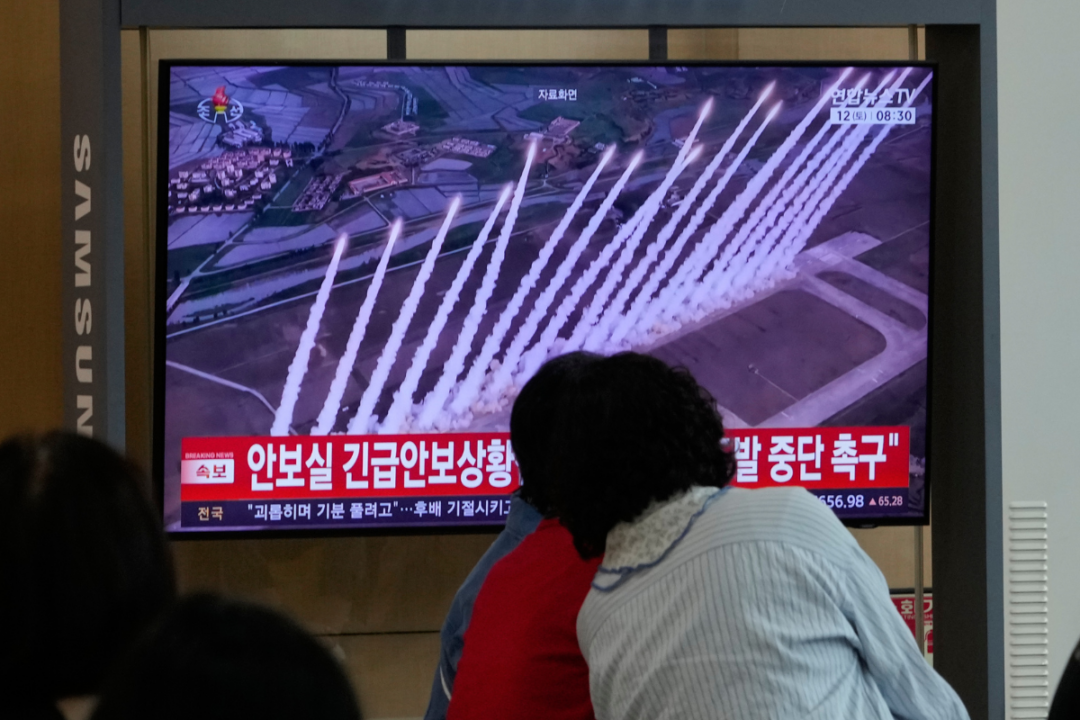
North Korea said that it launched several missiles and other weapons on Sept. 12 as part of a live-fire drill, conducted the day after the United States, South Korea, and Japan wrapped up their trilateral exercises in the region.
State-run media outlet KCNA said that five military units took part in the training exercise, mobilizing tactical ballistic missiles, cruise missiles, and rocket launchers, as well as attack drones. KCNA said that all weapons struck their targets with accuracy, demonstrating “concentrated, massive destructive power,” according to the Sept. 14 statement.
South Korea’s Joint Chiefs of Staff (JCS) said that Pyongyang had fired several short-range ballistic missiles from the Wonsan area, flying 155 miles toward the sea.
South Korean and U.S. authorities tracked the launches and analyzed the weapons’ specifications, the JCS said in a statement. It also said that it had shared information on the ballistic missiles with Japan, an ally in the region.
The JCS said it was closely monitoring North Korean activity and was “maintaining the capability and readiness to respond overwhelmingly to any provocation under its combined defence posture with the United States.”
The U.S. Pacific Command said in a post on X that based on current assessments, the drills did not pose an immediate threat to the United States or its allies.
“The United States remains committed to the defense of the U.S. homeland and our allies in the region,” the Pacific Command said.
Lim Eul-chul, a professor at Kyungnam University’s Institute for Far Eastern Studies in Seoul, said that this latest drill was a test not of a single weapons system but of an integrated strike network, and Pyongyang demonstrated its ability to coordinate drones, missiles, and other artillery through one command-and-control system.
“North Korea is also collecting operational data for actual deployment and demonstrating tactics aimed at saturating South Korean and U.S. missile defences through simultaneous attacks by weapons with different flight characteristics,” Lim said.
Freedom Edge 26
The North Korean live-fire drill came a day after the United States, South Korea, and Japan concluded their five-day trilateral Freedom Edge 26 exercise, which focused on countering nuclear and missile weapons threats from North Korea.
The Pacific Command said in a Sept. 11 statement that the integrated exercises took place across multiple domains—including maritime, air, and cyber—and were designed to improve how the three allies can operate and communicate quickly and effectively together.

A U.S. Air Force Boeing KC-135 Stratotanker aircraft participates in an air refueling exercise with fighter aircraft from South Korea’s Air Force and the Japan Air Self-Defense Force in international airspace in support of Freedom Edge 26 on Sept. 10, 2026. Courtesy of Senior Master Sgt. Hong Kwanyeong, Republic of Korea Air Force
The Pacific Command’s Lt. Col. Matthew McNeal said that Freedom Edge 26 built on previous training exercises.
“What began as a maritime-focused effort in the first iteration of Freedom Edge, now integrates air, maritime, missile defense, cyber and medical capabilities in a more connected training environment,” McNeal said.
Pyongyang has previously criticized the trilateral drills, calling them a reckless show of strength that demonstrates a confrontational stance against North Korea.
Previous Exercise Scaled Back
Last month, U.S. President Donald Trump scaled back the annual Ulchi Freedom Shield drills, saying they sent the wrong message to Pyongyang and were costly to American taxpayers.
Trump cited his good relationship with North Korean leader Kim Jong Un in an Aug. 16 post on Truth Social.

South Korean soldiers take part in an anti-terror drill at a hotel during the Ulchi Freedom Shield joint South Korea-U.S. military exercise, in Seoul, South Korea, on Aug. 19, 2026. Jung Yeon-je/AFP via Getty Images
“Based on my very good relationship with Kim Jong Un, of North Korea, I am not happy with the fact that the United States has, long ago, agreed to participate in Joint Military Exercises with South Korea,” Trump wrote.
As a result, the exercises ended six days earlier than scheduled. Pyongyang said at the time that shortening the drill will not change its “provocative, aggressive nature.”
Reuters contributed to this report.







Finland Joins French Nuclear Deterrence Program
Finland has joined the French nuclear defense initiative, known as Forward Deterrence,...

China’s Growing Auto Presence Forces Europe to Rethink Its Car Industry
As Chinese automakers gain ground in Europe, the continent’s car industry is...

Poland Finds Suspected Russian Drone Off Baltic Coast
The Polish military found a suspected Russian drone off the country’s Baltic...
Trump Says Countries Should Reimburse US for Strait of Hormuz Help
Vessels transit the Hormuz Strait off the coast of Iran's southern port...