Poland Finds Suspected Russian Drone Off Baltic Coast
 Guy BirchallUpdated 3 hours Ago3 Mins read
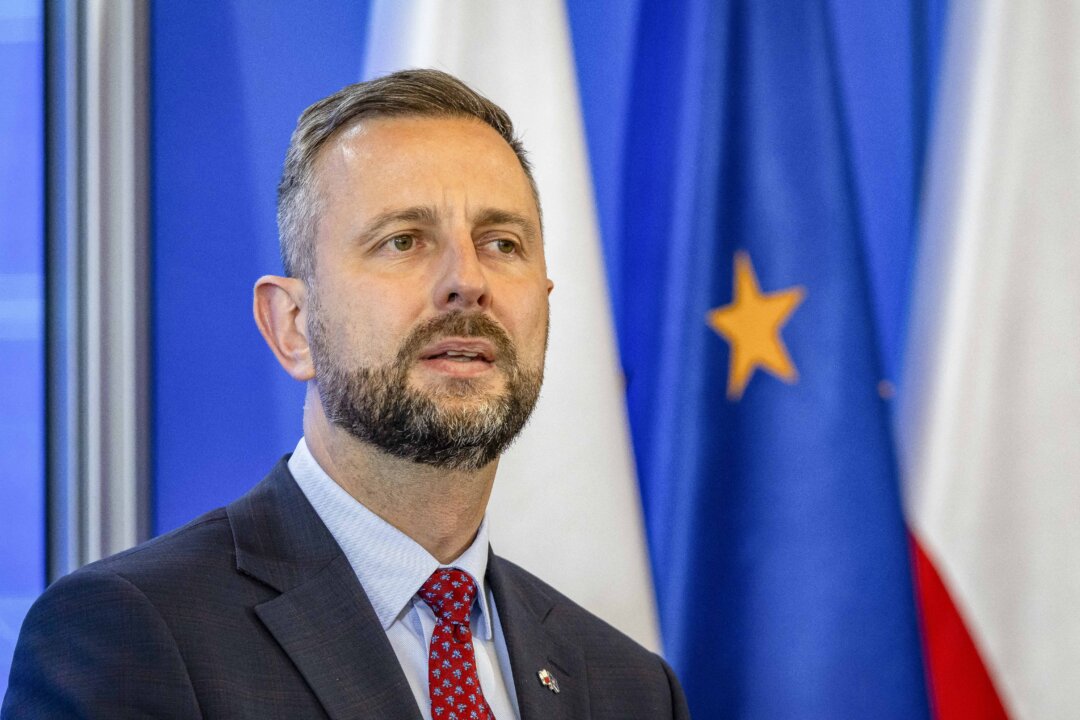
The Polish military found a suspected Russian drone off the country’s Baltic Sea coast, Polish Defense Minister Wladyslaw Kosiniak-Kamysz announced on Monday.
“In the beach area of the town of Rusinowo near Jaroslawiec, the military located and retrieved from the Baltic Sea a drone,” he wrote in a Sept. 14 post on X, adding that preliminary examination of the craft “indicates that it is a military unmanned aerial vehicle originating from Russia.”
Kosiniak-Kamysz’s deputy, Cezary Tomczyk, later told the Polish parliament that all indicators of the origin for the drone, thus far, pointed toward Moscow, adding that the relevant services had taken possession of the unmanned aerial vehicle (UAV) and would continue examining it.
“Poland is in many ways the No. 1 target today when it comes to hybrid attacks or surveillance,” Tomczyk told the parliament, Polish outlet TVN24 reports.
“As long as the threat from Russia persists, we will be tested in various ways. Surveillance aircraft and fighter jets will appear,” he continued, adding that “drones will appear, various threats may arise, and we will counteract and simply build this awareness and social resilience.”
Polish Operational Command of the Armed Forces spokesman Jacek Goryszewski told the same outlet that the found drone was “most likely a Gerbera-type unmanned aerial vehicle belonging to the Russian Federation.”
He added that “it should be assumed that this drone drifted from international waters or even from a further location.”
When asked if the drone could have been equipped with weapons, Goryszewski said he could not yet say for certain if it was armed or had been a “decoy drone.”
Goryszewski added that examination should shed light on that issue.
The Epoch Times contacted the Russian Ministry of Foreign Affairs for comment but did not receive a response by the time of publication.
The discovery of the drone comes a day after Polish Prime Minister Donald Tusk warned that Moscow was engaged in a process of escalation, after a Russian attack on a train near the Polish-Ukrainian border on Sept. 13.
Tusk at a special briefing of the Government Security Centre shortly after the train incident, said that “what can be expected is that the coming weeks and months will be a period of very intensified actions from the Russian side.”
He added that Warsaw “cannot rule out” that this escalation could affect Polish territory.
The drone strike on the Ukrainian locomotive occurred just moments after a group of European and American officials had disembarked a train using the same line.
Among the dignitaries who just avoided disaster were former British Prime Minister Boris Johnson and ex-CIA Director David Petraeus.
Johnson, in a Sept. 13 X post, said that he didn’t know what “warped logic” had driven Russian President Vladimir Putin to blow up the locomotive, while Petraeus, also a former U.S. Army general, told the New York Times that “for those who have not been under fire, this was terrifying.”
Drones have been a particular cause of concern for Poland throughout the war between its neighbor, Ukraine, and Moscow, with Polish and NATO forces having had to intervene after UAVs drifted into, or towards, the nation’s territory on multiple occasions.
In one of the more serious instances of Polish airspace violations of recent times, a cruise missile hit near the city of Lublin on July 30.
No one was injured, but the incident prompted Warsaw to summon Moscow’s ambassador to Poland and issue him with a formal protest note.
Putin, meanwhile, continues to maintain that Russia poses no threat to European nations.
Speaking at the 18th BRICS Summit in India on Sept. 11, Putin said that European capitals were frightening their own citizens by warning about an “imaginary threat” from Russia.
“There is no such threat and never has been,” Putin said.
“We do not threaten European countries, and we have no intention of threatening them,” he added.
However, he did also warn that should such nations send troops to Ukraine, that would mean “a war with Russia.”




Finland Joins French Nuclear Deterrence Program
Finland has joined the French nuclear defense initiative, known as Forward Deterrence,...

China’s Growing Auto Presence Forces Europe to Rethink Its Car Industry
As Chinese automakers gain ground in Europe, the continent’s car industry is...
North Korea Launches Ballistic, Cruise Missiles in Live Fire Drill
North Korea said that it launched several missiles and other weapons on...
Trump Says Countries Should Reimburse US for Strait of Hormuz Help
Vessels transit the Hormuz Strait off the coast of Iran's southern port...