Canada pitched itself as a climate leader. Its investment prospectus tells a different story, climate groups say
 Charlotte JamesUpdated 4 hours Ago5 Mins read
The fossil fuel projects Canada is pitching to global investors could produce an estimated 180 megatonnes of carbon dioxide-equivalent emissions every year when their oil and gas are burned — more than the annual emissions from every car and truck in the country.
That is the assessment of Richard Brooks, climate finance program director at Stand.earth, who analyzed a 66-page investment prospectus shared with would-be investors at Prime Minister Mark Carney’s first Canada Investment Summit in Toronto.
The prospectus lays out 167 projects across nine sectors that the federal government hopes will help attract $1 trillion in global capital over the next five years. Its Conventional Energy chapter alone contains more than US$107 billion in proposed oil, gas and coal projects.
“Those emissions would be locked in if these projects are built and run, at exactly the time we need to be accelerating our efforts to reduce emissions,” Brooks told Canada’s National Observer.
That US$107 billion figure includes a $35-billion, 1,250-kilometre oil pipeline connecting Alberta crude to a new export terminal on the BC coast; a $23-billion natural gas pipeline and floating liquefied natural gas (LNG) facility running from Alberta to Baie-Comeau, Que.; a proposed LNG terminal in northern BC; and a $9.9-billion expansion of Woodfibre LNG near Squamish.
The Minerals and Metals chapter also pitches restarting a coking coal mine in northeastern BC and expanding an existing operation to increase coal production.
The prospectus markets Canada’s energy sector as having “the largest oil resource base open to free-market investment in the world.” It also highlights $100 billion in LNG projects under development nationally.

Wet’suwet’en hereditary Chief Na’Moks on Sept. 14, 2026. Photo: Cloe Logan / Canada’s National Observer
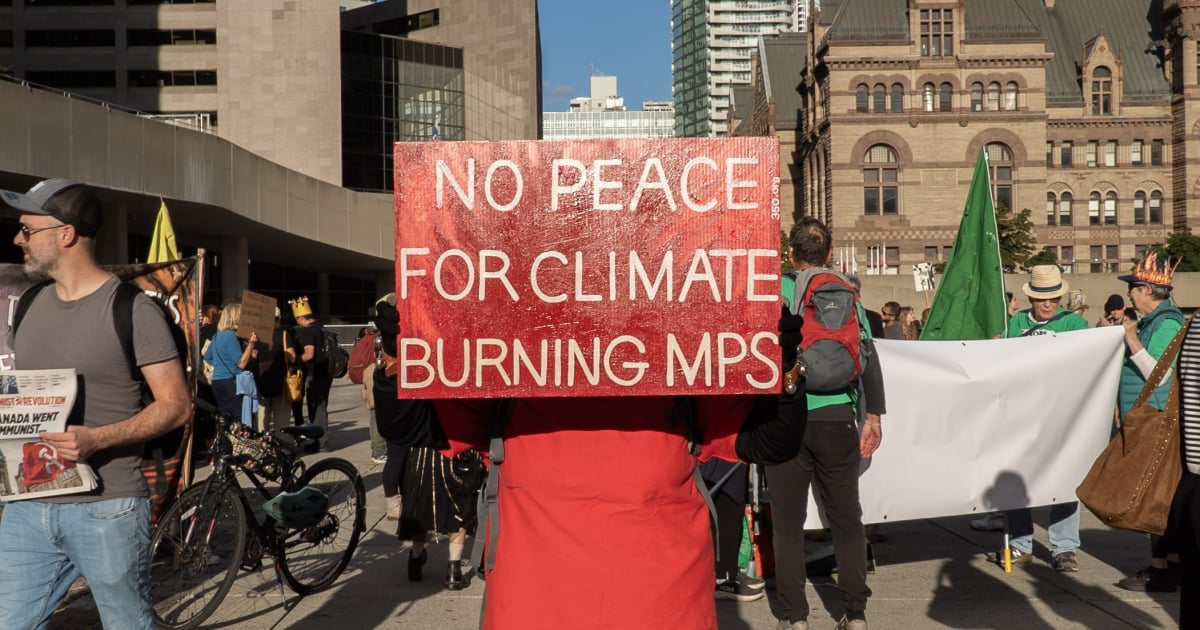
Chants of “Land back now” echoed through Toronto’s Nathan Phillips Square on Monday evening as climate activists and Indigenous land defenders gathered in protest against the summit.
“Our land and our public resources aren’t on the chopping block for their profits,” Kakeká ThunderSky, an Anishinaabkwe land defender with roots in Poplar River First Nation, told the crowd.
For Pat Smith, a 74-year-old member of Seniors for Climate, the simultaneous pursuit of renewable energy and fossil fuel expansion is precisely the problem.
“We can’t build two more pipelines,” Smith told Canada’s National Observer at the protest. “I’m good with renewable projects … but it’s fossil fuel. We have to stop any more investment in fossil fuels.”
A clean pitch, powered by gas
The pattern of contradiction outlined by Brooks continues in the prospectus’s Digital Technology chapter, which pitches Canada’s data-centre sector to the AI boom.
It tells investors that Canada offers data centres a “low carbon footprint,” citing electricity generated largely from renewable hydroelectricity and a cold climate the government claims reduces cooling costs.
Yet, at least two AI data-centre projects featured in the chapter plan, rely on newly built natural gas generation.
Alto’s three northern Alberta campuses – worth approximately $2.1 billion in their first phase – would use “dedicated behind-the-fence natural gas generation.”
Alberta-based StratGrid’s Project Wheatland would also use dedicated gas generation, initially producing 240 megawatts and eventually exceeding one gigawatt.
A third project, the $14.5-billion Redcliff AI Data Centre Campus near Medicine Hat, Alta., plans almost 900 megawatts of “behind-the-meter generation.” The prospectus does not identify its fuel source; however, the Alberta government has effectively banned developers from using renewable energy in data centres.
The inclusion of megaprojects such as pipelines and LNG terminals in the government’s pitch also raises questions about who will absorb losses if projects underperform or become subject to legal challenge.
“Since the government of Canada wants to get projects done, it is possible that they will offer preferential investment terms where Canadians take on the risks instead of the investors,” said Julie Segal, senior manager of climate finance at Environmental Defence. “Landing investments is not necessarily in Canada’s best interest if we take on too much risk, or if we give away too much control,” Segal told Canada’s National Observer.
Her colleague, energy analytics program manager Alex Walker, described the government’s simultaneous pursuit of fossil fuel and clean-energy investment as “driving towards a cliff, with one foot on the brake and the other foot on the accelerator,” they also told CNO.
‘Regulatory certainty’ or ‘regulatory erasure’?
It is clear from the prospectus where the government believes friction for investors remains: regulation.
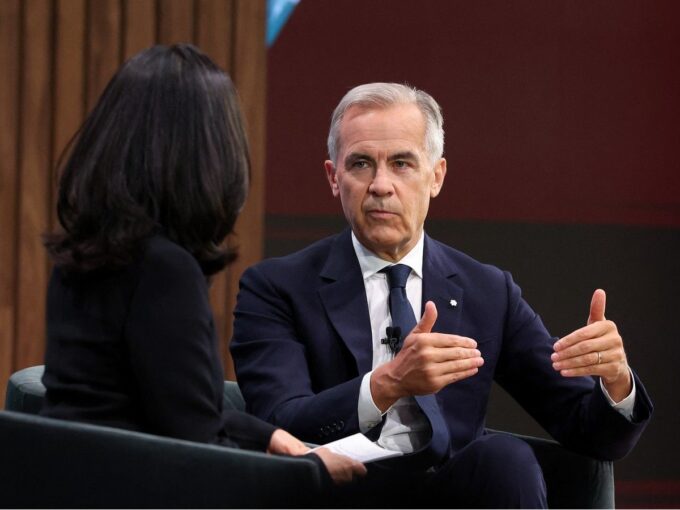
It repeats a message Carney has stressed for months and reiterated during a question-and-answer session with reporters at the summit: Canada intends to accelerate project development by making permitting more efficient and simplifying federal reviews for projects deemed nationally important. The government maintains that it can do so without weakening environmental standards or its commitments to Indigenous communities.
Brooks read that language differently.
“In this prospectus, ‘regulatory certainty’ is just code for regulatory erasure — stripping away environmental protections and Indigenous rights, so foreign private equity can extract profits while Canadian communities absorb all the risk,” he said.
The Building Canada Act, passed last year, allows the government to accelerate projects deemed in the national interest. Nine Ontario First Nations have sought an injunction against the law, calling it a “clear and present danger” to their self-determination rights. Amnesty International Canada has described it as a “troubling threat” to Indigenous rights.
Carney also rejected the suggestion that accelerating project reviews requires weakening existing safeguards.
“Canada will remain a country of high standards. But high standards do not require slow decisions,” he said at the summit, reiterating his promise to shorten the review period for major projects.
Invest in Canada, the federal agency that compiled the prospectus, disputes Brooks’ characterization.
Spokesperson Julia Blonda said regulatory reforms are intended to make reviews more efficient, predictable and coordinated while maintaining environmental protections and Indigenous rights.
“The objective is to provide greater certainty and timelier decisions for proponents by streamlining processes, not by lowering standards,” she wrote in an emailed statement to CNO.
The agency worked with the government and major Canadian financial institutions to identify “investment-ready” projects. Representatives of CPP Investments and PSP Investments — the pension funds co-hosting the summit — also helped review submissions.
Invest in Canada declined to comment on individual projects, saying inclusion does not predetermine the outcome of environmental assessments, Indigenous consultations or other approvals.
Consent and ‘investment readiness’
None of the roughly 167 listed projects identified free, prior and informed consent — the standard Canada has committed to under the United Nations Declaration on the Rights of Indigenous Peoples — as a condition of financing or inclusion.
“The document assumes investment-readiness and consent run on separate, parallel tracks,” Brooks said. “Without secured free, prior and informed consent, a project is not investment-ready — it is legally, financially and ethically non-viable.”
Some projects outlined do involve genuine Indigenous ownership, including the Selkirk First Nation-owned Minto Project and Minago Critical Minerals. Others, including the West Coast Oil Pipeline, Prairie Connector pipeline and Casino Project, list no such Indigenous consultation.
Ksi Lisims LNG illustrates how the distinction can become blurred. The proposed $28.5-billion terminal is frequently described as Indigenous-led and developed in partnership with the Nisga’a Nation.
The terminal itself is wholly owned by Texas-based Western LNG. The Nisga’a Nation holds a partial stake in the associated 800-kilometre pipeline.
In March, Nisga’a citizens Cecil Mercer and Stephen Nyce also filed a lawsuit alleging the Nisga’a Lisims Government failed to consult its own citizens adequately before partnering with Western LNG and was not financially prudent. The allegations have not been tested in court.
“Ksi Lisims LNG is held up as a model of Indigenous partnership,” Walker said. “In reality, it is entirely owned by a Texas-based company with no experience in building infrastructure.”
At the protest, ThunderSky directly challenged the idea that Indigenous consultation could be compressed to fit the government’s preferred timeline.
“You cannot fast-track free, prior and informed consent, nor can you fast-track Section 25 of the Constitution,” she said. “We cannot be an afterthought. We will not be an afterthought.”
The pitch versus the paperwork
Carney has staked considerable political capital on the summit. “Canada has what the world wants,” the prospectus’s cover declares, presenting the country’s resources and regulatory stability as a clear selling point.
Brooks said investors should question why the prospectus was not published, whether its projects reflect the direction of global energy markets and why smaller-scale Indigenous-led renewables and domestic heat-pump and solar manufacturing are absent.
For him, the mix of projects contained in the government’s pitch leads to a stark conclusion.
“We no longer have a credible climate plan in Canada,” Brooks said. “Period.”
Charlotte James is a Toronto-based journalist and researcher covering human rights, international affairs and politics.





Read Stephen Harper’s full speech on the need for Canada to defend its sovereignty against the U.S.
The former Conservative prime minister said Canada was right to walk away...

Cool Canadian comedy North of North is on the hot list
Anna Lambe, who stars as Siaja in North of North, will be...
Woman convicted of disfiguring biting attack given reduced sentence because she’s Haitian
A sign for the Quebec Court of Appeal. It’s an established Canadian...
Afternoon front page: Carney talks Stephen Harper and Donald Trump; why a ‘unique alliance’ with EU might be unlikely; and more
Prime Minister Mark Carney speaks during the second day of the inaugural...