

A U.S. citizen who sympathized with Hezbollah and the Iranian regime was convicted on July 29 of federal terrorism charges linked to the stabbing in 2022 of writer Salman Rushdie.
Former Iranian leader Ayatollah Ruhollah Khomeini issued a fatwa against Rushdie in 1989 after he penned the novel “The Satanic Verses.” [AP, delete]
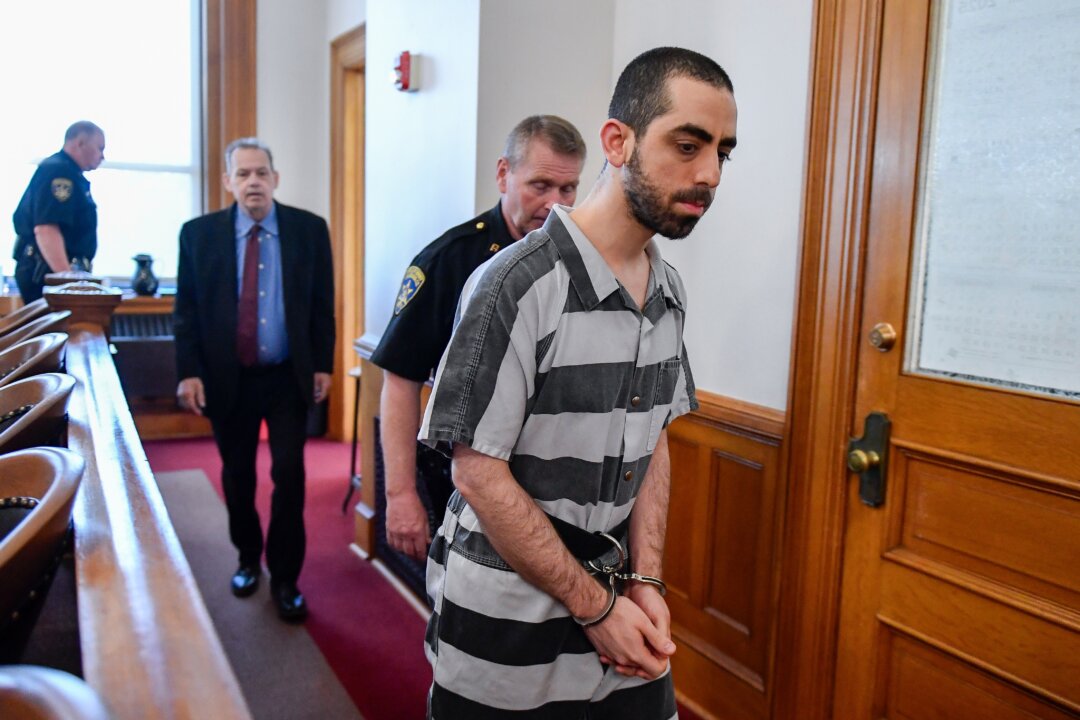
Hadi Matar, 28, is already serving a 25-year New York state prison sentence on an attempted murder conviction in the stabbing.
Mattar, who repeatedly stabbed Rushdie as he was about to give a lecture on writers’ safety in Chautauqua in western New York on Aug. 12, 2022, was found guilty of engaging in an act of transnational terrorism and several other charges by a jury in Buffalo, N.Y. His federal sentencing is set for Nov. 3.
Rushdie, who was stabbed 15 times, was seriously injured and lost sight in his right eye.
Matar never gave any reasons for the attack, but federal prosecutors told the jury he was motivated by a decades-old fatwa issued by Khomeini, who had accused Rushdie of blasphemy.
Assistant Attorney General for National Security John Eisenberg said in a statement that Matar had spent more than a year immersing himself in Hezbollah’s violent ideology and preparing to act on the fatwa.
“His brutal attack on Mr. Rushdie during a peaceful speaking event is a chilling reminder of the global reach of Iranian terrorism,” Eisenberg said.
‘Justice Has Been Done’
“With today’s verdict, justice has been done, and Matar will pay for his crimes,” Eisenberg said.
Matar could be jailed for life when he faces his federal sentencing hearing in November.
The Iranian regime—which has never formally rescinded Khomeini’s fatwa—has denied any involvement in the attack on Rushdie.
During the trial, Matar’s attorney, Nathaniel Barone, said the government could not prove what had motivated his client to carry out the attack.
Barone told jurors, “You’re going to have to ask yourselves: What was Hadi Matar’s intent?”
The prosecution said Matar’s writings and communications proved he was acting out of loyalty to the Iranian regime and Hezbollah, a Tehran-backed proxy based in Lebanon.

In this courtroom sketch, Salman Rushdie testifies on the witness stand, gesturing how the attacker slashed his throat in an attack at the Chautauqua Institute, during the trial of Hadi Matar, in Chautauqua County court, Mayville, N.Y., on Feb. 11, 2025. Elizabeth Williams via AP
Matar, who lived in Fairview, N.J., also holds Lebanese citizenship, and prosecutors told the jury that photographs in his bedroom and on his computer indicated his support for Hezbollah.
Assistant U.S. Attorney Timothy Lynch said in an opening statement on July 22 that Matar initially wanted to expose Rushdie but wrote, in a private note to himself, “We need to kill him ASAP.”
Matar—who chose not to testify in his own defense—was convicted of engaging in an act of terrorism transcending national boundaries, attempting to provide material support to Hezbollah, a designated foreign terrorist organization, and providing material support to terrorists.
As for Rushdie, who did testify, he said, “I can’t say what his ambitions or his aim was, but the wounds were dispersed across my body.”
Michael DiGiacomo, U.S. Attorney for the Western District of New York, said Rushdie survived thanks to “courageous members of the public and law enforcement.”
Matar Chose ‘Terroristic Values’
“Hadi Matar, who was born and raised in the United States, chose to align his values with the terroristic values of the leaders of Iran, which often promote violence, and in this case, the call for murder,” DiGiacomo said.
In an interview with “60 Minutes” in 2024, Rushdie described his survival after the August 2022 attack as a miracle.
“I certainly don’t feel that some hand reached down from the sky and guarded me, but I do think something happened which wasn’t supposed to happen,” Rushdie said. “I have no explanation for it.”
Rushdie won Britain’s prestigious Booker Prize for his 1981 novel “Midnight’s Children,” which was set around the time of the partition of India in 1947.
Then, in 1988, he wrote “The Satanic Verses,” a novel of magical realism, which included a dream sequence featuring the Prophet Muhammad.
Rushdie defended his freedom of expression in writing the novel, but in February 1989, he issued a statement saying, “I profoundly regret the distress that publication has occasioned to sincere followers of Islam,” according to several media outlets at the time.
In the past 36 years, riots over the book have led to the deaths of 45 people. A Japanese translator was stabbed to death, and a publisher in Norway and an Italian translator were also attacked.
Rushdie published a 2024 memoir about the attack and, last year, wrote “The Eleventh Hour,” a collection of five short stories about dying.
In November 2025, he was given a Dayton Literary Peace Prize lifetime achievement award.
The Epoch Times reached out to Matar’s attorney, Nathaniel Barone, for comment, but did not receive a response by publication time.
The Associated Press contributed to this report.