
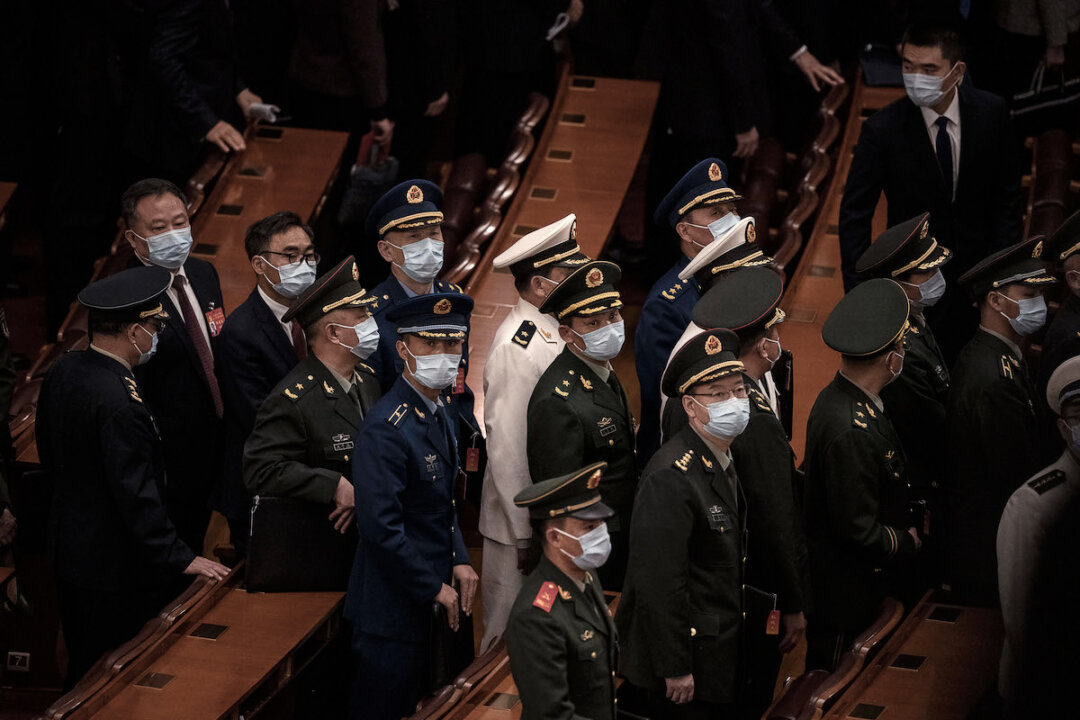

The command structure of Beijing’s Military Commission has been in disarray for more than six months, with instances where official documents were issued without anyone signing them, after Chinese Communist Party (CCP) leader Xi Jinping purged most of the top generals, according to sources who spoke to The Epoch Times.
Tang Jiezhong, an insider close to the Chinese military who used a pseudonym out of fear of reprisal, told The Epoch Times that after top generals Zhang Youxia and Liu Zhenli were taken down by Xi in January, “for over six months, the Central Military Commission’s command system has been in disarray; directives are issued without a single signature, and military morale has plummeted to rock bottom.”
The Chinese regime’s defense ministry announced on Jan. 24 that Zhang Youxia, vice chairman of the Central Military Commission—the top defense command and decision-making body of the CCP’s military—and Liu Zhenli, a member of the Central Military Commission and chief of the Joint Staff Department of the Central Military Commission, were being investigated for serious violations of Party discipline and state laws.
Tang said that investigations by the Central Commission for Discipline Inspection and military disciplinary bodies into the cases of Zhang Youxia and Liu Zhenli were concluded two months ago but that the probes have sparked dissatisfaction among generals within the military.
The conclusion of the investigation hasn’t been announced, and Zhang Youxia and Liu Zhenli still hold their
official positions
on paper, despite both having disappeared from public view since January. Analysts who previously spoke to The Epoch Times said that it shows the widespread
dissatisfaction
in the military and
resistance
to Xi’s purge in the Party.
Zhang Youxia was the only general in the CCP’s military with actual combat experience, which was during China’s war against Vietnam in 1979.
Tang revealed that Zhang Youxia and Liu Zhenli had long served in combat units and wielded influence within the theater command and military service systems.
“Following the simultaneous investigation into both men, officers across the theater commands lost confidence in the Central Military Commission’s new command arrangements; consequently, some officers became reluctant to sign important documents, fearing they might be held liable,” he said.
Tang said that Zhang Youxia and Liu Zhenli command respect within the military; they understand how the troops operate and know what the rank and file are thinking.
“Currently, the Commission’s top leadership lacks anyone who can truly command the confidence of the ranks,” he said. “No one is willing to sign off on documents because everyone fears bearing responsibility. It is not a lack of personnel in the military, but a lack of anyone daring enough to make decisions.”
Tang further explained that commanders across the various theaters consider Zhang Youxia and Liu Zhenli to be the Central Military Commission leaders they truly trust.
“This is because both have commanded troops—Zhang Youxia, in particular, has combat experience—and they are known for caring about the well-being of the rank and file, maintaining an approachable style, and possessing personal charisma,” he said.
Xi has purged five of the seven members that make up the current CCP’s Central Military Commission (CMC) since the CCP’s 20th National Congress in 2022, with only Zhang Shengmin and himself left. Xi has also purged numerous high-ranking military officials, including the Commanders and Political Commissars of the Navy, Air Force, and Rocket Force, who Xi believes were disloyal to him, creating a power vacuum in the military’s top leadership. Many of the positions have been left empty.
Zhang Shengmin, originally a member of the CMC, was appointed as a vice chairman of the commission in October 2025 and has long been responsible for military discipline inspection.

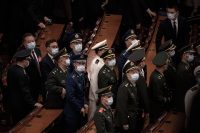
Zhang Youxia (front) swears an oath with members of the Central Military Commission after their election during the fourth plenary session of the National People’s Congress at the Great Hall of the People in Beijing on March 11, 2023, most of whom have since been purged. Greg Baker/Pool/AFP via Getty Images
Xi’s New Promotions Boost Military Unease
On July 3, Xi promoted Zhang Shuguang and Wang Gang to the rank of top general in Beijing. At the time, Zhang Shuguang served as secretary of the Central Military Commission Discipline Inspection Commission and director of the CMC Supervisory Commission, while Wang Gang served as commander of the air force. The promotion ceremony was presided over by CMC Vice Chairman Zhang Shengmin.
Zhang Shuguang’s promotion to the rank of general indicates that Xi Jinping is increasingly relying on the discipline inspection system to control the military, according to the insiders.
Mr. Bi, another insider within the CCP’s military who gave only his last name out of fear of reprisal, told The Epoch Times that the aforementioned rank promotions and personnel appointments have sparked dissatisfaction within the military.
“Since Zhang Youxia and Liu Zhenli came under investigation, the CCP has yet to publicly announce their successors as Vice Chairman of the Central Military Commission and Chief of the Joint Staff Department. Critical positions within the Commission’s decision-making leadership and the joint combat command system remain vacant,” he said.
Mr. Ji, a retired CCP military general who gave only his surname out of fear of reprisal, told The Epoch Times that in the past, whenever a major incident occurred within the military, the Central Military Commission would typically brief retired generals on the situation to secure the support of veteran officers. However, “following the investigation into Zhang Youxia, the military has not briefed them on the details of the case, nor does it seek the views of veteran officers regarding the promotion of key military officials this time,” he said.
This indicates that Xi Jinping no longer relies on the established mechanisms for coordination within the military, Ji said.
“Xi’s move to bypass retired generals and established military coordination channels—relying instead on the discipline inspection system to control the armed forces—has further heightened the unease among active-duty generals and officers,” he said.
Wu Ting contributed to this report.