Carney Tells European Parliament Canada Welcomes ‘Associate Member’ Proposal
 Etienne FauchaireUpdated 3 hours Ago5 Mins read
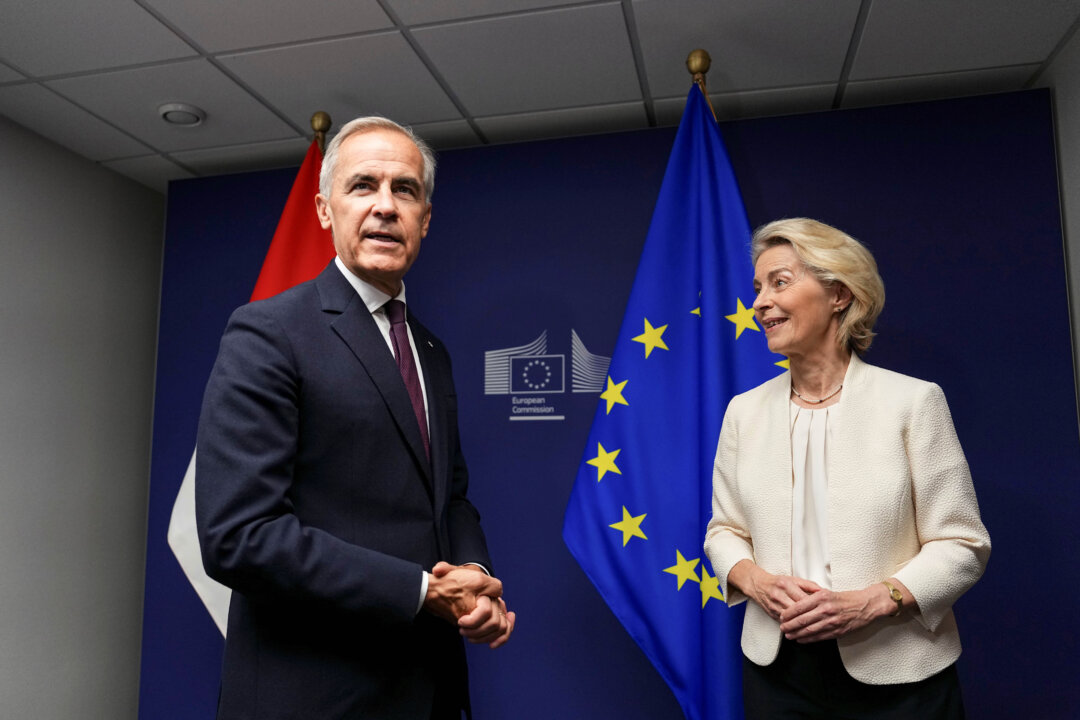
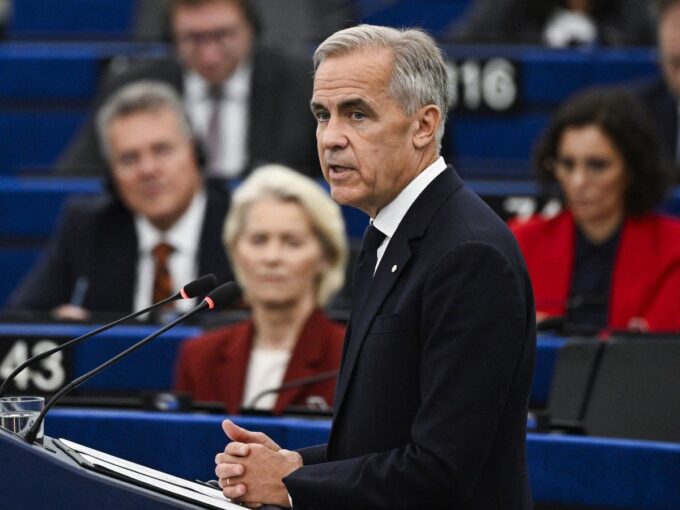
Canadian Prime Minister Mark Carney told the European Parliament on Sept. 17 that Canada “welcomes” the European Union’s proposal to make it the bloc’s first “associate member,” as he outlined a broader vision for a transatlantic alliance between Ottawa and Brussels.
He spoke in Strasbourg one day after European Commission President Ursula von der Leyen unveiled the idea in her State of the Union address.
His remarks came hours after President Donald Trump dismissed the proposal as “laughable” and warned that Europe could face “very heavy tariffs” if he considered the initiative a “hostile act.”
An ‘Alliance for the Future’
With Carney sitting in the front row during her Sept. 16 address, von der Leyen said the EU needed to “urgently reimagine” its partnerships in response to “the fracture in the international rules-based system.”
Addressing Carney directly, von der Leyen said she wanted to work with him “on opening the door for Canada to be the first associate member of the EU.”
The EU treaties currently provide no such membership category, meaning the precise nature of any arrangement would have to be defined and agreed upon by member states.
Trump reacted to the proposal later that day.
“If they do that, if I think it’s at all a hostile act, I will put very serious tariffs or stop trading with Europe on many things,” he told reporters in North Carolina, describing Canada as “a terrible trade partner.”
“If it’s a good intention, that’s fine,” Trump added. “If it’s a bad intention, we’ll put very heavy tariffs on Europe.”
Carney did not mention the United States by name in his address, but he repeatedly described the use of economic and financial ties as instruments of geopolitical pressure.
“Economic integration is now being weaponized, tariffs being used to exert pressure,” he said.
“Financial mechanisms have been used for coercion. Supply chains constitute weak points to be exploited.”
At the same time, Carney rejected the idea that closer ties between Canada and Europe should amount to the creation of another geopolitical power center.
“I’m not proposing a third bloc in order to become a great power rival, only with better manners,” he said.
“We do not seek power to dominate others. On the contrary, we are pursuing resilience so no one, no one can control our open markets, impair our sovereignty, threaten our territorial integrity, or undermine our freedoms.”
Carney said such an alliance could serve as “a beacon for other democracies,” remaining “open enough that others can join” while being “principled enough that our strength reinforces international law rather than seeks to replace it.”
Nicola Procaccini, co-chairman of the European Conservatives and Reformists (ECR) group in the European Parliament and a lawmaker from Italian Prime Minister Giorgia Meloni’s Brothers of Italy party, questioned the initiative in comments to The Epoch Times.
“This display of enthusiasm” for an exclusive partnership between Canada and the EU “looks less like an alliance than like a message addressed to Washington, a way of signaling distance from the United States,” he said.
“That is a mistake,” Procaccini said. “We must not divide the West, because we are facing a very strong and hostile enemy.”
He pointed to what he described as “the axis formed by illiberal regimes such as China, Russia, North Korea, Iran, and others.”
“I understand that Ursula von der Leyen does not like Donald Trump, but we must maintain the best possible relationship with both countries,” Procaccini said.
Minerals, Energy, and Student Exchanges
Carney said there was broad public support in Canada for closer relations with Europe.
“Polling shows that an overwhelming majority of Canadians support much closer ties with Europe,” he said.
An Abacus Data survey released this month found that 81 percent of Canadian respondents supported closer integration with the EU.
Carney outlined areas in which Ottawa was prepared to deepen cooperation, offering “deep cooperation in the full range of strategic capabilities, including critical minerals, defense industrial capacity, AI and compute, energy security, space, and payments.”
He also proposed Canadian participation in the Erasmus+ student exchange program and the EU’s next Horizon research program.
“Canada has deposits of over 34 critical minerals, and we are among the top producers of the 10 most essential for the energy transition,” he said. Canada, he added, “can contribute LNG and hydrogen at large scale to support Europe’s energy security.”
Speaking to reporters after his address, Carney said that Ottawa was not seeking full EU membership.
Canada “is not in a position nor seeking to become a full member of the European Union,” he said, adding that the final structure of the proposed alliance would be submitted to the Canadian Parliament for a vote.
Asked about Trump’s tariff threat, Carney said the initiative was “not a reaction to something else.”
“No one is going to dictate… with whom we can strike agreements internationally,” he said.
The two sides are expected to work out further details of the arrangement at a summit in Montreal on Oct. 29 and 30. Canada has already moved closer to the EU on defense procurement, becoming this year the first non-European country to participate in the bloc’s 150 billion euro SAFE instrument.
The push for closer ties with Brussels comes amid mounting trade tensions between Ottawa and Washington.
Reactions
The proposed partnership has drawn criticism on both sides of the Atlantic.
Canadian Conservative Leader Pierre Poilievre said Carney “can’t seem to get his story straight” about what his government is negotiating. Writing in French on X, he said that “no EU taxes, no EU laws, and no EU open-border immigration policies should be imposed on Canadians.”
In Europe, Marion Maréchal, a French vice president of the ECR Group, questioned the geopolitical rationale behind the proposal.
“This headlong rush, driven solely by ideological alignment with progressive governments and a desire to counter Donald Trump, reveals a serious lack of long-term vision,” she wrote on X.
Procaccini, meanwhile, questioned what “associate membership” would mean in practice.
“I frankly do not understand what this associate membership is,” he told The Epoch Times.
“Nobody does, because von der Leyen added the phrase at the very last minute of her speech, and it is not in the treaties,” the ECR Group co-chairman added.
Procaccini also said the proposal sent “a bad signal” to European countries outside the EU, citing the United Kingdom, Norway, and Switzerland.
“If we have such a card to play, we should play it with European countries before playing it with a North American one like Canada,” he said.
Speaking to The Epoch Times, Jérôme Blanchet-Gravel, a Canadian author and editor-in-chief of the Quebec outlet Libre Média, described Ottawa’s effort to strengthen its ties with Brussels as “an ideological fantasy, that of breaking free from Canada’s geography.”
Carney “seems to want to provoke Donald Trump by drawing closer to the European Union,” Blanchet-Gravel said.
The proposal, however, received a warmer reception from left-wing and centrist political leaders in Europe.
Socialist Spanish Prime Minister Pedro Sánchez signaled his support by posting an image on X combining the EU flag with Canada’s maple leaf.
German Chancellor Friedrich Merz’s government also responded positively to the initiative, Time reported, while Benjamin Haddad, a French minister delegate for Europe, called closer ties with Canada “a very good idea” in an interview with Public Sénat.
Jean-Luc Mélenchon, leader of the French far-left party France Unbowed and an advocate of closer ties with China, went further on X, describing Carney’s address to the European Parliament as “a significant event in the context of the emergence of a new international order no longer subordinate to the United States.”
“A third bloc could provide the starting point for an effective and influential non-aligned movement,” Mélenchon added.




10/3 podcast: Byelection fallout and Alberta’s looming referendum
Alberta Premier Danielle Smith responds to calls for Canada to use oil...
Marc-Olivier Fortin: The CAQ’s fear-of-Trump campaign starts to crumble
Coalition Avenir Québec Leader Christine Fréchette speaks to reporters following the Noovo...
Hockey jersey, selfies and applause: Carney mobbed by fans at EU speech as one member chanted ‘USA’
Canada's Prime Minister Mark Carney delivers a speech in the hemicycle at...
What Carney said about his vision for ‘associate membership’ in EU | Read or watch the full speech
'A Canada-EU alliance would create a beacon for other democracies,' the prime...