

China’s basic medical insurance fund expenditures exceeded 3 trillion yuan ($444.3 billion) for the first time in 2025, while the ratio of active employees to retirees covered by the employee medical insurance program fell to 2.6, highlighting growing demographic and financial pressures on the country’s healthcare system.
As the number of retirees continues to grow while companies cut jobs, reduce wages, and hire fewer workers, the contribution base supporting the insurance system is changing.
In interviews with the Chinese-language edition of The Epoch Times, analysts said that Chinese communist authorities have long avoided addressing the longstanding disparities in social welfare benefits among different groups. They pointed out that the financial burden created by a slowing economy and an aging population is increasingly falling on ordinary workers, gig workers, and younger generations.
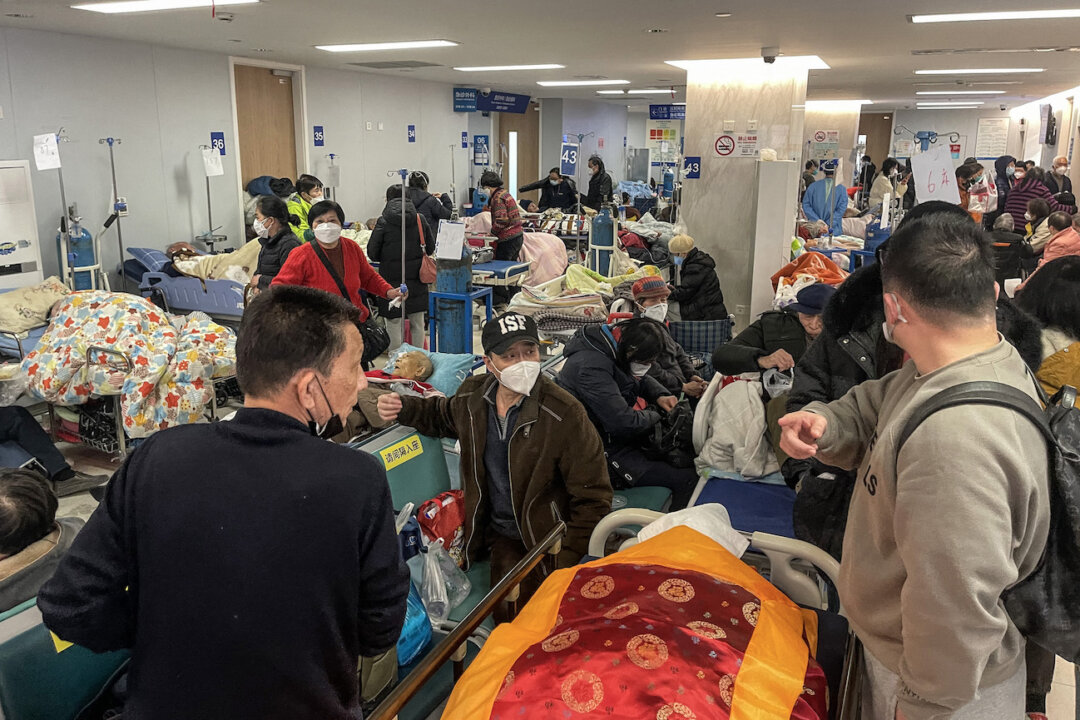
According to recently released data from China’s National Healthcare Security Administration, the country’s basic medical insurance fund collected 3.59 trillion yuan ($532 billion) in revenue and spent 3.01 trillion yuan ($446 billion) in 2025, leaving a surplus of 525.8 billion yuan ($78 billion) for the year. On average, more than 8 billion yuan ($1.2 billion) in medical insurance funds was paid out daily to hospitals, pharmacies, and insured participants.
One U.S. dollar is equivalent to 6.75 yuan based on the current exchange rate.
Chinese sociologist Zhang Liangdong told the Chinese-language edition of The Epoch Times that the record spending reflects not only an aging population and rising demand for healthcare, but also the healthcare system’s long-standing reliance on medical insurance funds to sustain operations.
“Officials emphasize that the fund still has a surplus, but they rarely explain how dependent the system is on steady contributions from younger people with stable jobs,” Zhang said. “Retirees generally no longer contribute at the same level as active workers. As the retired population grows, the working population expands only slowly, and companies are cutting jobs. Now, roughly 2.6 workers are supporting the medical costs of one retiree. I don’t think this can be sustained for long.”
Worker-to-Retiree Ratio Continues to Decline
China’s employee medical insurance system is funded primarily through contributions from active workers, while retirees generally no longer make regular contributions. In 2025, the worker-to-retiree ratio fell to 2.6, meaning every retiree was supported by an average of 2.6 active contributors. Public data show the ratio has steadily declined from 3.0 in 2012 to 2.82 in 2020, 2.71 in 2023, and 2.63 in 2024.
Zhang predicted that the burden on active workers will continue to increase.
“The ratio could fall to around 2.3 by 2027, and it will likely continue to decline after that,” he said. “This is no longer simply a question of birth rates. Many working-age individuals have ‘lain flat,’ which often reduces or stops their contributions to social insurance programs.”
“Lying flat” has become a popular expression in recent years, describing people who cannot find stable employment or choose not to pursue unsatisfactory jobs. These individuals live off their savings or rely on financial support from their parents.
Zhang noted that China’s state broadcaster CCTV’s recent encouragement of young people to move to rural areas is a ridiculous move. “Nowadays, which young people would respond to such a call?” he asked.
Young People Frustrated, Question Who Benefits
After the figures were released, many Chinese social media users questioned disparities in the distribution of medical insurance funds among different social groups and age groups.
One user in Beijing wrote, “I just want to know whether I’ll still be able to receive benefits 15 years from now.”
A user in eastern China’s Jiangsu Province asked, “How will workers born in the 1980s be protected after retirement?”
Another commented: “It’s not that young people are unwilling to contribute. Many simply can’t find a job. How are they supposed to pay into the system? Moreover, some retirees receive much more generous medical benefits, which many younger people see as unfair.”
In China’s employee medical insurance system, workers with formal employment contribute to the program together with their employers, with employers typically paying the larger share. However, once a worker loses a formal job, the employer’s contributions stop. Those who want to remain in the employee medical insurance program and continue accumulating the required contribution years for retiree benefits generally must pay the premiums themselves, increasing the financial burden on unemployed and underemployed workers.
Another user echoed the sentiment about unfair disparities, writing, “Many retirees get more than 10,000 yuan a month, while people still working usually earn only 4,500.”
Chen, a self-employed businessman from Guangdong, spoke with the Chinese-language edition of The Epoch Times on the condition that only his surname be provided out of fear of reprisal.
He said that after leaving his company, he had to pay for his own medical insurance and pension contributions. “My employer used to cover part of the cost, so the financial burden wasn’t as heavy,” he said. “It’s very difficult for businesses to succeed nowadays, and I still have to pay out of pocket for many medicines. The news keeps saying that social welfare is improving. That’s sheer nonsense!”
Xu, a Hubei-based rights advocate who is only identified by his surname for fear of reprisal, said that retirees’ medical benefits are funded by the contributions they made during their working years. However, he noted that retirees from the civil service and public institutions receive significantly more generous benefits than ordinary citizens.
“Medical insurance spending exceeded 3 trillion yuan last year, but much of that money doesn’t go to ordinary people,” he told The Epoch Times. “Official figures create the impression that everyone benefits equally, but ordinary people actually receive relatively limited support.”
Requirements Extended as Burden Shifts to Individuals
In recent years, authorities across China have gradually extended the minimum contribution period required for employee medical insurance.
In Guangdong Province, beginning Jan. 1, 2030, the minimum cumulative contribution period will be standardized at 30 years for men and 25 years for women. Individuals who retire before reaching the required number of years of contributions must either continue making contributions or pay the remaining balance in a lump sum to become eligible for retiree medical insurance benefits.
China’s National Healthcare Security Administration said the medical insurance fund remained in surplus in 2025. However, a positive national balance does not address concerns such as weak employment prospects for young people.
According to a recent official report, 280 million people in China were in “flexible employment” in 2025. This figure is projected to rise to 320 million in 2026, accounting for over 40 percent of the urban workforce.
This category consists of people on the margins of unemployment, informal workers, and those without stable employment relationships.
The latest medical insurance data, together with the employment figures, underscore the challenges facing China’s social security system. The system depends on steady contributions from formally employed workers, yet many young people struggle to secure stable jobs.
Xue Xiaoguang contributed to this report.